
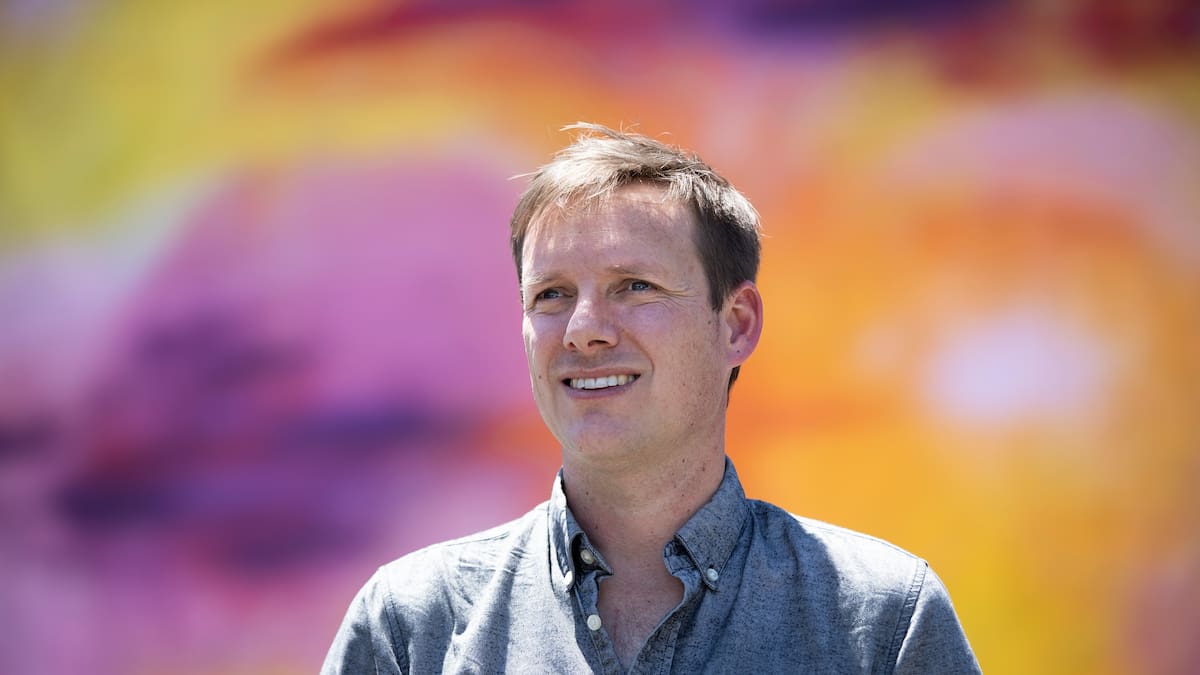
Today is his last day in the country: tonight he and his family are on the plane home to San Francisco.
Substack co-founder Hamish McKenzie and his wife Steph.
The kid from Alexandra, Central Otago – he’s just turned 45, but still possesses boyish looks – has spent much of the past two decades overseas, in a range of roles, including working for, and later butting heads with, Elon Musk.
McKenzie is, at heart, a creative rather than a tech guy – a trained journalist and passionate writer who cares deeply about the sustainability of media.
He is one of our great start-up success stories – a newcomer on this year’s NBR Rich List, with an estimated personal wealth of $110 million. He is also uniquely placed – especially as he’s observed the country in the past few weeks – to see just how we can uncover more of them.
As the renowned scientist Sir Paul Callaghan once said of New Zealand, “if we had 100 Fisher & Paykel Healthcares, our prosperity would be assured”.
McKenzie is of the same mindset. He says New Zealanders possess the talent, creativity and resourcefulness to build companies capable of taking on the world.
Perhaps we don’t exude that, though. “With Kiwis, I think the fire burns, but the exterior is made to seem like a refrigerator,” McKenzie says.
He says that comes with his own approach.
“One thing I’m definitely sensitive to, because I’m a New Zealander, is not over hyping myself or overpromoting myself. I tend to be pretty deferential in all the ways I work, and I think that does lead to people underestimating you sometimes. In its own way, it becomes a secret advantage.”
He thinks the All Whites epitomised that attitude early on in the recent Football World Cup. “They played their first game against Iran [and drew 2-2] … there’s no world in which we should be going toe to toe with Iran, which is a country of almost 100 million people. And yet those guys went out there, and they must have this internal fire burning that gets them to go against some of the world’s best – and match them.”
Coming home has prompted a deeper reflection. McKenzie wants to strengthen his connection to New Zealand even more and, as he puts it, move into “contributor and elder statesman mode”.
He’s played a personal role in helping New Zealand writers launch their own Substacks and wants to help more where he can, possibly in areas such as media and technology.
“I love New Zealand. I feel frustrated that I have been away for so long and not been able to contribute directly to New Zealand despite benefiting from all the great things that New Zealand gives you.”
Behind that desire also lies a tragic family story and a deeply personal understanding of how short a life can be.
Hamish McKenzie during the Substack after-party for the White House Correspondents’ Dinner in Washington DC in 2025. Photo / Getty
An over-reliance on government?
McKenzie says he and Steph make a habit of watching the 6pm TV news when they’re back in New Zealand. The bulletin highlights, to him, just how much we default to thinking about government in our personal and professional lives.
“Just about every segment has a comment from a Government MP, or an opposition MP.”
He doesn’t think that this Kiwi attitude is “necessarily a negative or a positive; it’s just true”.
“I don’t think it’s necessarily bad that the Government has a strong role. New Zealanders are a very community-oriented nation, and it’s of a size where it makes sense for the government to have a strong hand.
“But I don’t think it’s necessarily good for people to default to thinking, for example, [when they need to raise funds], ‘How much government money can we get? How can we unlock the government support for this?’
“It’d be great if they didn’t have to be so reliant on that.”
Pointing to the whiskey boxes, he refers to Reactory as a prime example of a successful New Zealand start-up. It’s developing technology that allows the alcohol-ageing process to be sped up to days, not decades.
McKenzie also references Rocket Lab and Halter.
“There’s a lot of cool, exciting activity going on, but New Zealand as a whole doesn’t seem to be that aware or that invested in that ecosystem, which is led by people who deeply believe and see the opportunity.
Substack’s co-founders, from left: Hamish McKenzie, Chris Best and Jairaj Sethi in San Francisco. Photo / The New York Times
“New Zealand, as a whole, visibly seems to be very Fonterra-oriented,” he says, referring to the traditional reliance and focus on our dairy industry and exports.
Which leads to the question of his impression of Kiwi business attitudes more generally. There’s that cool exterior, as McKenzie earlier referred to, but what about our much vaunted No 8 wire mentality, innovation and ambition?
“The way I interpret the number-8 wire myth is that New Zealanders are extremely resourceful, and that leads to the creation of really cool and interesting things.
“Rocket Lab is an amazing example of that, but it took Rocket Lab to get to success for people to start acknowledging how incredible Peter Beck is and what he was trying to do, when he’d been strapping rocket engines to his bike in Invercargill for a while.
“I do think it’s possible that New Zealanders are a little bit willing to settle for less sometimes.
“If we could get New Zealanders into a place where the resourcefulness is paired with ambition and risk-taking, and where the risk-taking is seen as a positive thing and not as an embarrassment – if the thing that you took a risk on doesn’t work out – then I think a lot more horizons open up for what’s possible to build out of New Zealand and for New Zealanders to achieve.”
In Silicon Valley, ambition is usually declared early and loudly. Failure can be absorbed and turned into a foundation for a crack at something else.
New Zealanders, says McKenzie, seem more inclined to understate their aspirations, deflect praise and keep that internal fire concealed.
“When you get across into Silicon Valley … the people are not any more or less brilliant than the top Kiwis I meet or hang around with, even if they’ve gone to the greatest schools and they’ve come from the right families.
“They’re just more embedded in an infrastructure that’s more able to support their ambition … and reprocess their failures into a different environment.”
The boy from Alexandra
McKenzie has only a few hours left in the country, and so he feels a New Zealand-relevant dish is in order, as he scans the menu at Bivacco restaurant on Auckland’s Viaduct.
He ventures for the chargrilled snapper, while I opt for the goat’s cheese ravioli. He also selects the Brussels sprouts for a side, and – after we attack our mains first – we’re lightly admonished by the waiter for not tucking into the Brussels sprouts earlier. We’re both somewhat bemused.
McKenzie attended Dunstan High School and the University of Otago and is a former editor of the university’s student magazine, Critic.
He studied journalism in Canada, worked in Hong Kong and the US, then landed inside Elon Musk’s orbit.
Elon Musk and Hamish McKenzie have butted heads in the past. Photo / Getty
As a budding tech journalist, he was asked by a publisher to write a biography of Musk. He contacted Musk, who hired McKenzie instead. He worked at Tesla for just over a year, between 2014 and 2015, as a lead writer. His experience gave him a front-row seat for the book he eventually did write on Musk, Insane Mode.
Last year, Musk had a crack at McKenzie on social media – labelling him “Hamish ‘Oathbreaker’ McKenzie” – after the Kiwi highlighted the growth of the Substack app with “69% less culture war” (referencing Musk’s own X platform).
McKenzie returned serve: “OK Optimus Whine.”
He’s pretty good with the one-liners. At one stage during lunch I asked him where the next Hamish McKenzie is coming from.
“Probably Alexandra.”
Death of a brother
When Hamish was 11, his 14-year-old brother David tragically died — electrocuted in a freak accident involving a water irrigator and power cable.
McKenzie says David’s death in February 1993 has played an “organising role in my life – for good and bad”.
“I got up at his funeral and gave a little speech about how I wanted to carry on living for him as well as for me. I think that was a really positive contributor when, in the first half of life, it drives you to try and do more and live a good life – live well and understand that it’s so fragile; that it can disappear at any moment.”
Hamish McKenzie (centre) in an early photo with his two older brothers, Andrew (right) and David.
But as he gets older, McKenzie also realises it’s a burden that would be too much for a kid to carry around.
“My brother wouldn’t want me to carry the burden of living up to the life that he never got to live.
“So I’m trying to hold that a bit more lightly. At that particular age, with someone who I was so close with … to lose him in those circumstances had a massive impact.
“I would be a different person if it didn’t happen. I do think it probably drove me to achieve more things than I otherwise would have because I had a very deep appreciation for how short, fragile, and special life is.”
Family continues to play a critical and central role in McKenzie’s life. He generally sees his mum and dad, Louise and Richard, twice a year.
On this year’s extended trip, McKenzie has spent time in Wellington – working out of the public library on some days – and in Alexandra. He’s also spoken to the Auckland University business school.
When Sir Sam Neill died in July, McKenzie wrote on Substack from Alexandra about the actor’s influence and support in that community. That week, McKenzie had taken his kids to the latest Minions movie at the small 40-seat Central Cinema in Alexandra. Its patron was Neill.
The rise of Substack
For the past nine years, McKenzie’s professional life has been subsumed by Substack, a platform born from a simple desire to discover a new business model for journalism, journalists, creators and writers.
McKenzie describes it as a “cultural mission” – to build a direct, high-trust relationship between writers and audiences.
“We didn’t start Substack to primarily build a huge business. We started Substack as a cultural mission to change the incentives of the media economy so that it could produce better outcomes for our culture and society.”
Substack has become a sprawling town square of voices, from Pulitzer Prize-winning journalists and bestselling authors to economists, comedians, political commentators, scientists, entrepreneurs and niche experts with loyal audiences.
High-profile names include Heather Cox Richardson, Bari Weiss, Margaret Atwood, and Salman Rushdie. Business and technology audiences follow writers such as Lenny Rachitsky, Nate Silver and Ben Thompson.
Bernard Hickey’s The Kaka Substack site has more than 27,000 subscribers.
In New Zealand, journalists such as Bernard Hickey, Dylan Cleaver, Anna Fifield, Paula Penfold and Simon Wilson are on Substack. In April, political commentator Ani O’Brien broke, on her Substack page, the Maiki Sherman-Lloyd Burr verbal set-to in Finance Minister Nicola Willis’ office last year.
Another Kiwi journalist, David Farrier, was on Substack at one time but left in August 2025 because of broader concerns about a lack of moderation. Substack has been criticised for hosting far-right content, revealed most famously in an article in The Atlantic in 2023 headlined ‘Substack has a Nazi problem’.
McKenzie and his co-founders, Chris Best and Jairaj Sethi, told the Herald at the time, “Substack is a platform that is built on freedom of expression, and helping writers publish what they want to write.
“Some of that writing is going to be objectionable or offensive. Substack has a content moderation policy that protects against extremes – like incitements to violence – but we do not subjectively censor writers outside of those policies.”
Time magazine last year named Substack as one of the top 100 most influential companies on the planet.
Substack itself is now valued at US$1.1 billion ($1.89b) – it secured US$100m ($170m) in a capital raise last year.
It now hosts more than three million newsletters, and tens of millions of people have signed up to them.
Some five million of those are paying subscribers.
But we’re also at a critical point in the media industry timeline where there is strong global debate about the potential growth opportunity for subscriptions — and whether we’ve reached an early plateau. Even The New York Times’ subscription growth has started easing.
McKenzie, however, is optimistic about Substack’s own growth.
“I think it could easily be more. I still consider Substack in its earliest days,” says McKenzie, who has previously cited a target of 50 million paying subscribers.
“I’m still very optimistic about that.”
I ask him how much of last year’s US$100m raise has been spent.
“Not enough, in my opinion,” he laughs.
“The truth is, we really haven’t spent much of it yet. We’ve started hiring a bit more aggressively. We’ve started an international push.
“We have started to make a push into sponsorships as an additive but we haven’t spent on the really big fireworks yet.”
I ask him when and what those fireworks might be. “We’re still building up to the point where we can take some pretty huge swings, but it’s still too early to say.”
Hamish McKenzie, co-founder of Substack. Photo / Brett Phibbs
He emphasises his and his co-founders’ focus on Substack being at the core of a new media business model – for individuals, as well as old and new media institutions unattached to a decades-old revenue model. He cites The Free Press, The Bulwark and Zeteo as examples.
“The foundation is in place for a new kind of media ecosystem, and Substack is one. It’s just, how big is it going to get? I think it can get very big, especially if you don’t only think of it in terms of monetising bloggers or monetising journalists or analysts. If you think about it as who can build an audience-first media business and what can they look like? How much can they flex, how big can they get?
“I would be very disappointed if it only hovered in the low tens of millions [paid subscribers]. There’s nothing in the trajectory of this company that suggests that it should stop anytime soon.”
He also thinks that traditional media firms can get on board a lot more fully and treat Substack as an ally – “valuing quality and a potential network that can help them grow their audiences [and] reach new audiences”.
McKenzie’s visit has also allowed him to step outside the intensity of building and developing Substack and appreciate what it has become.
His favourite measure of success is not a valuation or subscription number. It is hearing a writer say: “Substack changed my life.”
How to Save the Media
It’s not just Substack where McKenzie is now investing his energy and wealth.
He was recently revealed as an investor in Kiwi music start-up Lume.
“One key reason is that it shares something very important in common with Substack: an appreciation of depth,” McKenzie wrote on Substack, as he reposted commentary about Spotify’s rising tsunami of AI-generated music.
“When ‘content’ is abundant, and sometimes made by robots, depth matters more.”
McKenzie has also been putting the final touches on his new book, How to Save the Media, due for release in November.
Hamish McKenzie’s book is due out in November.
It’s a bold title, designed to “intentionally provoke”. Does he answer the proposition?
“What I try to do in the book is lay out the principles and not to say the Substack is the answer, but to use Substack as an example of how things can change.”
McKenzie says we “fell” into the existing ecosystem, whereby tech companies have settled on a model that’s broken traditional media, and therefore our culture.
“I don’t think it’s a mistake, for example, that we’re in a state of polarisation and tribalism and sensationalism with politics – that just happens to mirror exactly how culture plays out on Twitter, Facebook, Instagram and TikTok.
“The message in the book is to break out of that status quo. It’s very hard because they’re very rich companies; it’s not going to come down to just the right kind of government regulation or changing the personalities at the top of those companies.
“We need to change the incentives. We need to change the whole infrastructure and business model so that the rewards are different.
“With the direct relationships model – I subscribe to a writer or a publication who I trust, and that can also benefit from network effects of the internet – you can give publishers and creators a different game to play.
“And instead of the game being who can win the maximum amount of attention for a moment in an endless addiction feed, can you sustain the trust of your audience over a period of time?
“It doesn’t mean that the bad guys can’t win with this model, but it does mean that a lot more good guys are going to win.
“The people who have more integrity and more trustworthiness and the ability to go deep rather than wide get rewarded, and the audiences actually have agency rather than being mindless non-playing characters in a feed that we just scroll for our dopamine hits.
“We can take action to support the voices and the institutions that we really believe are worth supporting that we really value and with that you can get different cultural outcomes.”
At 45, McKenzie is no less driven in helping find that new model, while also broadening his contribution to New Zealand.
McKenzie’s own fire still clearly burns, even as he maintains that cool exterior. “I’m looking forward to the next stage where I’m focusing more on internal development than external status.”
Editor-at-Large Shayne Currie is one of New Zealand’s most experienced senior journalists and media leaders. He has held executive and senior editorial roles at NZME, including Managing Editor, NZ Herald Editor and Herald on Sunday Editor. As well as a weekly media column, he has a regular interview series featuring noteworthy and leading New Zealanders including Wayne Brown, Ruby Tui, Paddy Gower, Dame Kiri Te Kanawa, Scotty Stevenson, Chlöe Swarbrick, Simon Power, Josh and Helen Emett, Sir Ian Taylor, David Kirk, Sir Ashley Bloomfield, Paul Henry, Simon Barnett, Sophie Moloney, Brian and Hannah Tamaki, Sir Grahame Sydney, David Lomas, Carrie Hurihanganui, Sir Russell Coutts, Steven O’Meagher, Juliet Peterson, Brendan Lindsay, Tony Astle, Anna Mowbray, David Higgins, Ian Jones, Julian Savea and Shane Cameron.