
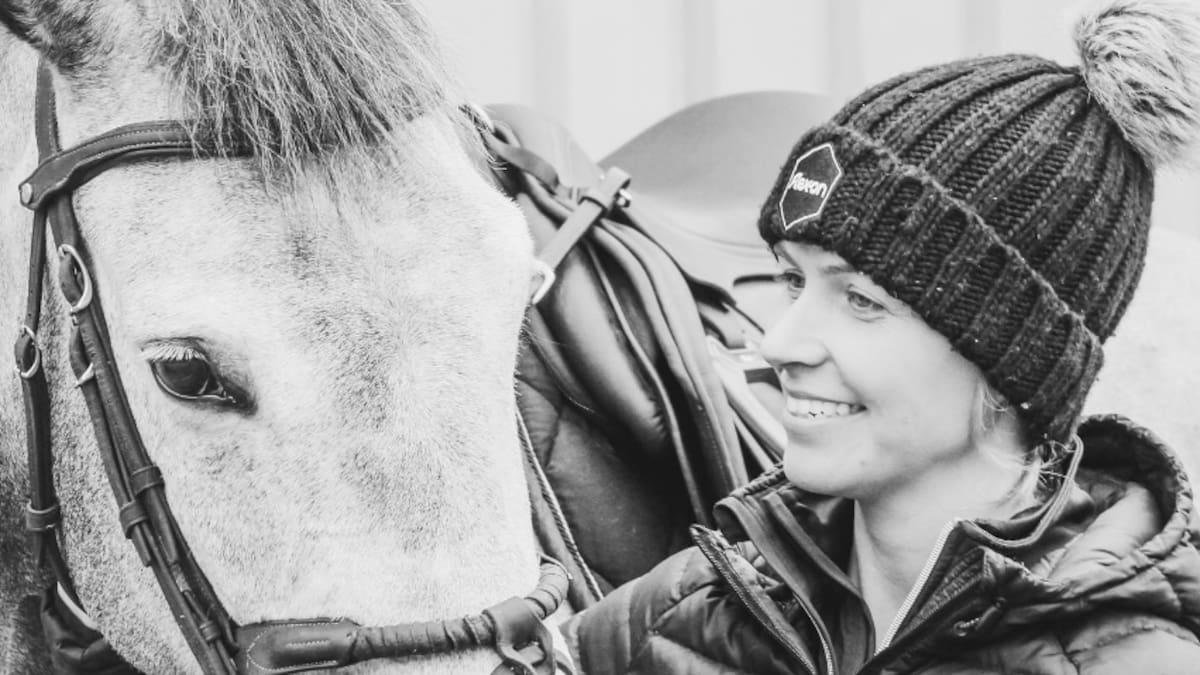
A Devon coroner would later rule that the 36-year-old’s death in May 2024 was the result of a “terrible, tragic accident involving a much-loved woman who died participating in the sport she loved”.
Now Jesse Campbell’s parents, Matamata couple Ezra and Craig, want to make sense of the family’s grief by ensuring no other New Zealand family has to endure the pain of loss from what they say could be a preventable accident.
They want to see safer frangible (collapsible) jumps fitted at equestrian centres throughout New Zealand to reduce the risk of rotational falls – when a horse somersaults or flips over after hitting a solid jump, often landing on the rider.
Jesse Campbell and his then girlfriend Jessie Strang in 2018 at the Luhmuehlen International Horse Trials in Germany. Photo / Libby Law
In July this year, two UK women died on the same day at separate events after suffering rotational falls. And earlier this year a young New Zealand rider suffered a concussion and a fractured pelvis from a rotational fall at the National Equestrian Centre at Taupō.
The Campbells have launched a charity, the All Together Safer NZ Eventing Charitable Trust (ATSE), to help fund Swedish-engineered MiMSafe clips to be fitted to jumps, starting with a $450,000 pilot scheme to install 80 frangible jumps at the National Equestrian Centre.
The MiMSafe clips fold the jump forward if it’s hit by the horse, helping to prevent deadly rotational falls. The horse might stumble but is likely to recover rather than somersaulting and landing on the rider.
ATSE’s pilot scheme at Taupō will also include tubbed plants, which help the horses (with monocular vision) to sight the jumps accurately; watering systems; the structure, or chassis, built beneath the jumps; security fencing; and equipment to install the jumps.
Rotational falls can occur at any level of cross-country eventing. Georgie was an experienced, top-level show rider before switching to eventing, representing the UK multiple times and competing in five-star events, the highest level, in the UK and Europe.
Georgie Campbell competing in the cross-country event at the Blenheim Palace International Horse Trials in the UK in 2022. Photo / Ryan Pierse, Getty Images
Jesse Campbell, 37, had not long returned from the Burghley Horse Trials in Lincolnshire when he spoke to the Herald from his home in Surrey this week. He remembers the moment of Georgie’s accident vividly. About to compete at Bicton himself, he was watching his wife on livestream when he saw Global Quest hit a solid jump, somersault into the air and land heavily on his back.
“I knew it was bad straight away.”
But he also remembers a happier moment, the day he met Georgie in 2017 at the Military Boekelo three-day event in Holland where they were both competing.
“We were at a barbecue … and a very beautiful girl sat down next to me, and I thought, ‘I think I’ll marry this girl’ and that’s the way it came to pass.”
Georgie and Jesse Campbell on their wedding day in Wiltshire in the UK in December 2020.
Campbell’s favourite photo of his wife was one taken on their wedding day in 2020, just four years before she died. Her smile, he says, would make him feel like he was the centre of the universe.
‘She was a very, very special person’
“She just had this incredible energy about her. People just gravitated towards her and she always had time for them. She was a very, very special person.”
Campbell wrote on Instagram after his wife’s death: “She would get as much joy from having a Greggs tea on the way home from the gallops as she would teaching a client in the pouring rain, or jumping and galloping around the biggest courses in the world.”
Jesse and Georgie Campbell after a fishing trip in the Hokianga during a trip to New Zealand in 2021.
Being with horses helped him get through the tough weeks and months that lay ahead.
“They’re incredible animals,” he wrote, “kind, generous and very good at dealing with me being quite teary at times.”
He and Georgie were based at her family’s farm in Kent where they planned to build a top-class riding school, stables and arena. But there were too many memories; Georgie and her smile just around every corner.
“I didn’t really feel like doing that myself, you know, that was our dream.”
Former Olympic rider Jesse Campbell and his wife Georgie on their wedding day in 2020. Photo / Instagram
Seven months after his wife died, Campbell moved to a client’s property in Oxted, Surrey, and established an eventing yard.
Jesse Campbell representing New Zealand in the Tokyo 2020 Olympic Games in August 2021. The games were postponed because of the Covid-19 pandemic. Photo / Kenji Demura, www.photosport.nz
He and Georgie’s sister, Jo Strang, founded the Georgie Campbell Foundation which aims to improve the safety of the sport and provide scholarships for up-and-coming riders. Campbell lists what the trustees will look for: riders with a strong work ethic, humble, a love of horses and talented. He’s effectively describing his late wife.
“What would a young Georgie need?” he says of the mentoring and support the scholarships will provide.
Campbell is proud of the efforts his parents are making to raise funds to improve cross-country safety in New Zealand in their daughter-in-law’s memory. He’d like to see more cross-country jumps designed so that frangible pins can be included on different styles.
“It’s important that when you have that moment of mistake or error from either party that it doesn’t result in a fatality.”
Georgie and Jesse Campbell riding together in the UK. Photo / Libby Law
Ezra Campbell says safety equipment like frangible clips and inflatable air jackets are similar to airbags and seatbelts in a car. They won’t stop accidents occurring, but they will save lives.
At the time of Georgie’s death, the jump that caused her rotational fall could not be fitted with a frangible pin because of its design. Her accident was witnessed by a European course designer who has since worked closely with the Swedish manufacturers of MiMSafe to work out how to incorporate the frangible clips into solid jumps involving big logs and “table tops”.
As a result, a combination of science, design and technology will help mitigate the risk.
The “chassis” construction beneath an equestrian cross-country jump showing the inclusion of frangible pins that help the top of the jump roll forward if it is hit by the horse.
“I know that risk is part of sport but preventable risk never should be,” Ezra Campbell says. She still mourns the loss of her daughter-in-law, describing Georgie as “the most gorgeous person”.
The couple flew to the UK to watch their son compete in the Burghley Horse Trials in September 2024, where he blew a kiss to the sky after finishing the course.
A woman introduced herself to the Campbells, telling them she was at Bicton the day Georgie died. The woman told them she had watched Georgie walk hand-in-hand with Jesse to the show jumping arena shortly before she was to compete.
She told Ezra: “They were watching the show jumping and just standing there hand in hand and I remember thinking ‘if I could have a smidgen of what those two have I’d be a very happy person.’”
Less than an hour later, Georgie was gone.
Last year Jesse was awarded an Against the Odds award by Equestrian Sport New Zealand at its gala dinner in Parliament House to celebrate the organisation’s 75th anniversary. The Campbells flew to Wellington to accept the award on their son’s behalf.
Craig and Ezra Campbell, of Matamata, receiving an Against the Odds award on behalf of their son, former Olympic rider Jesse Campbell, in Wellington in 2025 at the 75th anniversary dinner of Equestrian Sports New Zealand. Photo / ESNZ
“It was a very brave thing for Equestrian Sport New Zealand to do,” Ezra Campbell says, “because it was a night of celebration for them and here was this award which came about because of how Jesse had picked up and kept going, and kept the sport in a positive light.”
That night the couple talked to a course designer about safety on cross-country courses. They soon realised that the equestrian world wanted and needed more frangible pins but lack of funding was an issue.
The Campbells decided to launch a charity to fix that problem. To date they’ve raised $115,000 towards the $450,000 target, launching a Givealittle page to help boost funds.
After Taupō, they want to see more frangible clips incorporated into all cross-country courses throughout New Zealand to protect riders.
Ezra Campbell wants young Kiwi riders at all levels of eventing not to have to worry about whether or not a jump is safe.
“Their whole concentration should be their pony or their horse. It’s about us, the parents, the volunteers, the organisers. We’re the ones who have to be looking at what we can do better with safety.”
Horses, too, can be injured or killed from rotational falls although Global Quest, the Irish horse ridden by Georgie on the day of her fall, was uninjured. The horse competed this month at the Burghley Horse Trials, ridden by top New Zealander eventer Tim Price as a tribute to his late friend.
Equestrian Sports New Zealand CEO Julian Bowden described Georgie’s accident as an “absolute tragedy” that had led to significant changes in the way cross-country fences are designed and built.
“There is an absolute focus on safety.”
The Federation Equestre Internationale, the international governing body for equestrian sports, has led the way with ongoing developments around fence design and building techniques to improve safety for both horses and athletes, he says.
‘I wouldn’t be sitting in a wheelchair’
Dame Catriona Williams understands better than most the dangers of a horse hitting a non-frangible jump at speed. She’s spent the past 24 years in a wheelchair after suffering a rotational fall at the Kihikihi Horse Trails in Hamilton in 2002. Her horse cartwheeled over a fence, causing Williams, now a tetraplegic, to break her neck. She was 31 at the time.
Catriona Williams on her horse Win For Me at a cross-country jump at the Badminton Horse Trials, UK, in 1999.
Williams, 55, says she is “so proud” of the Campbells and the effort they have put into making cross-country events safer. She’s now patron of the Campbell’s charitable trust, and Auckland businesswoman Anna Mowbray is an ambassador.
“If these jumps had had the frangible pins, there’s a very high chance that I wouldn’t be sitting in a wheelchair.”
Williams is the first to support riders who want the challenge of cross-country riding, part of a three-day event that includes dressage in an arena and show jumping.
Speed and bravery is involved, something Kiwi riders are renowned for. She points to Olympic medal earners Mark Todd, Blyth Tait, Andrew Nicholson and Vaughn Jefferis.
Sir Mark Todd in action at the World Equestrian Games. Photo / Libby Law Photography
But she also wants young riders coming up through the ranks to be safer with the installation of frangible jumps.
“It’s not taking away the challenge, but it’s making the sport safer.”
Young Auckland event rider Mackenzie Marlo, 21, agrees, saying that although some MiMSafe clips have already been installed at various cross-country courses she has ridden in New Zealand she’d like to see more.
Marlo has activated MiMSafe clips a few times which means her horse has hit the top of the jump. She hasn’t suffered a bad accident but she’s aware of others who have.
She’s well aware of the ongoing sadness around Georgie’s accident, having spent eight weeks on work experience at Jesse Campbell’s eventing yard in Surrey last year.
Auckland eventer Mackenzie Marlo taking a cross-country jump at the National Equestrian Centre in Taupō in October 2025.
“I think there are always risks with the sport that we do, but it’s really exciting now that there is technology to potentially minimise these risks to some degree.”
In the past five years, equestrian-related claims have cost ACC nearly $109 million. Around 3300 claims are made each year and nearly 90% of those are women. One in three claims involves a rider between the age of 10 and 19 years.
In the first six months of 2026, ACC received 1809 new claims and handled 3171 active claims. Costs to July were more than $12m which did not include bulk-funded services, including ambulances and acute treatment in public hospitals. (ACC’s bulk-funding costs last year for all injury claims, not just horse riding, was more than $1 billion.)
Williams is an advocate of anything that will make the sport safer, including air vests, with a lanyard attached to the saddle so that if a rider falls, the vest will automatically inflate.
Both the frangible pins and the air vests are examples of how technology can help make the sport safer, she says.
“Why would you not have frangible pins? They’ve been developed, it’s been proven … get behind it and back it. They weren’t around when I had my accident.”
Dame Catriona Williams with Sir Mark Todd and his wife Carolyn at an Auckland event to promote the CatWalk Trust in 2019. Photo /Libby Law Photography
Williams still has horses in her life because her husband Sam runs horse-breeding stud Little Avondale in Masterton. But she still needs a carer to get her out of bed, toileted, showered and dressed every day.
“What is the cost to the Government because I’m in a wheelchair or someone else is in a wheelchair?”
She and a group of friends launched the CatWalk Spinal Cord Injury Trust after her accident, partnering with the University of Auckland. To date the trust has raised more than $28m towards spinal cord injury research. And it’s raised a further $8.5m towards a target of $10.5m for the CatWalk Cure Program, a collaboration of international research involving five different areas of cure for spinal injury.
Dame Catriona Williams in her handcycle, with family friend Tommy How, cycling 1100km from Scotland to London in the Cycle4Caroline team to raise funds for spinal research in 2024. Event rider Caroline March died earlier that year, two years after she suffered spinal injuries during cross-country riding.
On December 30 this year, Williams will set off on a mammoth 4800km handcycle journey across the US from Carlsbad, California, to Jacksonville, Florida, to raise funds for spinal cord injury research.
Williams says she would give anything to be able to stand up and dance again with Sam. The research into cures might not benefit her in time, she says, but it will benefit others in wheelchairs and with neurological conditions.
Jane Phare is a senior journalist based in Auckland. Her roles at the Herald have included assistant editor of NZ Herald, editor of the Weekend Herald, founding editor of Viva, features editor and deputy print editor.
Sign up to The Daily H, a free newsletter curated by our editors and delivered straight to your inbox every weekday.