
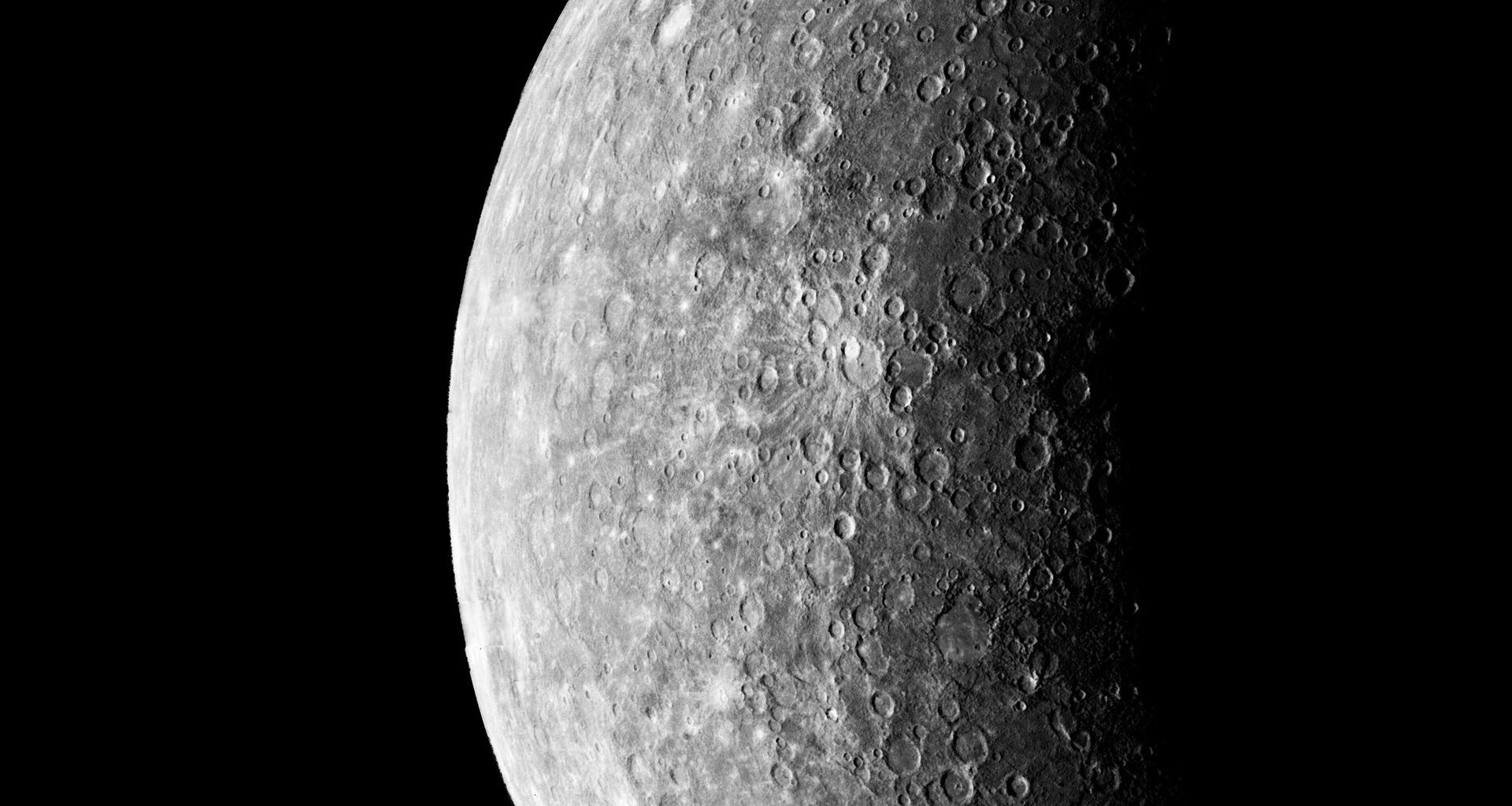
Scientists found that Mercury’s roughest terrain may conceal ancient cliffs, suggesting the planet shrank substantially more than estimates showed.
Mercury’s surface is crossed by long cliffs and ridges. They formed as the crust buckled to fit a planet that got smaller as its interior cooled. For decades, planetary scientists have added up those wrinkles to estimate how much Mercury has shrunk.
But the roughest parts of the planet, the ground around big impact craters, have almost none of them. A new study finds that the record is incomplete there. Once that’s corrected, Mercury may have shrunk 10% to 30% more than anyone had estimated, and that could mean a hotter start or a bigger metal core inside.
Gaku Nishiyama, a planetary scientist at the German Aerospace Center’s Institute of Space Research, led the work with six DLR colleagues. He also holds posts at Hokkaido University and the University of Tokyo.
Cooling made the crust buckle
Mercury formed about 4.5 billion years ago and has been losing heat ever since. As the interior cooled and the solid center of its metal core grew, the planet lost volume. The rigid shell had to fit a smaller planet, so it broke along faults and pushed the ground on one side of each break over the other.
Earlier teams estimated the loss of radius at 0.6 to 1.2 miles (1 to 2 kilometers), or as much as 4.3 miles (7 kilometers). The estimate depends on how researchers count the smaller cliffs.
A cooling planet should shrink equally in every direction, so its wrinkles should appear evenly across the surface. Instead, some regions have many long, tall scarps, as the cliffs are called, while others have almost none.
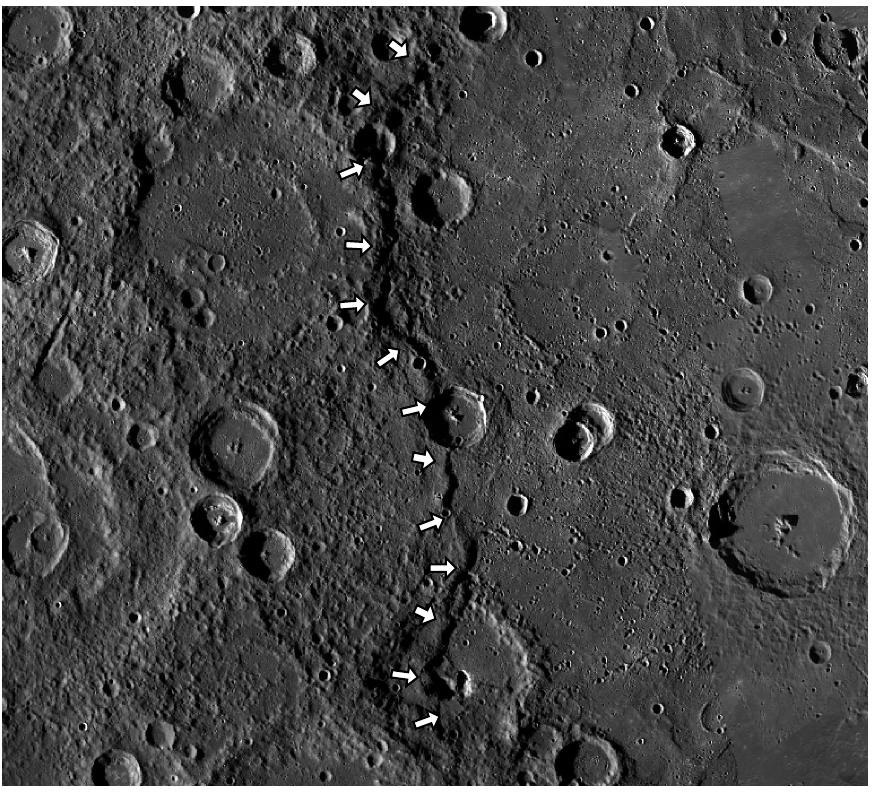 A contractional landform on Mercury with arrows marking the scarp. Credit: Hokkaido UniversityThe roughest ground has the fewest wrinkles
Nishiyama’s team suspected that younger events had covered part of the record. They tested that with a global roughness map they had published earlier this year. It measures how lumpy the surface is at a scale of 6 miles (10 kilometers).
A fresh impact sprays debris and smaller craters across the surrounding land, making roughness a useful measure of how recently an impact disturbed the surface.
Against a 2025 global catalog of scarps and ridges, the roughest regions had the fewest wrinkles. Around young craters wider than 90 miles (150 kilometers), such as Rachmaninoff, the zone of rough debris has far fewer of them.
“This correlation was the most surprising because it was well beyond my expectation at that time,” Nishiyama told Earth.com.
Crater debris likely buried the wrinkles
The team weighed three explanations. The first is that debris from big impacts buried older cliffs. Near Rachmaninoff, the few long scarps that cross the rough zone get lower toward the crater center, as buried cliffs would.
The second is that a rough background makes a ridge harder to pick out by eye. That can’t be the whole story, because researchers have mapped scarps in rough terrain south of the Caloris basin.
The third is that the wrinkles never formed. Heavily cratered ground may have a thick layer of loose, porous rubble. A planet can absorb some of its shrinking by crushing those pores shut instead of breaking along big faults.
Whichever is right, some shrinking is missing from the count, and the correction applies either way.
Mercury may have lost 7 miles of radius
Below a certain level of roughness, wrinkles and roughness increase together, because the cliffs themselves add bumps. Above it the trend reverses, and rougher ground means a lower estimate. The team took the smoother zone’s value as the true one for the planet.
When every cataloged scarp is counted, the uncorrected estimate of lost radius is 5.2 miles (8.3 kilometers), and the correction raises it to 7.2 miles (11.6 kilometers). That would take about 14.5 miles (23 kilometers) off the planet’s diameter. When only the main ridges are counted, the shortfall is smaller, and that spread is the 10% to 30% range.
Nishiyama said, “30% is a little bit surprising, but the corrected amount of contraction actually makes sense to me.”
The authors treat it as a lower bound, though. Some strain may be stored in the crust without ever breaking it, and later lava flows may have covered older scarps. And many ridge heights came from a terrain model too coarse to measure them well.
More shrinking means a hotter start
How much a planet contracts depends on what’s inside it, so a bigger number changes the picture of Mercury’s interior. “More shrinking means Mercury could have a larger metal core, less light elements like silicon mixed into the metal core, or a higher starting temperature,” Nishiyama explained.
Asked by Earth.com about the interior, he said thorough work with cooling models is still needed, but that the findings call for a re-evaluation of Mercury’s thermal history. No wrinkles cut across Rachmaninoff or its debris, and that crater is about 3.6 billion years old, so the cliffs around it are probably older.
BepiColombo will map the southern half
The analysis rests on data from NASA’s MESSENGER mission, which ended in 2015. Its laser altimeter, which measures heights, covered mainly the north pole. Everywhere else, the roughness comes from a terrain model built from stereo images, which can’t reliably resolve features smaller than about 3 miles (5 kilometers).
That’s why Nishiyama is waiting on BepiColombo, which photographed Mercury last year and reaches the planet in November. Its laser altimeter, BELA, starts science measurements next April, he said, and will map roughness at scales as fine as 330 feet (100 meters).
Nishiyama said the same method applies to other rocky worlds, above all to the Moon, whose highlands are about 40% rougher than Mercury’s cratered plains. Earlier mapping of the Moon’s ridges suggests it has lost less than 0.6 miles (1 kilometer) of radius, while models of its cooling interior predict more.
“As the roughness on the Moon is much higher than Mercury, by using the method developed in this study, we can get closer to understanding the thermal history of the Moon as well,” he added.
Until BELA delivers, whether the missing wrinkles are buried or never formed remains an open question, and the true size of Mercury’s shrinking is known only as a minimum.
The full study was published in the journal Geophysical Research Letters.
—–
Like what you read? Subscribe to our newsletter for engaging articles, exclusive content, and the latest updates.
Check us out on EarthSnap, a free app brought to you by Eric Ralls and Earth.com.
—–