
In July 2026, Environment Court Judge Jeff Smith ruled the plant didn’t need consent, labelling it a “permitted activity” under the regional plan, a decision that sits uneasily alongside a string of emergency callouts.
Fire and Emergency New Zealand incident reports obtained by Zero Waste and sent to NZME detailed the callouts.
On August 23, 2025, a report said a member of the public called 111 after seeing smoke coming from the property.
A fire was discovered at the plant but the occupant said it was under control.
Hours later, Fire and Emergency was called back after the occupant became concerned the flames were becoming unmanageable.
“Person on site was happy with it this morning but no longer okay with [it],” notes from the report said.
The notes also said the site had to be fully evacuated and the “machine filled with copious amounts of water”, with the cause indicated as “equipment not being operated properly”.
On the night of July 23, 2026, Fire and Emergency was contacted again about smoke coming from the plant’s vicinity, with a caller telling responders it “seems similar to a burn-off but smells absolutely awful”.
Sinclair told the Environment Court in July the smoke from the site was “vapour” or “steam” and in a statement to NZME, he said the comments on the incident report were not an official statement of finding.
The occupant told Fire and Emergency it was a controlled burn.
Fire and Emergency classified the incident as a “false alarm – good intent”, with the cause recorded as “steam, dust etc mistaken for smoke”.
Hours later, Fire and Emergency was called again to a structure fire at the site, noting “burn-off out of control”.
Two fire engines were dispatched and firefighters wore breathing apparatus to get the situation under control.
The crews said “can you notify Northland Regional Council that the runoff from this fire is entering the stormwater system”. The firefighters did not clarify which system was affected.
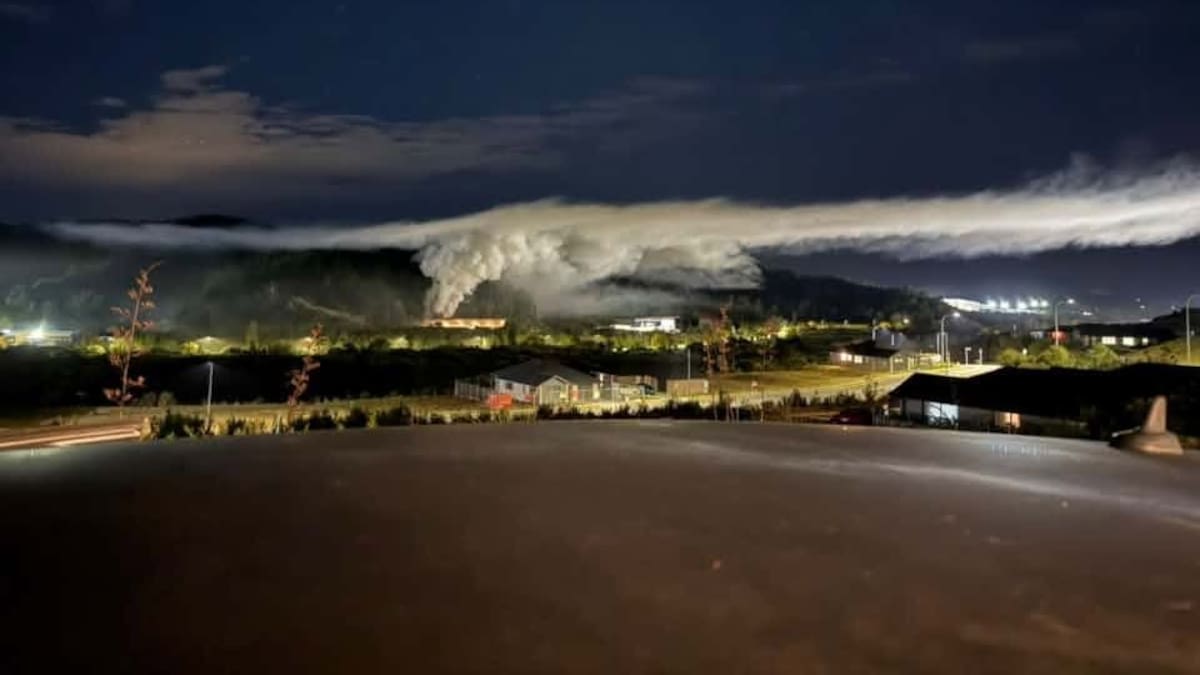
On September 9, 2026, a plume from the site triggered concern on a public Whangārei Facebook site, with many complaining about the smell and warning others to stay indoors.
Fire and Emergency told NZME it was alerted to the smell of burning plastic and a large amount of smoke covering Port Whangārei at 8.36pm that day.
“One fire truck from Whangārei responded, where it was discovered the smoke was coming from a business on Kioreroa Rd, Port Whangārei. No firefighting action was required and the crew was stood down,” it said.
A plume from an industrial site on September 9 triggered concern on a public Whangārei Facebook site. Photo / NZME
Sinclair gave his comments to NZME in response to the incident report.
He said the site is not connected to the Whangārei public stormwater network and there was no independent verification of where any firefighting water travelled.
Sinclair said the 2025 call-outs were “equipment-related events during the early operational phase of the facility”.
“Following those events, operational procedures, monitoring systems and plant controls were reviewed and improved as part of the normal commissioning and continuous-improvement process undertaken for industrial equipment,” Sinclair said.
“We do not seek to minimise any incident involving industrial machinery. However, we believe it is important that the complete Fire and Emergency record is accurately represented and that comments made by callers, preliminary communications entries and operational observations are clearly distinguished from formal findings and conclusions.
“We remain committed to operating the Whangārei facility safely, transparently and in co-operation with Fire and Emergency New Zealand and the relevant regulatory authorities.”
Warren Sinclair’s plastic-burning plant has caught fire twice. Photo / Northland Regional Council
In a statement to NZME, Zero Waste’s Sue Coutts said the reports show environmental impacts beyond property boundaries.
“Overall, these events are not what you would expect from the kind of low-risk operations that fall within the category of permitted activities in the Northland Regional Plan,” Coutts said.
“In our view, technology such as plastic waste-to-fuel is a toxic disposal solution that does not solve our plastic waste problem, but instead creates new problems and unacceptable levels of risk for the communities in which they are situated.”
The regional council’s group manager for regulatory services Colin Dall said it had appealed the High Court decision and was therefore unable to comment about the plant.
Shannon Pitman is a Whangārei-based reporter for Open Justice covering courts in the Te Tai Tokerau region. She is of Ngāpuhi/Ngāti Pūkenga descent and has worked in digital media for the past five years. She joined NZME in 2023.
Join the NZ Herald’s Open Justice team for Case by Case, a video and podcast series examining the disputes and decisions making headlines across New Zealand.