
Chief executive Justin Watson sees the growth in the context of a wider South Island resurgence.
“If you just look at Christchurch and Queenstown, they grew about the same last financial year,” he says, “and that was about three times what Auckland grew. So Auckland’s published numbers are 2% passenger growth, and we grew at 7.1%.”
The international story is even stronger, up 12.6%, Watson notes.
Air New Zealand Boeing 787-9, photographed on 20 September 2014 from Wolfe Air Aviation’s Learjet 25B. Air New Zealand’s wide body aircraft.
The airlines are responding.
Air New Zealand is restoring wide-body services from Christchurch to Singapore, Tokyo Narita and Perth — a significant vote of confidence after a stop-start period affected by Covid and engine availability.
“We’ve got Air New Zealand recommencing wide-body operations out of here,” Watson says. “So starting from October, they’ll be flying to Singapore, then Narita, and to Perth. That’s a big advancement for us to have the national carrier flying again out of here.”
The significance goes beyond passenger numbers. Because what is happening on the freight side may ultimately prove more important to Canterbury’s economic development than another percentage-point increase in visitor traffic.
The freight city
The transformation is taking place on the freight apron.
Christchurch Airport has dramatically expanded its capacity for dedicated freighter operations. The apron can now accommodate up to eight smaller freighters or four larger widebody aircraft.
But the freight story needs unpacking. “There are two types of air freight,” Watson says.
There is traditional belly-hold freight carried in passenger aircraft — everything from chilled and frozen products to high-value exports. Then there is parcel freight: the express shipments and e-commerce traffic that have exploded since Covid.
The latter is harder to measure.
“There’s not very good data on that,” Watson says. “And that’s the stuff that is going into our new freight apron.”
The underlying trend is unmistakable.
Covid changed consumer behaviour almost overnight. People who had rarely bought online were suddenly forced to do so. Businesses that had depended on physical stores were pushed on to digital platforms.
“People were at home and so they bought a lot online,” Watson says, pointing to Temu.
“Businesses, because they couldn’t trade, were forced to go online.”
The result was a structural increase in parcel traffic.
“It just went like that,” he says. “And it’s continued to grow since then.”
New Zealand still has considerable room to catch up with larger online markets in Asia and the United States.
That makes the DHL investment particularly significant.
Prime Minister Christopher Luxon, Christchurch Airport chair Sarah Ottrey, Christchurch Mayor Phil Mauger and Christchurch Airport CEO Justin Watson officially open the new $40 million freight apron.
DHL’s South Island bet
DHL Express has opened a $42 million, 8500sq m international gateway at Christchurch Airport — its largest infrastructure investment in New Zealand to date. It consolidates the company’s previous service centre and gateway operations and has direct airside access.
This is not simply a bigger courier depot.
It is a piece of international trade infrastructure. The new facility has an automated parcel-sorting conveyor capable of processing up to 6500 inbound parcels an hour and 5600 outbound parcels an hour. A high-speed X-ray screening system is designed to increase throughput fivefold compared with the previous facility.
And DHL says the numbers behind the investment are already compelling.
Shipment volumes in the South Island have grown 104% since 2019.
DHL says Christchurch and the wider South Island have been among its fastest-growing regions over the past five years. This underlines why DHL is treating the city as a growth hub rather than simply another point on its network.
“Christchurch is the growth story,” is how Watson describes it.
DHL’s South Island operation is also connected to dedicated Boeing 767 freighter services.
In 2023, DHL upgraded its Auckland-Melbourne operation to a larger 767, while its existing Auckland-Sydney 767 service gained an additional Christchurch leg.
For South Island exporters, the advantage is straightforward: The Christchurch gateway gives goods a direct entry point into DHl’s international express network without first having to be trucked north.
The airport’s new freight apron reinforces that advantage.
Opened in June at a cost of $40m, the apron adds substantial aircraft-handling capacity and flexibility and is designed to work alongside the DHL gateway. Christchurch Airport says the development covers an area larger than six rugby pitches and includes more than 11km of underground services.
The airport is building not just for today’s freight volumes but for a different kind of South Island economy — one in which a Christchurch manufacturer, technology company, medical business or specialist exporter can increasingly plug directly into global supply chains. That is a different proposition from being simply a regional passenger airport.
The wider Dakota Park freight and logistics precinct is now an 80ha development with direct connections to State Highway 1 and the airport’s freight operations. DHL sits alongside companies including DB Schenker, DSV, Mainfreight and other logistics and distribution businesses.
The effect is cumulative.
Once freight operators, manufacturers, warehouses, couriers and technology companies begin clustering around an airport, the value of the infrastructure becomes greater than the sum of its individual buildings.
The quiet automation revolution
The airport’s other quiet revolution is happening inside the terminal.
Christchurch Airport has long experimented with new technology. Five or six years ago, Watson says, the organisation embarked on a deliberate innovation journey that included a driverless vehicle and robotics.
A driverless vehicle at Christchurch Airport.
The airport’s flirtation with robotics began as a public experiment. In 2019, it introduced Pepper, a humanoid robot developed by SoftBank Robotics, in collaboration with the University of Canterbury. Pepper was designed to interact with passengers, answer questions and explore how people responded to robots in a public environment.
The airport now has four humanoid robots — two Pepper and two NAO — and a Digital Innovation Zone where emerging technologies are demonstrated and tested. One Pepper has even been used to help passengers through security and provide information in the terminal.
The airport is now using robots to perform repetitive physical work that can be automated, freeing people for jobs where human interaction and judgment matter more.
Christchurch Airport now has four humanoid robots — two Pepper and two NAO — and a Digital Innovation Zone where emerging technologies are demonstrated and tested.
In 2019, Christchurch airport introduced Pepper, a humanoid robot developed by SoftBank Robotics, in collaboration with the University of Canterbury.
One example is OSCA, an autonomous electric floor-scrubbing robot developed through the airport’s partnership with cleaning contractor OCS New Zealand.
OSCA can clean up to 2000sq m of floor an hour, according to the airport.
The airport’s technology strategy is increasingly about finding the small operational tasks where automation can produce measurable gains — and then reinvesting the human capacity released by those gains elsewhere.
One of the best examples is almost comically mundane: airport toilets.
Traditionally, bathrooms were cleaned according to a standard schedule regardless of how heavily they were used.
“So we put sensors on the outside of the bathrooms, anonymous, of course, and it effectively just counts people in and out,” Watson says.
Watson says the airport’s data-driven approach reduced cleaning time by about 25% to 30%. That could have simply translated into a cost reduction. Instead, the airport redirected the capacity into robotic floor cleaning and allowed staff to concentrate on more visible cleaning and sanitisation work.
“So that wasn’t a downsizing strategy,” Watson says. “It was actually more about efficiency, but then reallocating that.”
The airport earlier established itself as a test bed for autonomous vehicles. Its relatively controlled environment and private roads have allowed it to work with Christchurch-based technology company Ohmio on autonomous electric shuttles, including a 3D-printed vehicle capable of carrying up to 15 people.
“We want to be kind of a leader in this space,” Watson says, “but we’re not an innovator, so we partner with those people who can innovate.”
Its Digital Innovation Zone, meanwhile, keeps one foot in the future. The airport describes innovation as a core driver of growth, performance and value, with automation, artificial intelligence, mixed reality and robotics being applied across the business.
And there is a distinctly Christchurch flavour to the model. The airport has repeatedly worked with the University of Canterbury and local technology businesses, using the airport’s scale and controlled environment to turn ideas into practical applications.
The same approach is being applied to recruitment.
For some roles, the organisation can receive hundreds of applications.
“We might get 500 to 700 applications,” Watson says. “So it automatically uses AI to go through them and says, okay, these are the five to look at.”
Then there is LiDAR technology, which provides anonymous people-flow data through the terminal, allowing the airport to analyse queues, alert staff when congestion reaches particular thresholds and assess how changes in terminal layout affect retail traffic.
Even firefighting training has gone virtual.
Watson says, instead of having physical aircraft shells representing every aircraft type that operates into Christchurch, firefighters can use virtual reality to familiarise themselves with different cabin configurations and practise emergency responses.
It is a practical, rather than futuristic, version of AI.
Powering the next phase
The same partnership philosophy is visible beyond the runway.
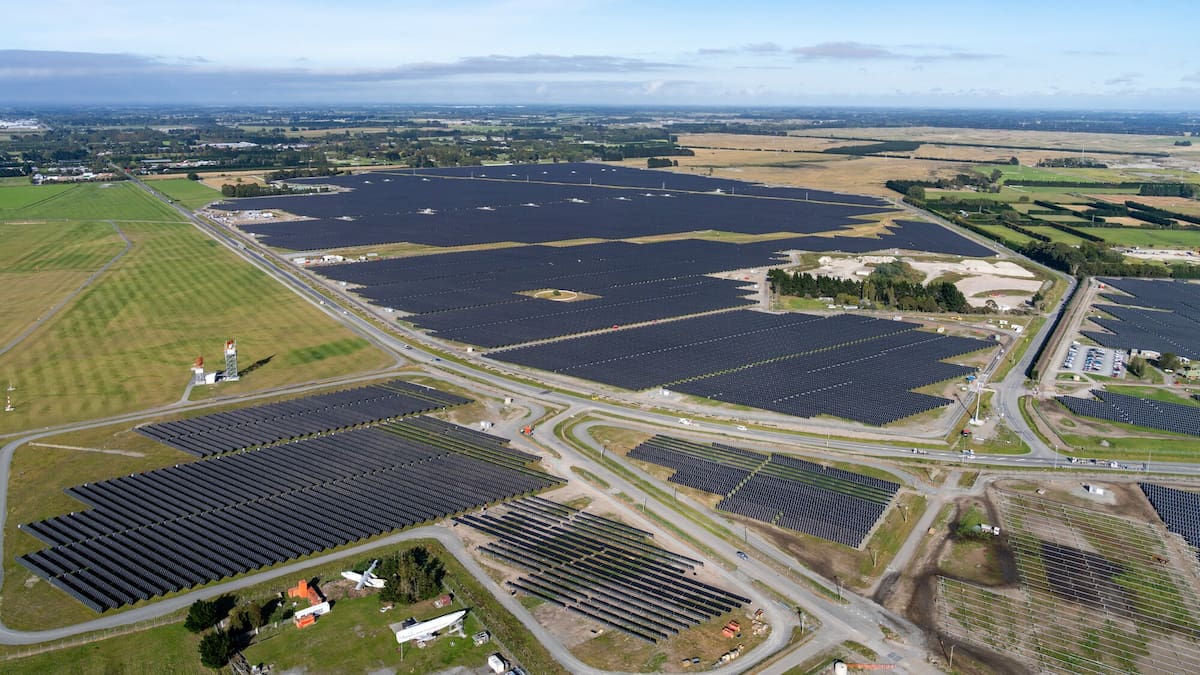
Kōwhai Park, the vast solar development beside the airport, is moving from construction into operation.
Watson say the panels are now installed and the project is undergoing “livening” ahead of becoming operational.
The development is being delivered by Contact Energy and Lightsource bp with Chint/Astronergy involved as the engineering, procurement and construction contractor, with around 300,000 panels being installed across the site.
“The bulk of that electricity from day one will go back into the grid,” Watson says.
Over time, more of the power can be consumed on the airport campus as demand grows.
From the air, the scale of the project is difficult to miss.
“It’s amazing,” Watson says. “Especially when you see it from the air. It’s huge.”
That clean-energy infrastructure adds another layer to the airport’s economic proposition.
A different Canterbury story
That is the bigger Project Canterbury story. The region has moved beyond earthquake recovery and is now testing how far its economic potential can run.
The airport’s financial performance gives the argument substance.
Its freight investments show where the next growth could come from. DHL’s rapid shipment growth suggests the logistics market is changing rapidly.
The airport’s own balance sheet tells the story. Its diversified model now stretches well beyond aviation with property and commercial activity helping cushion the business against the volatility of the global aviation sector.
It’s betting on being the right size, in the right place, with the right infrastructure — close enough to global markets to compete, but with the space and lifestyle advantages that increasingly matter to businesses and skilled workers.
The airport sits at the centre of that proposition.
Its passenger growth connects Canterbury to Asia and Australia. Its freight network connects South Island businesses to global supply chains. Its technology programme is turning a conventional transport facility into a test bed for practical automation. And Kōwhai Park is beginning to turn the airport campus into an energy asset as well as a transport hub.
For Watson, the direction is clear: grow ahead of demand, strengthen international connectivity, build freight capacity and use technology to make the existing infrastructure work harder.
The intriguing question is whether the rest of New Zealand has caught up with the significance of what is happening.
Christchurch Airport’s international expansion
Christchurch Airport’s biggest-ever international summer is taking shape, with more than 1.27 million international seats scheduled between November and March — 21% more than last summer. Long-haul capacity is up an extraordinary 54%, adding around 130,000 seats.
International carriers are not merely restoring Christchurch services; they are adding frequency, deploying larger aircraft and extending seasons. That is a significant vote of confidence in the South Island market.
Air New Zealand is returning wide-body aircraft to Christchurch, with plans for three-times-weekly services to Singapore, Tokyo Narita and Perth. Together, those routes will add about 92,250 seats over the season.
Christchurch Airport CEO Justin Watson and Air New Zealand CEO Nikhil Ravishankar announce a new partnership.
Cathay Pacific is increasing its Hong Kong capacity by 15%, while China Southern’s Guangzhou service is up 57% with the carrier operating daily and increasing to as many as 10 flights a week at peak. United Airlines is using larger Boeing 787-9 aircraft on San Francisco, adding 14 seats on every flight.
Jetstar is launching new Christchurch services to Perth and Sydney.
Qantas is a case in point.
The Australian carrier has been steadily building its Christchurch operation, and its latest expansion takes that relationship another step. For the coming summer, Qantas will operate seven passenger services a day into Christchurch. Its third daily Sydney service will run for 14 weeks, compared with six weeks last summer, adding around 11,700 seats. Brisbane will operate twice daily throughout the season.
That builds on a substantial increase in Qantas capacity during the 2025/26 summer, when Sydney flights rose by as much as 47%, Melbourne by 26% and Brisbane by 16%.
The significance is not simply more Australians coming south for holidays.
Qantas’ Sydney hub provides Christchurch with onward connections into Asia, Europe and other international markets. More transtasman frequency therefore increases the South Island’s access to the global network without requiring every traveller to route through Auckland.
Christchurch Airport CEO Justin Watson sees the additional capacity as evidence of a market that airlines increasingly want to serve.
Christchurch Airport CEO Justin Watson.
“Every new flight brings people, trade and opportunity.”
That opportunity extends well beyond tourism. The belly-holds of passenger aircraft carry high-value South Island exports — fresh fruit, seafood, meat and other time-sensitive products — allowing producers to reach overseas customers quickly.
The airport’s 2025/26 summer results illustrate the economic multiplier. International visitor numbers rose 22% with 287,000 international visitors contributing an estimated $861 million to the South Island economy. Qantas capacity across the Tasman rose 18%, while Jetstar capacity jumped 49%.
The cumulative effect is more important than any single route.
Christchurch is moving from being a destination reached through another New Zealand gateway to becoming a destination in its own right.