
“We buried him with his latest Warren Buffett book,” she said of Gillatt’s 2024 funeral.
Ron and Joan Gillatt. Photo / The Ron and Joan Gillatt Charitable Trust
The Companies Office records Gillatt remained an active investor until the first decade of the 2000s, and had bought stakes in dozens of startups. At one stage he was a 7% shareholder in Syft Technologies.
“They were both very special people, but very modest and unassuming,” Kathy said.
The Gillatts’ Avonhead home was sold by estate executors last year for $970,000.
“He caught the bus, using his [Super Gold] card so that was free, so he and they lived a very quiet and unassuming life. He was a banker with the BNZ, a bank manager,” she said.
He had kept a very low profile during his life. Newspaper archives record him receiving prizes for banking and securities studies while at Canterbury University in the 1960s, but he was quoted just once in news media during his lifetime.
In 1994, at the 25th anniversary of Tait Electronics, Gillatt spoke in honour of founder Sir Angus Tait. “In my opinion he is a great man … though he is self-effacing and always gives credit to others,” the Press reported Gillatt saying.
Gillatt had managed the BNZ’s relationship with Tait since the technology company’s formation, and retired in 1993 as the bank’s business manager.
Ron and Joan had given considerable thought to what should happen to their discreet fortune after their passing, with the Ron and Joan Gillatt Charitable Trust founded in 2001.
Wynn Williams partner Annabel Sheppard assisted the Gillatts with the trust’s formation 25 years ago, and became a trustee after Ron’s death in order to manage his extraordinary bequest.
Annabel Sheppard, partner at Wynn Williams and trustee of the Ron and Joan Gillatt Charitable Trust.
Sheppard told the Herald it was a privilege to have known the couple.
“They were both only children, Ron and Joan, and they didn’t have children, and they were philanthropic, and they have set up a legacy forever,” she said.
The trust’s first set of financial accounts, to March 2025, show it held $9m in cash, $37.9m in shares and another $13.5m in bonds for a total capital base of $60.4m.
The trust is structured to be perpetual, and its deed calls for two-thirds of surpluses to be reinvested, and the remaining third divided up in a precise formula to be annually distributed to 15 Christchurch-based charities, churches and clubs to help fund capital expenditure.
With this setup, presuming relatively conservative 6% returns, trust capital is likely to grow beyond $100m by the end of the next decade and provide an ever-rising stream of funding for its beneficiaries.
Beneficiaries spoken to by the Herald this week said the first distribution was made late last year, but they had been informed that one-off costs incurred on establishment – and capital growth – would likely see larger distributions in future.
One quarter of trust distributions – effectively the proceeds of $15m in capital – are flagged for the tram and model railway enthusiasts based at Ferrymead Heritage Park.
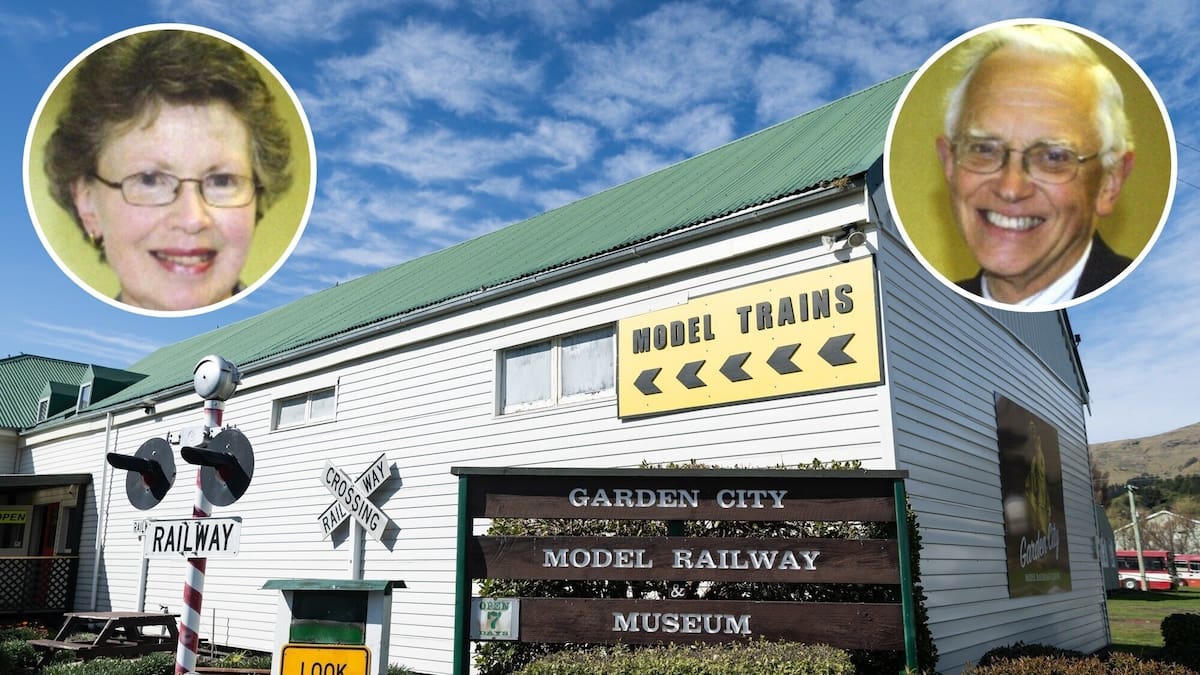
One fifth of distributions (20%) – the largest individual beneficiary share – is directed to flow to the Tramway Historical Society (THS). Another twentieth (5%) is going to the modest Garden City Model Railway Club.
The bequest provides outsized financial backing for the two organisations. THS recorded $71,762 of income last year, and the Model Railway Club recorded just $46,812. Both groups were unaware of Gillatt’s intentions – or in the latter case, even his existence – before being contacted by the Trust.
The Tramways Historic Society in Ferrymead, Christchurch. Photo / Anna Heath.
Ron Gillatt had been a member of THS since 2010, treasurer and former president Stephen Taylor said.
Gillatt was said not to have been particularly interested in driving or working on trams, but he and his wife were regular attendees at society social functions.
Taylor said a decade ago, THS was struggling to fundraise $100,000 for a storage building to keep historic and work-in-progress machinery out of the weather.
“He brought out a chequebook – back in the days when there were chequebooks – and was sort of willing to write us a cheque on the spot, so long as we agreed to pay him back in the fullness of time,” Taylor said.
THS ultimately declined the loan offer, worried about the effect of a liability on its cash-strapped balance sheet, and eventually raised the funds piecemeal in the following years.
Gillatt’s last involvement at THS was attending its AGM in September 2023, a few months before his death.
“At that stage Joan had passed. Ron didn’t drive, so he relied on Joan to get to meetings, and after she passed he would take the bus,” Taylor said. “That was the last time we’d seen him.”
It was only after his death, as lawyers sought to settle paperwork, that Taylor became aware THS was listed as the primary beneficiary of Gillatt’s extraordinarily large bequest.
“We think on a large scale, but unfortunately our finances weren’t able to support that,” Taylor said.
The Garden City Model Railway Club in Ferrymead, Photo / Anna Heath
Things have now changed: “A lot of projects that were potentially going to happen [over] a long period of time can be done sooner and quicker.”
Douglas Mack, the president of the Model Railway Club, said he was unaware Gillatt even existed until contacted by the trust last year – more than a year after Ron’s passing – and they could only speculate how they had been named beneficiaries.
“I think he had some involvement with the THS at Ferrymead. But it appears that he just maybe went for a walk around the park and he found us and happened to talk to one of our members and he was impressed with what we were doing,” he said.
Remaining beneficiaries were a mixture of healthcare providers and local churches, schools and institutions that featured in Ron and Joan’s life.
The Fred Hollows Foundation and the Christchurch Charity Hospital are each directed to receive 10% of proceeds. The Order of St John South Island Region Trust Board and the Christchurch branch of the Nurse Maude District Nursing Association are each to receive 5%.
Hagley Community College and Riccarton High School – attended by Ron and Joan as children – are each to receive 5% to provide scholarships for students to attend university. Two Anglican churches in Halswell and Hornby, and the Halswell Community Hall, are also flagged as 5% beneficiaries.
Rhema Media and the Cats Protection League Canterbury, each getting a 5% share, round out the list of recipients.
The latter beneficiary was subject to a 2021 amendment to trust rules requiring the League to “supervise the ongoing welfare of any cats that are owned by Ronald Joseph Gillatt at the date of his death”.
This provision was ultimately not required: “Sadly the Gillatt’s cat died before they did,” Sheppard told the Herald.
Sheppard’s role with the trust has not just been bearing good news to beneficiaries. In the months after Ron’s passing, she had to go to the High Court at Christchurch to vary the terms of the trust after finding her settlor’s collecting of physical artefacts did not match his financial management.
The court heard the trust had originally been instructed to preserve and protect his beloved collection of stamps, DVDs and magazines, and ensure his 73-piece art collection found a good home – ideally public display at the Christchurch Art Gallery.
Sheppard submitted that what she found at Gillatt’s home had little value, or worse. Much of it was “rubbish with no enduring importance”.
Justice Rachel Dunningham records: “She was shocked at the sheer amount of property stored there. Furthermore, it was haphazardly stored, some of it was infested with silverfish and insects, and much of it was valueless paperwork.”
The stamp collection was valued in its entirety as possibly being worth $3000, but a valuer said it was “not readily marketable”. The artworks ranged in value from $20 to $1600 each, but experts said none were considered significant enough to display in any New Zealand public collection.
Sheppard submitted that being required to indefinitely preserve items of dubious or no value would not serve a charitable purpose and would be a drain on trust resources.
Justice Dunningham granted the orders, and directed the chattels be disposed of as trustees deemed fit.
The Gillatt’s bequest is believed to be the third-largest charitable donation in New Zealand history, behind only US billionaire Julian Robertson’s bequest of $200m worth of paintings to the Auckland Art Gallery in 2022 and Auckland farmer Harold Plumley’s gift of $122m to the Auckland Catholic Church after his death in 2016.
Matt Nippert is an Auckland-based investigations reporter covering the intersection of politics and business. He has won more than a dozen awards for his journalism – including twice being named Reporter of the Year – and joined the Herald in 2014 after having spent the decade prior reporting from business newspapers and national magazines.
Stay ahead with the latest market moves, corporate updates, and economic insights by subscribing to our Business newsletter – your essential weekly round-up of all the business news you need.