
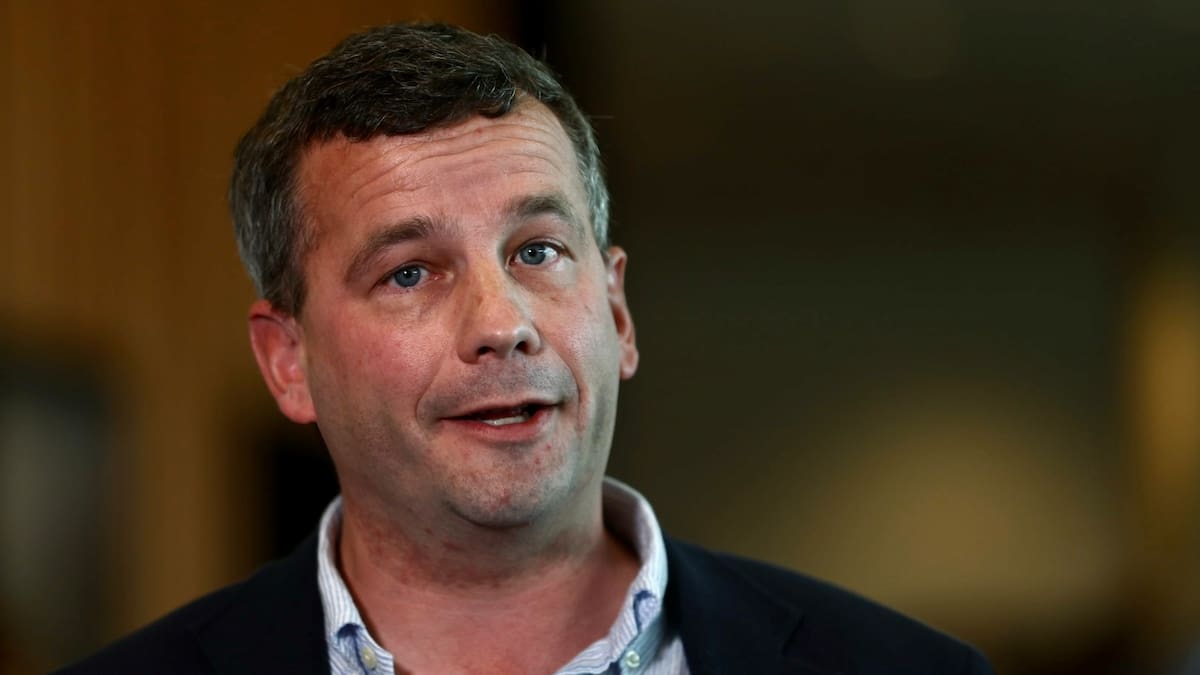
“[I was] worried we’d run out of things, pollute the skies and water, and it’d be the end. I even tried to join Greenpeace as a kid, but I was too young to set up an automatic payment, so I was kind of saved by the banking system.”
It wasn’t until he studied engineering that he began to think differently about issues. He came to believe “the only way to solve those problems is with creativity”.
He used the evolution of telephones to illustrate how his thinking had changed.
“When I was a kid, phones were all connected by copper wire. Today they’re connected by fibre optic cable, and it’s much easier to find sand – which is basically all fibre optic cables are – than it is to find copper. And of course most phones don’t have any wires at all.
“That was an example from engineering of how you can solve a problem and get a better product or service using fewer resources.”
After his degree, Seymour worked in Canada for the Frontier Centre for Public Policy, a think tank in Regina.
He described the experience as valuable preparation for the future, even likening it to a “free, paid postgrad diploma”.
“I got to read a lot of economists and philosophers, learned how to do a radio interview and a TV interview as best I can, write a newspaper column … which turned out to be useful for what I did later,” he said.
Seymour first stood as an Act candidate in 2005, but it wasn’t until 2014 that he was elected to Parliament. Looking at how politics has changed since then, Seymour points to the internet as a major shift.
“I have a Facebook page that 130,000 people follow – that’s pretty big. Apart from really big shows like Hosking or 1News, there’s not much that reaches that many people. If you do a good post, it can go well beyond your following.”
However, Seymour also acknowledged the internet has contributed to increasing political polarisation.
He recalled a recent interaction that made him reflect on how attitudes have changed since the days before social media.
“I had someone come up to me about a year ago and say, ‘Look, I won’t vote for Act, I don’t really agree with you, but I’m really glad your perspective’s in Parliament’.
“I thought, ‘that’s pretty weird’, and the next day I realised what was weird about it is that that was fairly common when I was first elected in 2014. Today, that must have been the only person in the last few years who’s said that to me.”
He believes both the Covid-19 pandemic and the emergence of social media were major contributors to the problem.
Despite this, Seymour remains optimistic about the civility of New Zealanders away from the online world.
“I think the most important thing to recognise is that the online world amplifies, and it often amplifies bad things. If you go along and knock on doors … or hold a street corner meeting like I do in Epsom, you find overwhelmingly that New Zealanders are decent people who basically just want the country to work and are looking for some answers about how.”
Outside politics, Seymour has a few things that keep him fizzing.
He told Cowan about his old Lotus Seven sports car, which he built from scratch as a teenager.
“I started in the first school holidays of fifth form, laid it out on a piece of plywood, sketched the shape, and started cutting and filing the tubular steel.”
He enjoys riding his e-bike and makes time to swim each day.
“That’s a wonderful way to start the day. No one can ring me, and if you can get your blood moving before your first interview, it makes a big difference.”