
However, that was whittled down to the 28 charges the jury were left to decide, most relating to methamphetamine and cocaine.
Heart was found not guilty on five charges of supplying methamphetamine, conspiring to money launder, offering to supply cocaine, conspiring to murder, and conspiring to kidnap.
The jury found him guilty on 12 charges of supplying meth at Mercer, Bombay, Rangiriri, Hampton Downs, Huntly, Te Awamutu, Hamilton and Tauranga; four charges of supplying cocaine in Hamilton and Tauranga; and conspiring to supply P in Hamilton.
The offence dates range from December 3, 2019, to May 28, 2021.
Heart had earlier pleaded guilty to 77 charges.
He was convicted by Justice Brett Tantrum and remanded in custody for sentencing next month.
In her opening, Crown Solicitor Jacinda Hamilton said Heart peddled the drugs with one focus – money.
“It was his business. It was how he earned a living and how he was getting rich and growing his power.”
Hamilton said a kilogram of meth was worth $180,000 to $220,000 between October 2019 and June 2021.
Heart could source meth and cocaine from China and Mexico for US$5000 ($8450) to US$10,000, “making it a very profitable business”.
She claimed Heart, who was “exacting and ruthless”, was selling meth in kilograms and ounces to others below him to make their own profit.
Revealing details of the wounding charge, Heart is alleged to have told another man that he was “thinking about chopping [the man’s] finger off tomorrow, lol”.
“Need butcher knife and hammer,” he reportedly said. The other man allegedly replied: “Send him the gangster message.”
Hamilton claimed that at the time of Heart’s arrest in June 2021, he was waiting on a 270kg shipment of meth from overseas, after telling his contact he would “take as much as [he] could possibly offer”.
As for cocaine, the amounts sold “paled in comparison” to meth, but he was allegedly supplying it in May and June 2020, after the first Covid-19 lockdown.
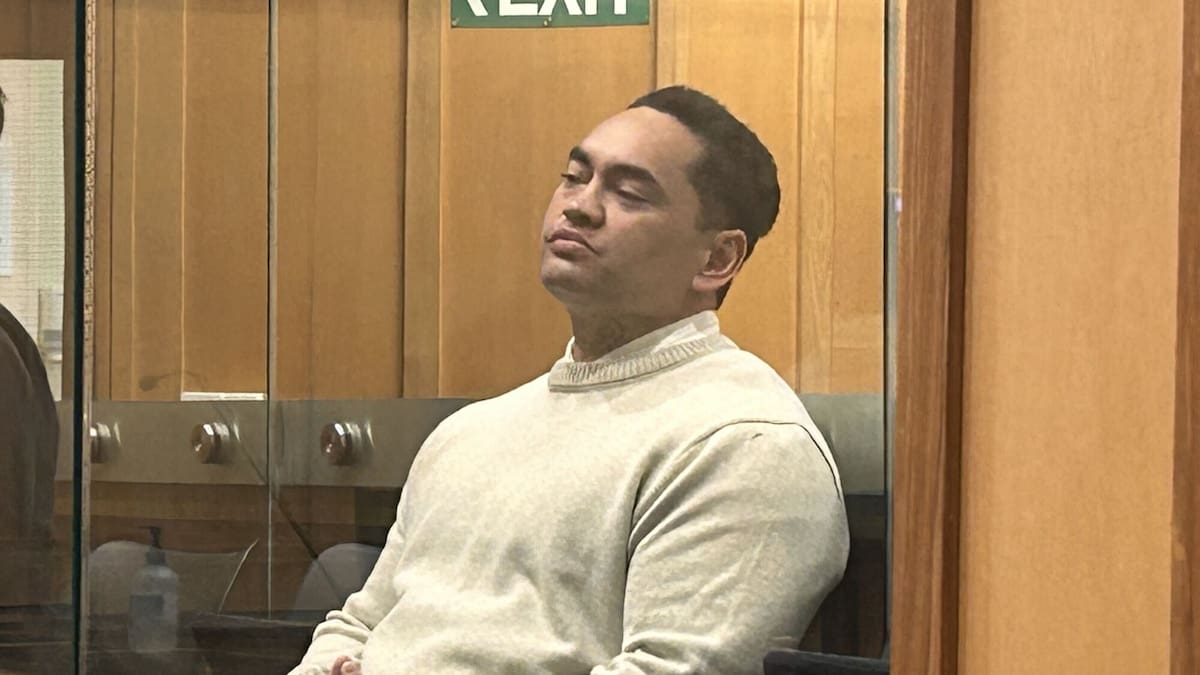
Junior Heart, pictured in the dock of the High Court at Hamilton, was today found not guilty of nine of the 28 charges he was defending. Photo / Belinda Feek
At one point cocaine was “the champagne of drugs” but when supplies increased, prices dropped and it was soon on par with meth.
As for MDMA, also known as ecstasy, about 5000 pills could be pressed from 1kg of the drug.
She claimed Heart sourced 2kg of MDMA between March 2020 and June 2021.
Heart had already pleaded guilty to charges relating to the distribution of MDMA.
Hamilton said Heart’s business ran like a “well-oiled machine” and “he set the prices”.
‘Who let the dogs out?’
In his closing address to the jury on Friday, Wimsett said they “may have a natural dislike for Junior Heart given all the things he’s admitted doing and that he is accused of doing”.
“And that is understandable. You’re not immune to those natural feelings you may have.”
He told them they might have trepidation or nervousness in trying to decide all the charges, but must put those feelings to one side in deciding the verdicts.
He then went through the charges his client was fighting, and bunched them up according to “chapters, or signposts”.
“So that if I was writing a book about this case these might be the chapter heads,” he said.
The chapter names included a successful, “Gym Juice and cash”, relating to the alleged supply of meth in Hamilton in November 2019.
However, Wimsett said Gym Juice was slang for steroids, and the communications were between him and a co-defendant comparing their own lines of the product.
He had mixed success with a chapter named, “Who let the dogs out?”, which related to the supply of meth around South Auckland and Waikato between December 3 and December 24, 2019.
He dubbed a conspiring to money launder charge, which his client successfully defended, as “A gift without conditions”, and a conspiring to supply meth charge, that he was not as successful with, “What’s yours is yours and what’s mine is mine”.
Two other successful chapter names, relating to offering to supply cocaine and meth, were “Noah sure yet brother, what’s the usual”, and “What’s Heart got to do with it?”.
The chapter of the chopping-finger charge was called, “See how he goes”.
“Those themes are all based on what I say are important points to note regarding each of those charges or sets of charges.”
Wimsett told the jury not all the things discussed were followed through with, and “things that were planned sometimes failed”.
The jury heard of a planned import operation but no evidence it was completed, and an associate giving his client money back because a deal didn’t go through.
“So I’m asking you to watch yourselves or each other and don’t assume that because the Crown said something happened, or there was talk that something happened, that it did.
“I’m asking you to look for evidential confirmation.”
Belinda Feek is an Open Justice reporter based in Waikato. She has worked at NZME for 11 years and has been a journalist for 22.