
Gi competitors wear a traditional heavy cotton jacket, pants and belt showing their rank. Competitors grab the fabric to hold, control or choke opponents.
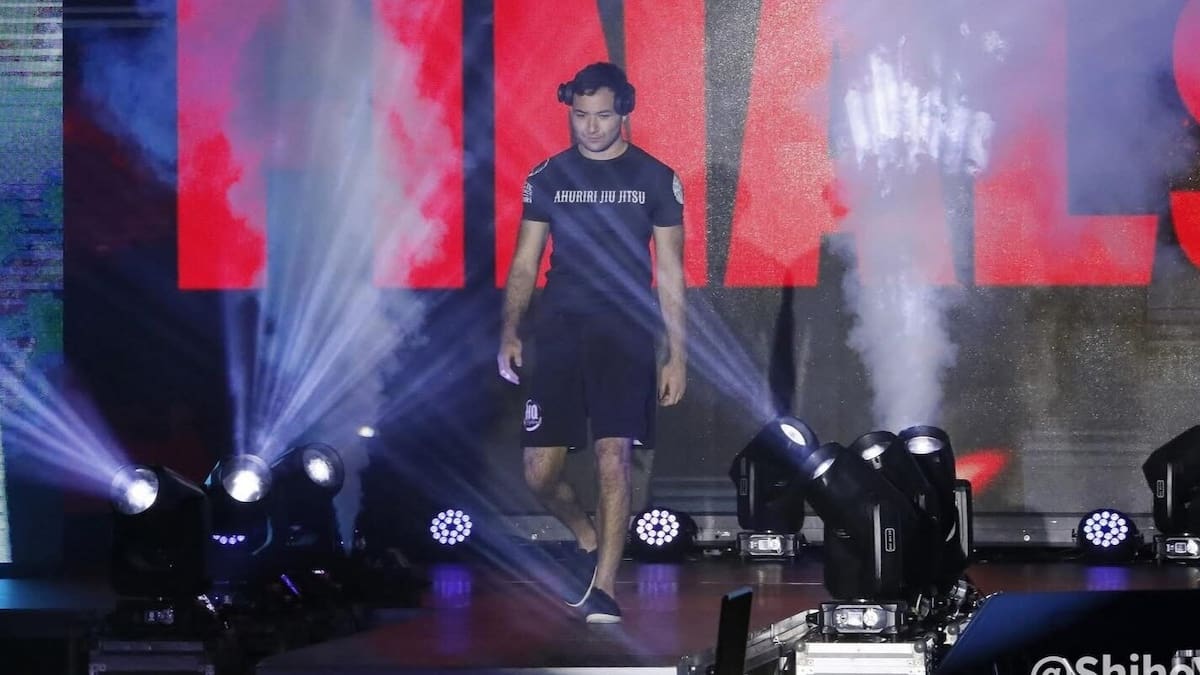
No-Gi competitors wear tight synthetic shirts and board shorts, forcing them to grip bodies and use underhooks, wrist ties and body locks.
Competitors are separated into sex, belt, age and weight categories.
Rio beat two fighters from Mongolia and Mexico to win gold, winning the first fight by Aoki lock (footlock) in the first minute and the second with a triangle chokehold submission.
Jaye Rio, centre, stands atop the dais at the Sport Jiu-Jitsu International Federation World No-Gi Championship in Tokyo, Japan.
He said the tournament was good fun and felt like any other once he hit the mats.
Despite the gold medal, Rio said the lead-up to the tournament was the worst he’d experienced after catching a winter illness that hit him hard.
Losing his coach a month or so before the competition was mentally challenging to process.
“[It] felt good to go out there and just go hard though.”
This was Rio’s first international medal at black belt level, but he said medals didn’t mean a lot to him; it felt better to win the final with a move his coach was a specialist in.
“My coach Damian Smith was a triangle specialist and taught me all I know about triangles, so when I felt the opening for one, I was thinking about him and all the times he’d coached me at tournaments, [the] perfect way to end the tournament.”
He thanked his team at Gracie Allegiance Ahuriri and Gracie Allegiance Team New Zealand, and his friends and training partners at Brazilian Jiu-Jitsu gyms in Hawke’s Bay.
“You get nowhere in martial arts without good teammates and training partners,” he said.
“The BJJ community in the bay is pretty tight-knit, so if you train long enough you’ll end up getting to know most of the gyms around and the good people in them.”
Jaye Rio, left, with partner and fellow Gracie Allegiance Ahuriri coach Yukako Mori at the 2026 Sport Jiu-Jitsu International Federation World No-Gi Championship in Tokyo, Japan.
Rio and his partner and fellow coach Yukako Mori were spending a few more weeks in Japan, seeing friends and getting more Brazilian Jiu-Jitsu and Judo training.
He said that once back in Hawke’s Bay he planned to continue training in Ahuriri and “keep having fun with Jiu-Jitsu”.
“Aside from being a good way of learning some self-defence, it’s an awesome way to stay active without feeling like it’s a chore and it’s a great way to make lifelong friends. Anyone is welcome.”
Jack Riddell is a multimedia journalist with Hawke’s Bay Today and has worked in media in the UK, Germany and New Zealand.