
First off, the flight
Jetstar business class. Photo / Jetstar
Kiwi travellers often anticipate a punishing transit, so I prepared as if going into battle – but I needn’t have. We were trying out Jetstar’s business class on a refreshed 787 Dreamliner.
The seat is more high-end cinema recliner than a full lie-flat, but you are greeted with sparkling wine, ample legroom, and the best plane meal I’ve ever had (slow-cooked lamb shank at 40,000ft).
With an attentive cabin crew bringing handfuls of chocolate, in-flight Wi-Fi, and a whole season of Love Is Blind UK pre-downloaded on my phone, the 10-hour flight flew by.
Day 1: Authenticity of the intoxicating kind
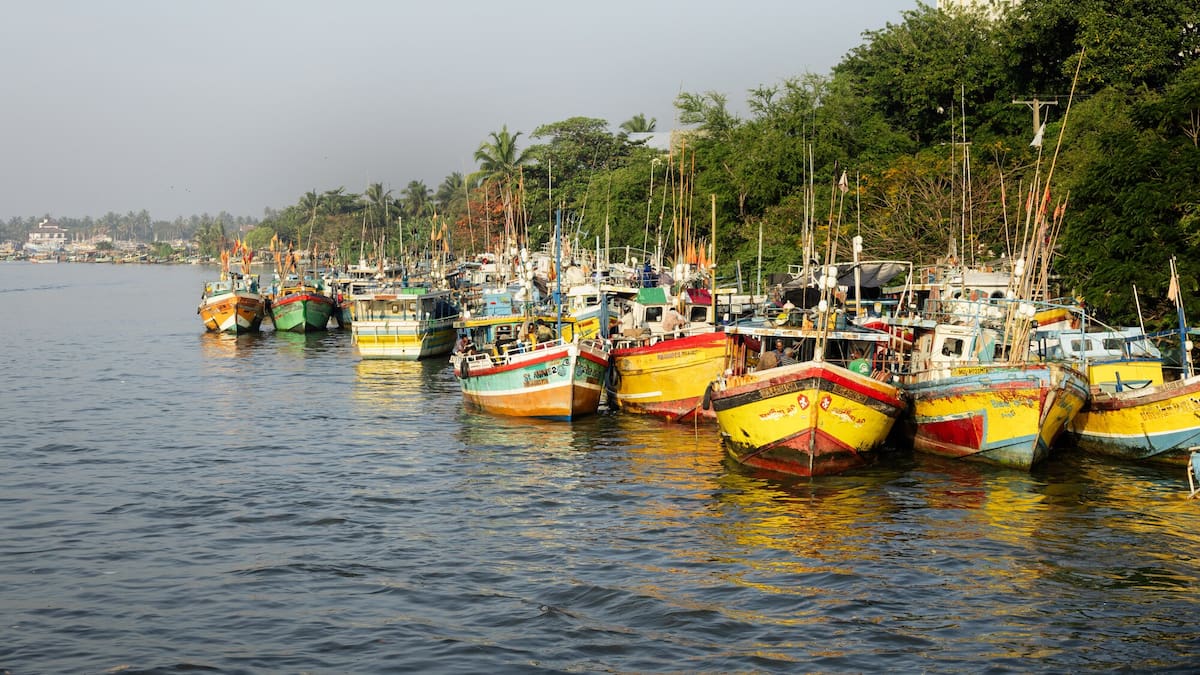
Negombo Fish Market. Photo / Intrepid
At 5.30am, the Negombo fish market visit didn’t initially inspire boundless joy, but it turned out to be a raw, sensory introduction to local life – the kind synonymous with Intrepid tours.
Colourful boats with names like ‘Welcome Jesus 2’ bobbed as fishermen shouted prices over glistening giant tuna. Next, we met a ‘toddy tapper’, who scaled huge palm trees without a harness, walking tightropes between them to tap coconut flower sap.
A man climbing a palm tree for coconut flower sap. Photo / Intrepid
Moments later, we were sipping a delicious, mildly alcoholic toddy. I also breezed through my first squatting toilet experience here, despite our guide Dodan trying to dissuade me, clearly unaware of how many music festivals I’ve camped at.
By evening, we arrived at Jetwing Lake, a mystical resort on the jungle’s edge in Dambulla, overlooking an ancient water reservoir and giving extreme White Lotus energy, minus the murder.
Monika Barton at dinner. Photo / Supplied
Sambol making. Photo / Monika Barton
Dinner was a barbecue feast in an outdoor kitchen twinkling with fairy lights in the middle of nowhere. We ate whole grilled fish, coconut sambol and fiery Sri Lankan chicken prepared by a local mother and her sons, agreeing it was the sort of authentic, off-grid experience Anthony Bourdain would’ve showcased on Parts Unknown.
Day 2: Lions, hikers and beers – oh my
Lion Rock in Sri Lanka. Photo / Monika Barton
Today’s 4am alarm made yesterday’s seem like child’s play. We were off to scale Sigiriya (Lion Rock), a 200m granite column fortress.
As a person of questionable cardio fitness who, truthfully, only sees that time of the morning having not slept the night before, this wouldn’t normally feature on my itinerary.
But beating the 35C heat to watch the sun rise over jaw-dropping vistas at the summit is mandatory. And reader, I hate to tell you, it was worth it.
Sigiriya was built by the 5th-century King Kasyapa, who erected an architecturally staggering palace atop the rock, accessible only through the mouth of an enormous carved lion. I don’t know if he was a Leo, but as one myself, I resonated with this big-cat flex. Most of the lion has eroded, but you still pass its immense stone paws guarding the final stair climb.
We followed a polished brick “mirror wall”, once so shiny the king could admire his own reflection (further evidence of the Leo theory) and detoured through a fresco cave bearing ancient paintings of topless women. Some of the surviving surfaces even bear 9th-century tourist graffiti, proving the impulse to scrawl “I was here” is timeless.
Huffing skyward, we passed an English couple who told us, “We probably shouldn’t still be doing this at 200 years old, but we’ve come back six times. This place gets under your skin.”
After a necessary dip at the hotel’s unnecessarily long pool (75m), we boarded open-top jeeps at Minneriya National Park to witness ‘The Gathering’. Here, up to 300 elephants congregate around the lake during the dry season.
We stood in awe, watching the interactions of huge matriarchal herds – with babies! – and passing by lone bachelor males flapping their colossal ears.
Later that night, sipping a cheap, ice-cold local Lion lager in the hotel pool in the balmy night’s air, I had to wonder: respectfully, Bintang who?
Day 3: Where the wild things are
Time to tackle the Ancient City of Polonnaruwa, where, at Gal Vihara, we attempted to take in the majesty of mammoth 850-year-old Buddha monuments hewn from solid granite.
We cycled through the ruins of another ancient king’s royal palace, marvelling at ornate stone carvings and padding barefoot – as custom dictates – through sacred temples.
Our status as uninitiated tourists was solidified when we sprinted across scalding ground to retrieve our Jandals, which, left baking in the sun, had reached the approximate temperature of the Earth’s molten core, prompting a chorus of high-pitched shrieks.
A monkey from Sri Lanka. Photo / David Whitehill
Other things to note to avoid embarrassment: no photos with your back turned to Buddha; keep shoulders and knees covered and remain a safe distance from the monkeys idling in the low tree branches. They’re adorable, but try striking up a conversation, and one will casually bare its fangs, sending you cycling fervently in the wrong direction.
Wildlife is so integrated here that actual safaris feel almost obsolete. On the drive back, a wild elephant sauntered across the main highway in front of us, while tuk-tuks honked cheerily and steered around it. Minutes later, a massive water monitor lizard (basically a dragon) peered through our van window, flicking a menacing blue tongue.
An elephant crossing. Photo / Monika Barton
We finished a huge day with a visit to the ZeroPlastic Impact Centre, where they “don’t believe in recycling – it doesn’t work”, but instead focus on reducing waste and creating plastic alternatives.
We made coconut teacups and bought beautiful homewares crafted by local artisans – an example of the conscientious tourism that supports communities and affects positive change in a developing country.
Day 4: From ancient caves to pina coladas
Our final stop was the Dambulla Cave Temples, a consecrated complex of shrines and one of the most sublime places you will ever step (bare)foot. Five caves house 153 Buddha statues beneath kaleidoscopic ceiling murals of celestial figures, marauding demons and ancient kings, with depictions of deities wearing protective ‘cobra hoods’ (an accessory I coveted deeply).
Incense wafts through the humid air as devotees offer lotus flowers amid low chanting. The scale, beauty and energy of the place can’t be captured on any smartphone. At the entrance, Dodan pointed out a royal decree “inscribed in 12th-century medieval Sinhalese” – a phrase I found so wonderfully incomprehensible as a Kiwi.
We capped the trip by finally getting to sip a pina colada in a rooftop infinity pool overlooking the metropolis of Colombo, proving Sri Lanka generously offers it all, from beaches to jungles, to bustling cities.
A blessing
The 16-hour return transit via Melbourne is surprisingly easy, provided you book a quick stopover and manage a few winks on the overnight leg.
So, if you think your soul needs a reset that a crowded Bali beach club simply cannot provide, I suggest you skip the scooter traffic and get on the Dreamliner.
Among the many moments that stuck with me: Vendors at the cave temple hawking white pirith nula (blessing threads); Dodan sternly steering us past them, reminding us of something all travellers should keep front of mind – that real blessings cannot be bought; they are always freely given.
The journalist travelled courtesy of Jetstar and Intrepid