
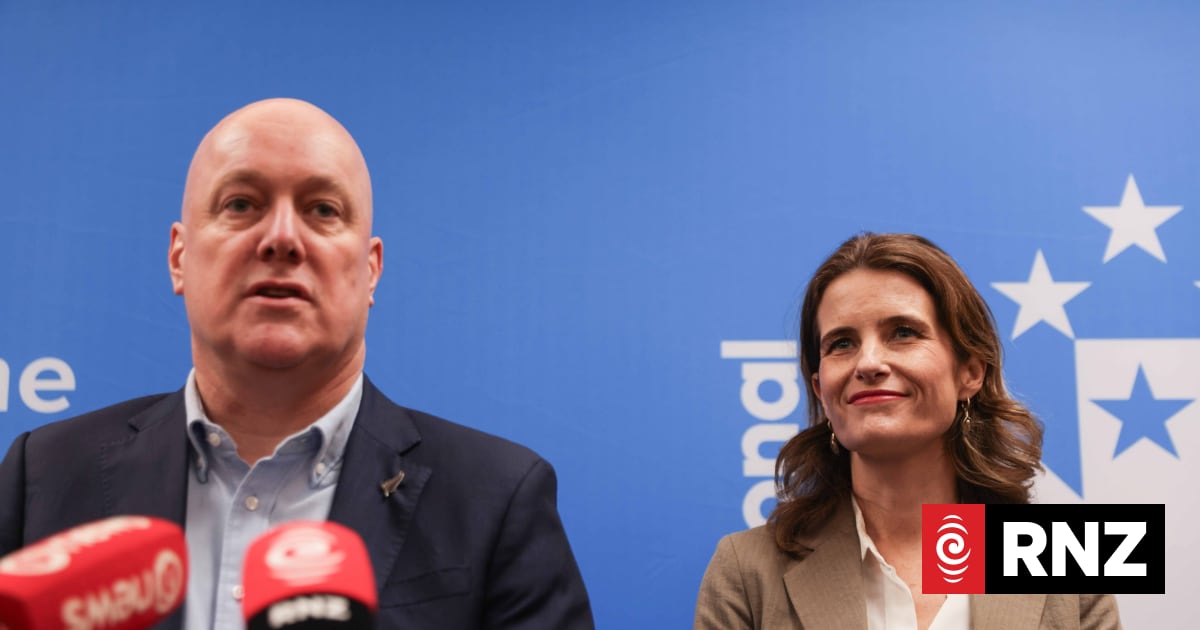
National has made a supermarket break-up a key part of its election pitch, proposing to sever Pak’nSave from New World in a bid to drive down grocery prices.
The shake-up would be contingent on a six-month review by the Commerce Commission into whether the split would actually leave shoppers better off.
If the watchdog gave it the green light, National said it would legislate to force through the separation.
The significant policy was announced with little warning on Wednesday morning, and on the same day that Labour promised to ban big companies from charging excessive prices.
Foodstuffs – made up of two co-operatives – currently manages all New World, Pak’nSave and Four Square stores.
National’s plan would split them up, leaving the country with three nationwide supermarket chains: Pak’nSave, New World/Four Square and Woolworths.
“This is, I acknowledge, a bold and unprecedented step,” finance spokesperson Nicola Willis told reporters at Parliament.
“It is the right one. It puts the Kiwi shopper first.”
Willis said the proposal followed a comprehensive cost-benefit analysis – by Sense Partners – and two peer reviews which she commissioned as finance minister to explore proposals for breaking up the duopoly.
But she said rather than taking a proposal back to Cabinet this term, National would instead seek an “explicit electoral mandate” from the public given the significance of the move.
“No Kiwi shopper or store owner would thank us if we mucked this up,” she said. “While it’s always tempting to rush in, the stakes are very high, and work of the sort requires a prudent, careful approach from ministers.”
Hipkins: “New Zealanders can’t eat a review”
Labour leader Chris Hipkins dismissed National’s policy as little more than “another review” and said New Zealanders deserved “more decisive” action.
“It’s not a commitment. It’s another review,” he said. “New Zealanders can’t eat a review.”
Hipkins would not be drawn on whether he supported breaking up Foodstuffs, but said Labour would have more to say about supermarket competition before the election.
He also pointed out National would find it difficult to get its policy over the line with coalition partner ACT, given its leader David Seymour previously lambasted the plan, arguing it would scare away investment.
New Zealand First, in contrast, announced its own plan to break up Foodstuffs in April.
Willis said the coalition had proven an ability to compromise on various policies this term: “Obviously, this is a key priority for us, and that would be reflected in our coalition discussions.”
National leader Christopher Luxon told reporters Labour had failed to put forward a proper “substantive solution” and was so far offering only “more clipboards and bureaucrats”.
Willis said the shake-up could eventually save households up to $1320 a year, pushing down grocery prices about 5 percent lower than they would otherwise be.
Sense Partners’ modelling estimated prices would be about 3.5 percent lower in the first year of separation, with gains growing as the new chains bedded in. By 2035, the estimated annual household benefit ranged from $200 to $1320 depending on income and family type.
“That’s real money back in the pockets of New Zealanders,” Willis said.
“More competition means supermarkets have to work harder for every customer, on price, specials, range and service. That is how shoppers get a better deal.”
National also trumpeted a potential $12.6 billion in “consumer benefits” over 20 years. However, the underlying analysis put the overall net gain to the whole economy at just $2.9b once lost supermarket profits were counted, or even lower if Foodstuffs’ costs increased.
The independent report also carried some hefty warnings, with the economists warning their analysis was “indicative rather than definitive” and flagging potential “insurmountable” legal and implementation hurdles.
Willis acknowledges “tough fight” ahead
Willis stressed that National would act carefully on the Commission’s advice and not play “supermarket executive from the Cabinet table”.
“There is a very high bar for this kind of intervention and National is not pursuing structural separation in any other sector,” Willis said.
“However, after years of reviews and incremental reform, it’s clear the status quo isn’t working. It’s time for change.”
Willis acknowledged the difficulties ahead, saying she had already felt the “full force” of the supermarkets’ well-resourced lobbyists.
“I know that I am taking on a big entity here,” she said. “I’ve satisfied myself this is the right thing to do, but I know that it’s going to be a tough fight.”
National said no individual Pak’nSave, New World or Four Square owner would be forced to sell or change brands.
Instead, the two Foodstuffs brands would be split into rival nationwide groups, with separate structures and incentives to compete against each other.
The Commerce Commission’s latest monitoring showed Foodstuffs and Woolworths still controlled about 82 percent of the grocery market, with little movement in the core measures of competition over the past year.
Wednesday’s announcements follow repeated efforts by both the coalition and former Labour government to break the supermarket stranglehold, with little to show for it.
Willis last year put out a call for third major challenger to enter the market, sounding out potential competitors, but the industry’s biggest global players declined to engage.
The government also created an “express lane” for consenting new supermarkets, but it appears no applications have yet been lodged.
In 2020, Labour ordered a market study, then brought in a Grocery Commissioner and banned restrictive land deals.