
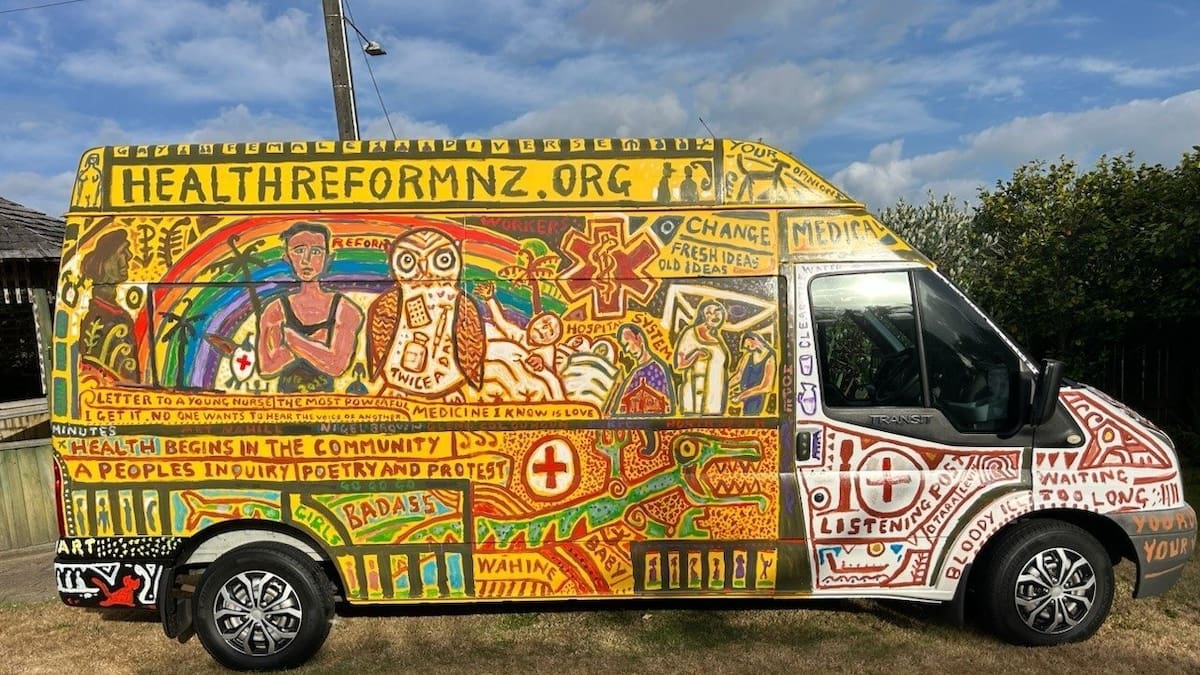
The new hīkoi kicks off with a special documentary screening followed by a Q&A with the pair in Auckland on Friday before heading through Northland, the Bay of Plenty, Gisborne, Hawke’s Bay, Taranaki and Manawatū. It concludes with a presentation of the book to members of Parliament in Wellington.
They will be in Kaitāia’s Peekaboo Cafe on Saturday at 4pm then at the Old Packhouse in Kerikeri at 12.30pm on Sunday and the Te Tii – Te Hiruhārama Hou Marae at 5.30pm.
On Monday the doctors will be at the Hihiaua Cultural Centre in Whangārei at noon, before moving to other stops on the North Island.
Doctors Art Nahill (left) and Glenn Colquhoun are taking their vanbulance to share their findings across the North Island before presenting their book to Parliament.
Nahill said while the Kaupapa was coming to an end he hoped that some of the ideas in the book and documentary will create a sense of hope.
“That we are not chained to the old ways of doing things and that we can reimagine the kind of high-quality, equitable and sustainable health systems we all deserve.”
Nahill said many of the stories collected during the hīkoi pointed to a healthcare system struggling to meet people’s needs.
“The vast majority of stories that we had were ones where people acknowledged that the health system was irreparably broken.
“People often acknowledged how hard healthcare workers were working, but the system they were working in has become completely outdated and is no longer fit for purpose.”
Among the stories that stayed with him were accounts from Far North residents who had been unable to find a GP after moving to Kaitāia.
Nahill said one couple had lived in the area for three years but had been unable to enrol with a local practice.
“Whenever they became unwell they had to use urgent care or drive all the way back to the Coromandel to get their regular medications because they hadn’t been able to transfer their care to anybody in the Kaitāia area.”
Other stories highlighted lengthy waits for specialist care and poor communication between different parts of the health system.
Nahill said people repeatedly raised concerns about accessibility, fragmented services and difficulties navigating healthcare.
Following the hīkoi, the team convened healthcare innovators and community leaders to discuss how a redesigned health system might look.
The ideas and themes gathered from those discussions have been compiled in the book, which the pair hope will help spark conversations about healthcare reform.
“We’re going back really to give copies of the book back to people who shared their stories originally and say, ‘At least we listened’.”
Despite his concerns about the system, Nahill said the project was intended to encourage people to think differently about healthcare.
“The way the health system is functioning now was never intelligently designed. It sort of developed in an ad hoc fashion and it’s not really designed with the patient at the centre.”
He acknowledged that significant reform would be difficult to achieve but said the conversations were still worth having.
“It’s a bit like playing the lottery. If you play, the odds are stacked against you, but if you don’t play, the odds are 100% stacked against you.”
For more information on the events and how to get the books and documentary visit healthreformnz.org
Yolisa Tswanya is deputy news director at the Northland Age. An experienced journalist and newsroom leader, she reports across the Far North and Northland, with a particular interest in health, education and community affairs.