
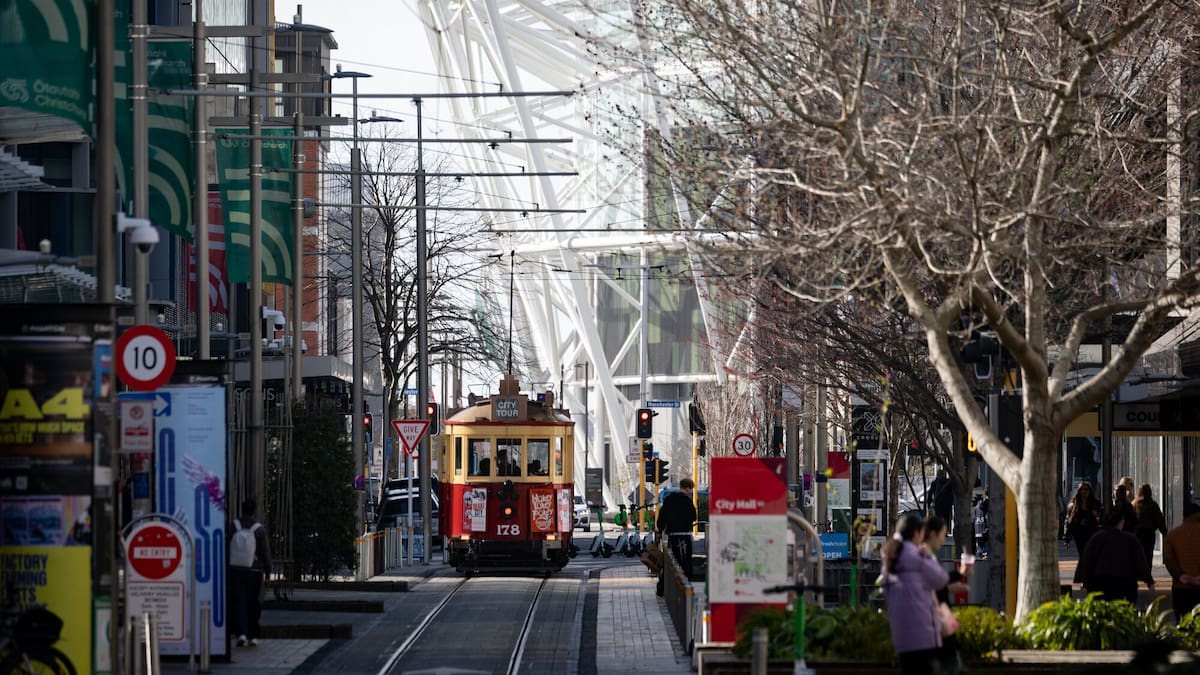
“Households are spending, businesses are investing, the labour market remains resilient and strong dairy returns are providing an additional boost to the economy,” Mundy said.
Canterbury has reclaimed the top position in ASB’s latest Regional Economic Scoreboard. Photo / Anna Heath
Canterbury’s labour market held up in Q2, with employment up 2.6% year-on-year and one of the lowest national rates of unemployment at 3.6%.
The region’s housing market remained strong, with house prices rising 3.3% annually.
High dairy prices boosted export returns, while continued population growth and major events bolstered by One New Zealand Stadium supported economic activity during the quarter.
Events supported by One New Zealand Stadium supported economic activity in Christchurch. Photo / Photosport
Core retail sales in Canterbury grew 8.8% year-on-year, the strongest result in the country.
“What’s interesting about the retail data is that we can see there’s been a 4% year-on-year decline in tourism spending in the region, suggesting the strong retail sales in Q2 was driven by locals rather than visitors,” Mundy said.
Canterbury’s place on the scoreboard comes just a week after Prime Minister Christopher Luxon said Christchurch shows what New Zealand needs to look like.
Prime Minister Christopher Luxon (left) being interviewed by NZ Herald chief content officer Murray Kirkness at NZME’s Project Canterbury business breakfast. Photo / Anna Heath
Speaking at NZME’s Project Canterbury business breakfast at One NZ Stadium, Luxon explained why he sees Christchurch as a shining example of New Zealand’s future.
However, Canterbury isn’t the only region that has climbed the ranks, with Taranaki delivering the biggest surprise, climbing to second place in the rankings after sitting near the bottom last quarter.
Mundy said Taranaki recorded one of the “country’s strongest rebounds”.
Employment growth in Taranaki was among the strongest nationally, construction activity surged 47.1% year-on-year and new vehicle registrations increased 21.6%.
“Taranaki recorded one of the country’s strongest rebounds, benefiting from strong dairy and meat sector performance, supported by the Fonterra capital return payout and favourable export conditions,” Mundy said.
“These strengths likely offset some weakness in the oil and gas sector.”
Kim Mundy, ASB acting chief economist.
There were also plenty of bright spots for Southland, with strong house price growth, a surge in new car registrations and solid retail sales growth underpinning their result of third place.
“While housing markets remained subdued across much of New Zealand, Southland’s housing market continued to show remarkable resilience, with annual growth in both house prices and house sales remaining the strongest in the country,” Mundy said.
Strong dairy and meat exports, with Fonterra’s capital return payout, continued to support the regional economy.
Retail sales rose around 7% over the past year, while new car registrations increased sharply.
“The region’s Achilles heel has been its softening labour market, with employment falling 2.9% annually,” Mundy said.
“However, agriculture remains a significant contributor to the local economy and is currently performing strongly, helping offset some of the weakness in the jobs market.”
The City of Sails slipped down the rankings to sixth place, underperforming the national average across most indicators in ASB’s Q2 Regional Economic Scoreboard.
Auckland slipped down the rankings to sixth place in ASB’s Regional Economic Scoreboard.
Despite new car registrations rising strongly, reflecting demand for electric vehicles, and building consents showing healthy growth, other regions recorded even stronger gains in these areas.
“Auckland’s housing market remained a key drag on performance, with both house prices and sales down significantly on a year ago,” Mundy said.
“Buyers continued to hold the upper hand as listings remained high and demand subdued.
Mundy said while some sectors were bolstering Auckland, other factors created “ongoing uncertainty” for the region.
“Population growth and tourism are providing some support to the region, but Auckland’s economy continues to contend with cost-of-living pressures, interest rates trending higher, a soft labour market and ongoing uncertainty,” Mundy said.
“While these challenges may weigh on activity in the near term, the region remains well positioned to benefit as economic conditions gradually improve.”
Despite a slowing economy, New Zealand’s export sector remained resilient in Q2.
Export volumes rose 6.4% over the quarter and 10% on a year ago, while export prices increased 3.5%.
Dairy, meat and wool all posted solid gains, helping offset the surge in import prices from the Middle East conflict.
“Exports look set to remain a key source of support for the economy, underpinned by firm commodity prices and a weak New Zealand dollar,” Mundy said.
“For now, New Zealand’s two-speed economy appears likely to persist.”
Mundy said the subdued economic backdrop is expected to continue, with Middle East tensions adding to uncertainty.
“We expect further 25-basis-point hikes from the RBNZ [Reserve Bank] in October and December, taking the OCR [Official Cash Rate] to 3.25%,” she said.
“Higher interest rates are likely to weigh on consumer spending and delay a broader housing market recovery.
“While the outlook remains data-dependent, inflation is expected to stay close to 4% through the rest of 2026 and labour market conditions are likely to remain soft.”
The ASB Regional Economic Scoreboard ratings are updated every three months and are based on 11 measures, including employment, construction, the retail trade and house prices.