
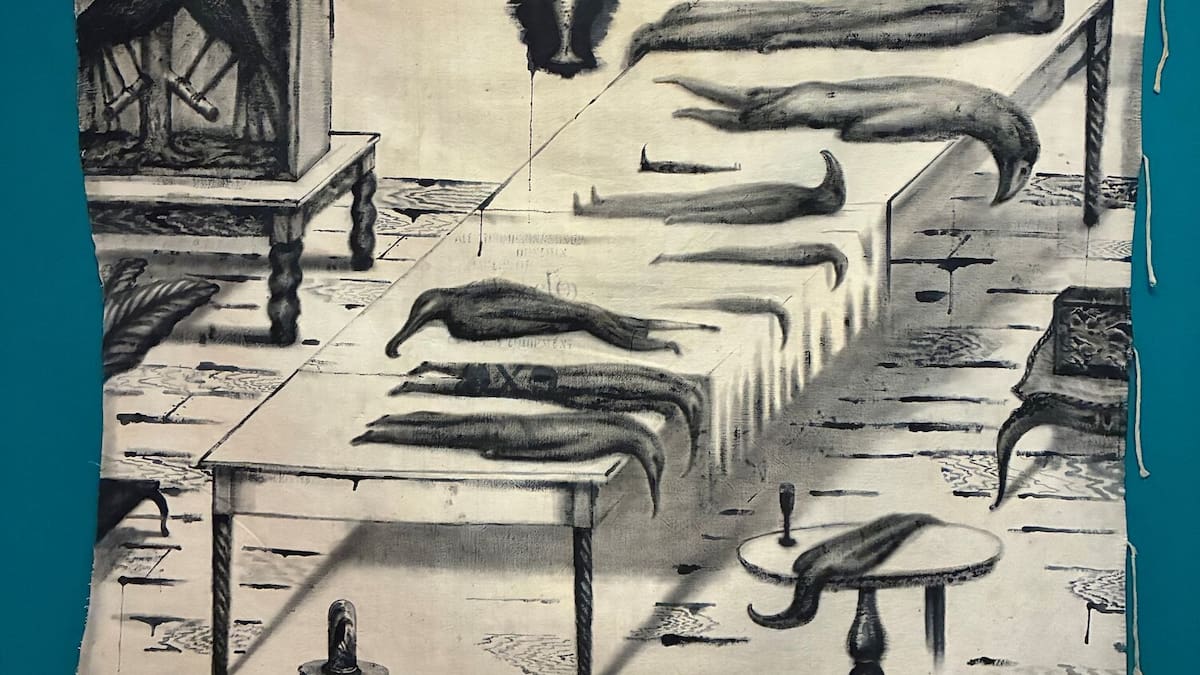
In 1989, after Hammond travelled to Auckland Island where birds dominated, he began to create artworks that reimagined Aotearoa as a primeval land of birds, reflecting upon the irreversible impact of European settler colonialism on Aotearoa’s ecology.
Buller’s Table Cloth, 1994, by William (Bill) Hammond.
Painted in dripping black over loose hanging canvas, Buller’s Tablecloth pulls us into a macabre scene. To the left and in the foreground, huia are taxidermied in glass cases. Over the tables, humanoid corpses of birds are draped. With the dark window, the room lit by a single light permeating darkness, the work makes the practice of bird stuffing feel particularly grotesque.
The eerie scene and artwork title reference Walter Buller, the late 19th-century naturalist and collector who worked to observe, hunt and create taxidermy specimens of the last huia as they neared extinction. Near Hammond’s painting, a copy of Buller’s A History of the Birds of New Zealand is displayed alongside a selection of its illustrations. These include a huia, based on one such taxidermied specimen Buller sent to the illustrator, J.G. Keulemans.
On the far rear wall of the exhibition, a taxidermied huia appears once more, in another standout work by brilliant contemporary artist Fiona Pardington (Ngāi Tahu, Kāti Māmoe and Ngāti Kahungunu): Manawarahi – Female Huia, MTG Hawke’s Bay (2022).
Emerging from an inky darkness and enlarged to immense proportions, this huia dominates the space. Pardington created the photograph as part of a project in which she visited the museum’s collection to photograph its huia, capturing the same female specimen visitors encounter at the exhibition’s entrance. Seen here again, the huia feels transformed: no longer a natural history specimen, but a larger-than-life image of a species that carries immense symbolic weight.
You will encounter white-tipped huia feathers as you leave the exhibition, displayed alongside a waka huia (treasure box): a carved wooden vessel traditionally used to hold taonga (treasures), including huia feathers. You will encounter its beak at the exhibition’s exit, presented within a huia-beak brooch and pendant.
Together, the huia haunting He Hononga Manu, in art, artefacts, taonga and natural history specimens, create something more complicated than a memorial to an extinct species. They highlight the complexity of humankind’s relationship with this bird. A relationship that continues to be complex, even a century after its extinction.
He Hononga Manu: Connecting Birds, People and Place, insightfully curated by Tryphena Cracknell, asks us to consider the ways we have connected with birds and place without shying away from the consequences of those connections – including a species extinction. The huia is not unique in that regard, nor is the threat of human-caused extinction a crime of the past.
Across Aotearoa, the habitats of endemic birds continue to be threatened. The huia may be gone, but the factors that contributed to its demise did not entirely disappear with it. He Hononga Manu: Connecting Birds, People and Place, on display at Kahukura until March 2027, draws from the region’s rich collection and beyond to tell a myriad of rich and complex stories.
The huia’s is but one.