
He was by this time also a Nomads Motorcycle Club gang member and his criminal offending led to him being kicked out of the country under Section 501 of the Australian Migration Act.
This made him one of the infamous “501 deportees” – New Zealand citizens sent back across the Tasman because of their criminal behaviour.
In Fakaosilea’s case, he was also one of those criminals created by Australia, having lived there since the age of 5, who was about to become a lifelong burden to the New Zealand taxpayer.
On his arrival, he promptly joined the Comancheros gang, made up largely of fellow 501s and co-founded in New Zealand by Ulakai’s younger brother, Seiana Fakaosilea, who was also subsequently convicted of serious drug dealing and money laundering offences.
Just 10 days after the deportation flight, Ukalai was involved in what was then the largest known importation of methamphetamine into New Zealand, helping to land half a tonne of the drug on Te-Oneroa-a-Tōhē Ninety Mile Beach.
On this day, organised crime was not well organised enough, making the crucial mistake of trying to bring the meth ashore through the surf in a brand-new $98,000 boat, which ended up abandoned on the beach.
The suspicions of the Far North locals and the quick thinking of a local police officer led the authorities to the record-breaking haul, some of it buried in the sand and some hidden in a campervan.
“If this quantity of methamphetamine had been distributed it would have flooded the market,” Justice Simon Moore said at Fakaosilea’s sentencing hearing.
“The human cost and the misery and the havoc such massive quantities would have wrought in our communities throughout our land does not bear thinking about.”
Fakaosiliea was sentenced to 22 years and nine months in prison with no prospect of parole for more than eight years.
But being imprisoned didn’t stop Fakaosilea’s drug offending, and on a large scale.
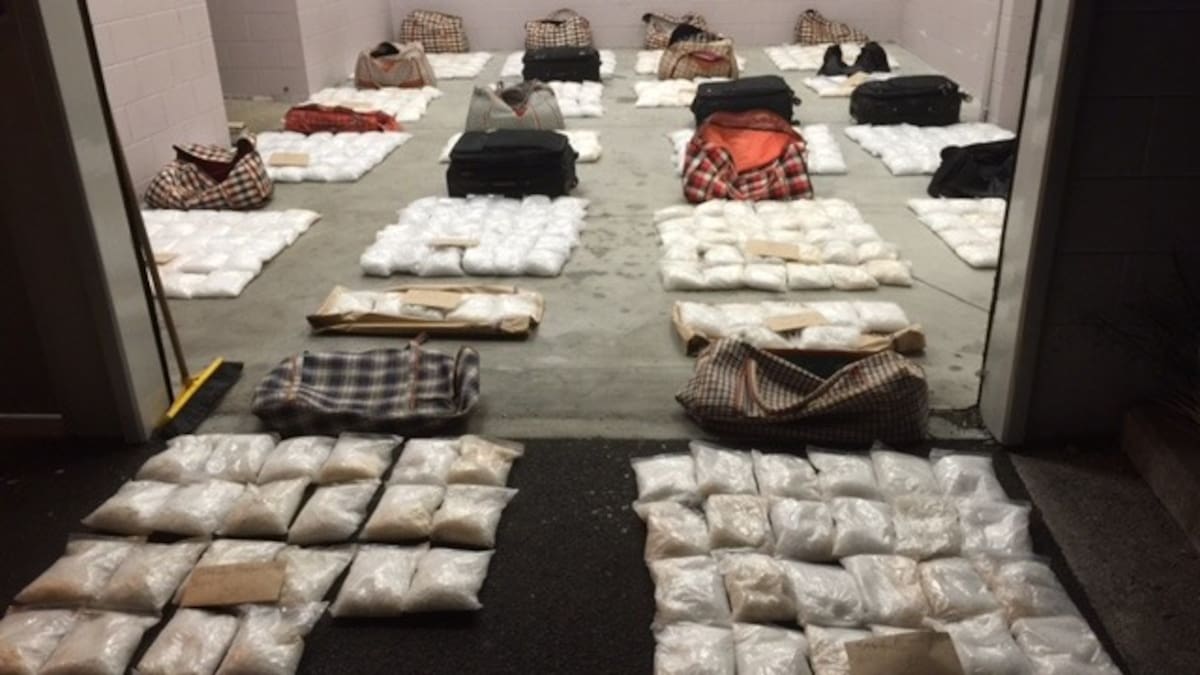
He used a contraband mobile phone behind bars to arrange $185,000 worth of drug deals and then the importation of another 198kg of meth, concealed in thresher machines brought in from Dubai.
For this offending, in 2023, he got life imprisonment with a minimum term of 10 years.
It was just the fourth time that a life sentence had been handed down in New Zealand for drugs charges.
Fakaosilea’s case has been back before the courts recently as he tried to have his open-ended prison term reduced.
Ulakai Fakaosilea, while in prison, arranged the importation of 198kg of meth hidden inside thresher machines from Dubai in 2023. Photo / NZ Police
He argued before the Court of Appeal that a life sentence was “manifestly excessive” and a finite sentence of a set number of years should have been imposed, particularly given his guilty pleas and his personal circumstances.
The reference to personal circumstances included his upbringing and how he came to the gang lifestyle.
In considering these, the Court of Appeal had to take into account the full details about his journey from child flower-seller, to 501 deportee, to Comancheros meth-trafficker, to one of the most heavily sentenced drug-dealers in the country.
Two siblings also in prison
Fakaosilea is the second eldest of eight siblings who are cousins to the family of the late rugby great Jonah Lomu.
Two of them – Ulakai’s brother, Seiana, and a sister, Selaima Fakaosilea – are in prison. Selaima was also involved in the Ninety Mile Beach offending.
The Court of Appeal viewed with scepticism a comment made in a cultural report that Ukalai turned to gangs in search of kin relationships and a “place to fit in”.
It said he came from a relatively supportive family, and was visited every fortnight by at least one family member, flying across the Tasman to see him. He speaks to them regularly on the phone.
The report writer noted that Fakaosilea had continued to hold a high-ranking position within the Comancheros. He is considered a high risk of causing harm, including within the prison system.
A probation officer who wrote a pre-sentence report observed that Fakaosilea’s prison behaviour was compliant, which allowed him to move down the security classifications.
However, Fakaosilea arranged the importation of meth from Dubai while he was held in lower security conditions, first at Spring Hill Corrections Facility in Waikato and then at Rimutaka Prison in Upper Hutt.
This showed, the probation officer said, that his apparent compliance within the system and expressed motivation to rehabilitate, “is not considered a reliable indicator” of his risk of serious reoffending, or readiness to change.
The appeal court justices said: “It can be said with some confidence that Mr Fakaosilea does not, despite protestations to the contrary, display any intention of rehabilitating or leaving gang life.”
Ulakai Fakaosilea’s sister Selaima was also imprisoned for her part in the Ninety Mile Beach importation. Photo / NZME
The appeal court, comprising Justices Susan Thomas, Matthew Palmer and Graham Lang, said a 10-year non-parole period was imposed for a life sentence for drug dealing. The minimum term of imprisonment for a finite sentence of 30 years or more was also 10 years, or close to it.
“The key difference is that a sentence of life imprisonment never expires and theoretically the offender can be kept in prison for their entire life,” the justices said.
“If and when released, the offender will be subject to parole conditions and the possibility of being recalled to prison for the rest of their life.”
The appeal justices said that they considered the sentencing judge was correct to find that the sentencing principles of deterrence, denunciation and community protection required “nothing short of a life sentence” in Fakaosilea’s case, despite his guilty pleas.
“It is hard to argue against the degree of oversight Mr Fakaosilea needs, given the circumstances and seriousness of his offending,” they said.
“Prior to Mr Fakaosilea’s Ninety Mile Beach offending in 2016, the largest known importation of methamphetamine into New Zealand was merely 96kg. Mr Fakaosilea has now played either a leading or trusted role in the importation of 700kg of methamphetamine.”
The abandoned boat on Ninety Mile Beach that led to the record-breaking methamphetamine haul. Photo / Supplied
The justices said that Fakaosilea offended with the 2023 importation of drugs from Dubai when he was under “extreme conditions of oversight” while in prison.
“A life sentence means that Mr Fakaosilea will be subject to some form of oversight for the rest of his life.
“Bearing in mind the seriousness of the offending, that is appropriate.”
The appeal against the life sentence was dismissed.
Ric Stevens spent many years working for the former New Zealand Press Association news agency, including as a political reporter at Parliament, before holding senior positions at various daily newspapers. He joined NZME’s Open Justice team in 2022 and is based in Hawke’s Bay. His writing in the crime and justice sphere is informed by four years of frontline experience as a probation officer.
Join the NZ Herald’s Open Justice team for Case by Case, a video and podcast series examining the disputes and decisions making headlines across New Zealand.