

Fuel prices continue to surge around Australia despite no shortage of supply, and truck drivers are now raising the alarm that they’re losing money on long-haul drives.
Data from Fuel Radar on Sunday showed the national average price of Unleaded 91 reached $2.34 per litre, while diesel was $2.76 per litre.
Christopher Roosa, a Victoria-based owner-driver with 32 years in the trucking industry, said prices were the steepest he’d ever seen.
The industry veteran is an independent contractor who uses freight job marketplace Loadshift, with the company warning hundreds of its truckies are doing it so tough they’re reconsidering the industry.
‘I’ve been doing this for three decades and I’ve never seen it like this,’ he told Daily Mail.
‘Diesel’s sitting around $2.76 to $2.80 a litre – I’ve watched it jump 15 cents in eight and a half hours at one servo alone.’
The Albanese government early last month removed the last remaining discount on the fuel excise tax, which caused a spike in prices for millions of drivers.
However, the price at the pump has risen even further this month after the crucial east-west oil pipeline in the Middle East – used by Saudi Arabia to bypass the beleaguered Strait of Hormuz – was targetted in a drone attack and closed.

Christopher Roosa, who’s driven his truck (above) for more than 30 years, said the industry is in the worst state he’s ever seen

The Australian average fuel price for the last 90 days has steadily risen, a spike is seen in early August when the fuel excise cut was scrapped, but it has surged again this month

The average price of Unleaded 91 reached $2.34 on Sunday, while diesel was $2.76 per litre
Mr Roosa said many employers he takes jobs from were insisting on paying the same discounted price that was in place while the fuel excise was halved.
‘Some operators are quoting $1.20 a kilometre, but that doesn’t come close to covering fuel, rego, insurance, maintenance and wages.
‘It’s the small, one-truck operators like me who get hit hardest – the bigger outfits can absorb it, we can’t.
‘I’m parking my truck until prices come back down to around $2 a litre. Anything above that, and it’s just not viable to keep going.’
Loadshift director Mas Mohammad warned that while fuel excise reductions were expensive for the government, the devastating alternative would be Australia’s freight industry grinding to a halt.
‘We understand a cut isn’t free, and we understand the inflation risk,’ Mr Mohammad said.
‘Someone’s paying for this either way – right now, it’s small operators paying with their own margins, and some of them won’t make it to whatever comes next.
‘For many of them out there on the road, an excise cut is the difference between finishing the week and folding the business.’

Director of trucking company Loadshift, Mas Mohammad (above), said his drivers are battling massive losses due to high fuel prices
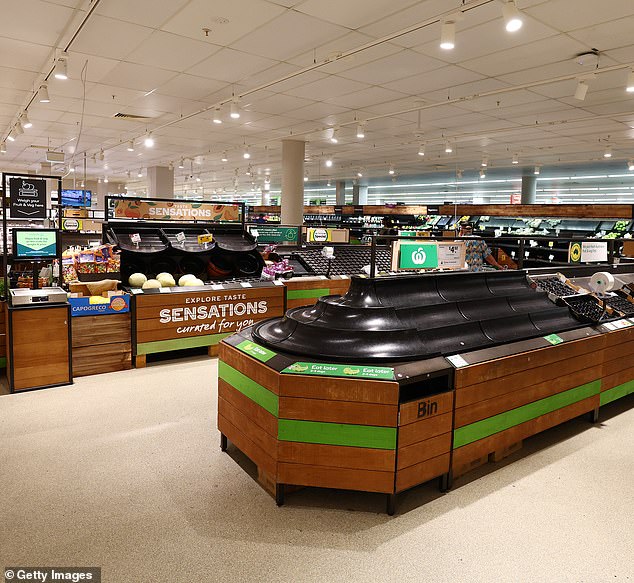
Mr Mohammad warned the country runs on freight transport such as for produce deliveries to supermarkets (file image)
Over the weekend, the Coalition put forward a proposed ‘fuel price shield’ that would automatically halve the fuel excise for up to three months when the price of crude oil topped $US100 per barrel for two weeks.
This would save drivers about 27c per litre on petrol or diesel and the heavy road user charge would also be halted, further easing pressure on the trucking industry.
The estimated cost of the policy while it was in operation would be almost $1billion per month.
Another owner-driver based in NSW with three years of experience, Frank Capri, told Daily Mail that with no similar plan from the current government, he was considering retiring his truck for good.
‘Diesel’s gone from $2.15 a litre in July to $2.54 now – that’s a 40-cent jump, and it hits everything, not just fuel. It’s tyres, repairs, parts, oil, all of it,’ he said.
‘Customers won’t pay more, so you’re stuck: charge what it actually costs and lose the job, or charge what they’ll pay and go broke doing it either way.
‘As well as cutting the tax excise, bringing back the Emergency Fuel Order would help – but it needs a lower trigger at $1.60 a litre, and it needs to switch on automatically instead of making us apply for it every time.’
The Emergency Fuel Order forces businesses to review and adjust the rates they pay drivers based on fuel prices.

Fuel prices are high around Australia, but particularly in NSW, Queensland and the NT
Opposition Leader Angus Taylor said the Coalition’s policy would be funded by another Coalition promise to cut the tobacco excise by 80 per cent.
‘The cut to tobacco excise will raise $8billion of funding,’ he told reporters outside a petrol station in Canberra on Sunday.
‘We worked through that with the Parliamentary Budget Office and that will fully fund the cut to the fuel excise.’
The policy would be ‘anti-inflationary,’ Mr Taylor said, as it would take pressure off transport costs and provide relief for motorists when prices approached $3 per litre at the bowser.
The price of Brent crude oil has repeatedly breached $US100 in recent months.
The Federal budget forecast prices to return to $US80 by mid-2027, but some experts have since predicted oil prices could reach as high as $US150 per barrel as global stockpiles are depleted.
The government temporarily halved fuel excise in April in response to the US and Israel’s war with Iran, slashing about 26 cents per litre from the cost at the bowser.
A scaled-back extension of the discount, at 16 cents per litre for petrol and diesel, lasted until August 2.

Truck drivers say they are under pressure to keep freight transport prices low despite the rising cost of fuel
Treasurer Jim Chalmers dismissed the Coalition policy as a political move performed in response to rising voter support for One Nation.
‘What we’ve seen overnight from Angus Taylor is more about polling numbers than petrol prices,’ he told News24’s Sunday Agenda.
‘He is under very serious political pressure and that matters much more to him than the cost-of-living pressures that people are feeling around the country.’
Labor has not ruled out another temporary cut to fuel excise if international conditions deteriorate.
Energy Minister Chris Bowen is set to travel to Saudi Arabia in the coming days to discuss the flow of oil to refineries around the world.
Join the discussion
Should the government step in to save small truckies, or let the market decide their fate?