
One of my favourite explorations was a hike along the Funf-Seidla-Steig (Five-Brewery Hike) in Swiss Franconia, which, despite the name, is very much part of Germany, although locals will swiftly correct you if you refer to them as Bavarians.
Swiss Franconia, the setting for Annafest, wasn’t originally part of Bavaria, but in 1806 Napoleon Bonaparte came along and made the region (which had — and still has — its own dialects and culture) part of the state to make up for territory lost during other battles. Its proud locals still refuse to be labelled Bavarians, intent on holding onto their identity and traditions.
One of these traditions is the Annafest beer festival, first held in 1840, 30 years after the first Oktoberfest. It takes place on the outskirts of Forchheim, a small town 30km from Nuremberg.
Its setting is the Kellerwald (“cellar forest”), a beech tree-covered hill peppered with ancient cellars used to store beer for hundreds of years.
Writer Tamara Hinson raises a stein in Annafest’s beer garden. Photo / Tamara Hinson
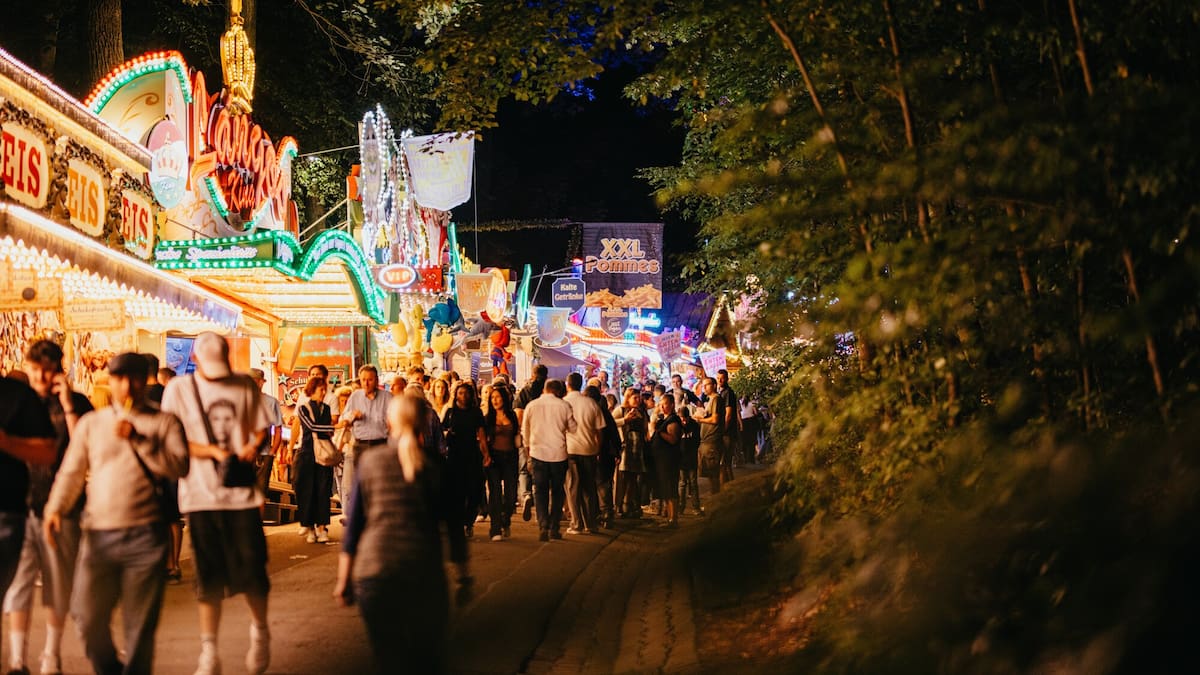
During Annafest, dozens of local breweries set up shop next to these subterranean caverns, packing them with barrels of their beer and transforming leafy clearings into beer gardens filled with wooden tables that transform into impromptu dancefloors during stein-waving singalongs.
When I arrive at Nuremberg Airport for my second visit to the 10-day festival, the border agent asks the reason for my visit. I reply that I’m heading to Annafest, and he seems confused, keen to know how I’d heard about it. When I explain it’s my second time, he looks positively baffled.
Later, I hop on the train to Forchheim, squeezing alongside other stein-swinging passengers heading to the festival on the first day, which kicks off with a ceremonial tapping of the first beer barrel. Many of the women have donned their dirndls (a folk dress regarded as national dress) while the men sport lederhosen.
A reveller balances a haul of foaming steins at Annafest. Photo / Tamara Hinson
Elsewhere, other passengers (all of whom are German) offer reminders that this is a festival which, unlike Oktoberfest, is an absolute hit with locals. My fellow Annafest-bound passengers include families, teens and pensioners clutching chipped steins which have clearly seen multiple Annafests.
I end up squeezed next to a girl who’s colour co-ordinated her gel nails with her schurze (the apron-like garment worn over dirndls) while her friend, sporting piercings in her lips and nose, has accessorised her traditional dress with biker boots.
I arrive at Annafest, where the process is simple: hit the footpaths criss-crossing the Kellerwald and head to the first bar (each bar is run by a local brewery and only serves that brewery’s beer) and order your drink, paying an additional deposit of €5 ($9.70) for a returnable ceramic one-litre stein. And repeat.
Beer garden tables fill beneath Kellerwald’s shady beech trees. Photo / Supplied
The ordering part, that is — your deposit and stein are returned when you leave, and the process begins again at your next watering hole, often just metres away. Tables and benches are very much communal.
Being a Brit, and hailing from a nation that takes personal space seriously, I initially struggle with this concept, but by the time I’ve drained my first stein, I’ve swapped numbers with two locals who’ve offered recommendations for another lesser-known German beer festival.
Crowds dance as a band plays on Annafest’s forest-side stage. Photo / Supplied
One of my favourite moments occurs as I wander past a brewery bar with a band playing traditional Oompah music to a crowd singing along to every word.
I turn the corner, and I’m hit by a wall of sound courtesy of the lederhosen-wearing punk band belting out Rage Against the Machine’s Killing in the Name to the rapturous revellers below, many of whom are achieving the impressive feat of furiously headbanging while ensuring their foamy steins stay upright.
A ferris wheel rises above Annafest’s woodland funfair. Photo / Supplied
I’m cautious about advising readers to head to Annafest because part of me doesn’t want the wider world to cotton on. I want to urge them to stick with Oktoberfest and its 10,000-capacity tents, even though Annafest is infinitely more fun, significantly cheaper and has a glorious woodland setting.
And everyone is wonderfully, ridiculously friendly, including the policeman I spot scooping a reveller out of the Kellerwald’s bushes. In fact, I take it back. Don’t go to Annafest. Go to Oktoberfest instead. You (and the six million visitors who attend every year) will have an absolute blast, I’m certain.
Details
The next Annafest will take place from July 23 to August 2, 2027.
This year’s Oktoberfest in Munich runs from September 19 until October 4.
The writer travelled at their own expense.