
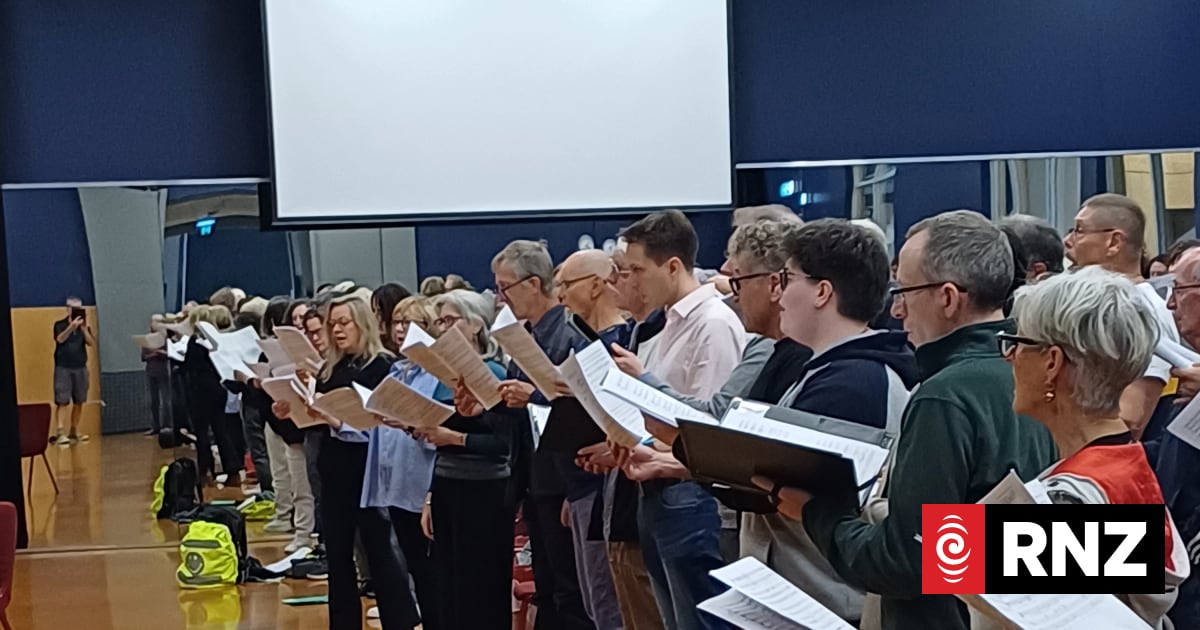
Musicians from bands, choirs and orchestras are worried a fresh round of public service cuts will mean the disappearance of a much-loved sheet music hire service.
Confusion and fear over National Music Library threat
There has been a chorus of complaints from choirs, bands and orchestras around the country, worried they’ll be cut off from a national service that delivers free or cheap sheet music.
Their message – don’t get rid of the National Library Music Hire Service.
The alarm was raised in a proposal put to National Library and Archives staff about cuts to the wider workforce. Among the 49 positions to be disestablished was the experienced librarian who looks after the sheet music collection.
The wording in proposal documents sent out to employees was carefully couched in corporate human relations language.
“Due to our financial pressures we are proposing to cease the music access service as it is currently delivered,” it said. “We would work with kaimahi to consider what transition arrangements may be needed to minimise customer impact, including assisting customers to move to alternative services.”
The Department of Internal Affairs denies that means the service will be discontinued, saying in a statement to The Detail there has been some misinformation about its future circulating through news and social media.
The statement, to be attributed to National Librarian Rachel Esson, says suggestions the service is proposed to be stopped are not correct.
“The National Library is proposing changes to how the Music Hire Service continues to be delivered,” it said.
“I would like to reassure you the Music Hire Service is not being discontinued.
The change proposal currently with Archives New Zealand and National Library staff is focused on the delivery model for the service and how it can continue to meet user needs sustainably.
The value of the collection and role the service plays for musicians, choirs, orchestras, schools and community groups is well understood.
While consultation with staff continues, we will not comment further until their feedback has been received and final decisions are made.”
But to the PSA, the change proposal contained a black and white message, and National Secretary Fleur Fitzsimons says people are right to be worried.
“It is very clear, there has been no misinformation,” she tells The Detail.
“The reality is, the change proposal document and the communication to staff says the proposal is to cease the music access service.”
Fitzsimons calls it a form of cultural vandalism and says it’s the second time the government has had a go at axing the service.
“We’ve just been overwhelmed by this government’s cuts to the public service,” she says. “They have been consistently decimating government departments and we’re seeing the impact every day … and what we know is that we’re going to see the impact for generations to come. It’s not just in the short term.”
Fitzsimons says choirs and orchestras all over the country access the music library.
“What this change proposal is doing, is looking to dismiss the people with the expertise that our orchestras rely on, that our choirs rely on, that genealogists and historians rely on. We’re losing the people that do this work and their expertise. It is dangerous for New Zealand.”
The gap between what people are reading into the change proposal and what the DIA is saying has confused and upset creatives all over the country. They’re bombarding the ministers of Internal Affairs (Brooke van Velden) and Arts, Culture and Heritage (Paul Goldsmith) with letters appealing for a reprieve.
One high profile objector is former RNZ Concert radio host, now the chief executive of the New Zealand Choral Federation, Christine Argyle.
“People are really worked up about it,” she says.
“I think it’s great the messaging that’s coming out of National Library now is, ‘no, no, we’re not going to stop the service’. That’s great to hear. I would contest that wasn’t necessarily off the cards when they first wrote that proposal document but it’s great to hear they’re saying the service will continue.
“But we’re still really concerned about the lack of consultation with users of the service as to what a new delivery method might look like, what it would involve.”
Hiring scores from overseas can run to thousands of dollars, and because they’re heavy pieces of paper, the freight is very expensive. If small organisations had to resort to that, many wouldn’t be able to put on their productions.
Some of the music stored in the National Library wouldn’t be available overseas because they are New Zealand artists, including notably the Douglas Lilburn collection.
The library’s origins came when RNZ transferred its own library of sheet music to it in 1987 in order to preserve it. At the time it was one of the most valuable collections of its kind in Australasia. There are now more than 4,700 orchestral sets, 2500 plus choral sets and nearly 600 for bands.
Argyle says it supports the performance of a wide range of music, and has also hired out New Zealand music internationally.
Former Prime Minister Helen Clark and Labour’s current spokesperson for Arts, Culture and Heritage, Rachel Boyack, have called on the government to pause the proposed changes to the Music Hire Service.
“These cuts will have an impact on thousands of New Zealanders who participate in choirs, orchestras and bands up and down the country, and those who attend their concerts,” says Boyack.
They will “have a disproportionate impact on smaller communities, who can’t afford to purchase music, or hire music internationally at much higher prices. It may also see the cost of attending a concert increase.”
“All New Zealanders should be able to participate in the arts. These cuts will cost communities and make the arts less accessible.”
Erica Challis is a choir singer, horn player and the orchestral librarian for Orchestra Wellington, and is in charge of ordering the music the musicians play and doing the budgets for that. She says the National Library costs are around a tenth of what they would pay elsewhere.
“The smaller organisations, they run on the smell of an oily rag,” she says.
For example, ordering a Gershwin piano concerto from Germany would be $1300, with freight another $100 each way.
“If National Library have that music it will cost you $44 dollars,” she says. “It would absolutely break some of those small groups.”
Challis says when you look at a culture historically, “you don’t think about their trade deals or how great their infrastructure was. You know them as a culture by their art, by what they wrote, and in the more recent cultures by the music they made. That tells us who a people are.
“And if we can’t make music, if we can’t have the arts, if we can’t express ourselves, then how do we actually know who we are? And how will we be remembered as a society?”
All the music in the podcast today was performed by kiwi musicians and recorded by RNZ.
All the music played in the podcast today was performed by Kiwi musicians and recorded by RNZ.
+ O fortuna, from Carmina Burana (a frequent hire from the National Library) performed by the Orpheus Choir and Orchestra Wellington
+ Robert Wiremu’s Tahuri koe kie performed by Voices New Zealand and Wellington Young Voices
+ Handel’s Messiah, All we like sheep – a piece that’s borrowed annually by many choirs and performed here by The Tudor Consort and NZSO
+ massed choirs from this year’s Big Sing Gala, Hine e Hine from Princess Te Rangi Pai
+ Wellington Brass Band/David Bremner performing Gabrielli Fantasy
+ Overture Aotearoa by Douglas Lilburn performed by the NZSO
Check out how to listen to and follow The Detail here.
You can also get in touch with us by emailing thedetail@rnz.co.nz