
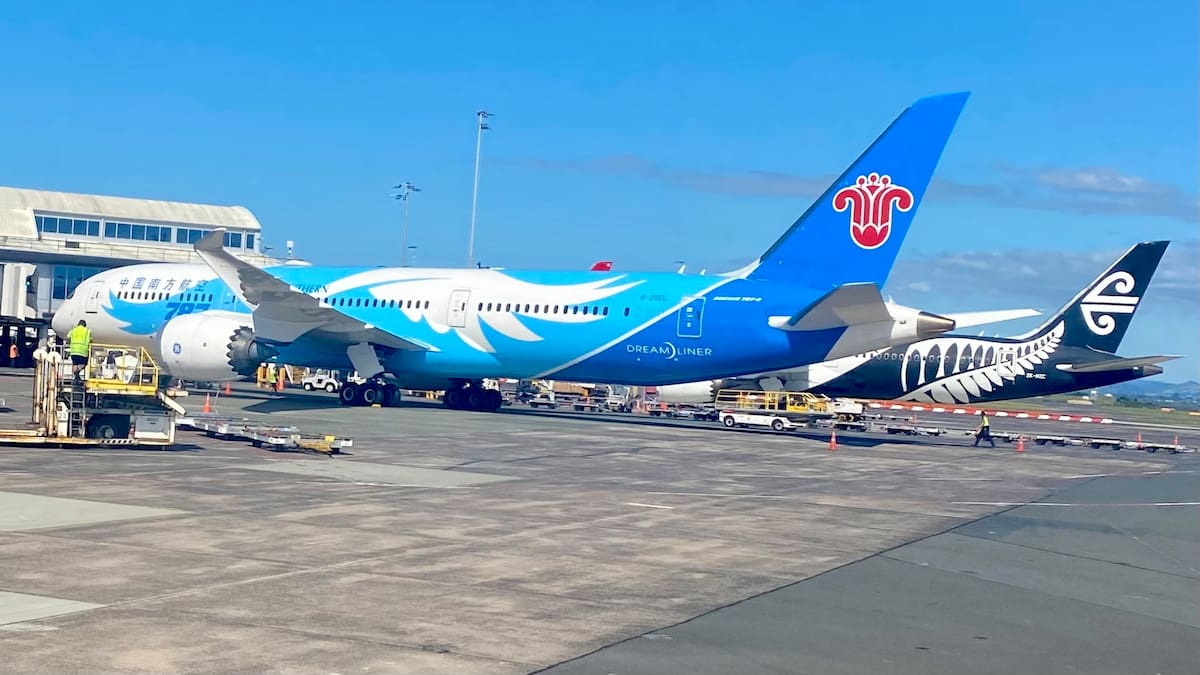
He credited increased flight connectivity and capacity and visa changes as three of the main drivers.
Callaway said international airlines like China Southern have created direct flight links between New Zealand and China since 2015.
The airline is based in Southern China and offers direct flights from China’s five major cities: Beijing, Shanghai, Wuhan, Guangzhou and Shenzhen. This creates a connection which draws from “a huge pool of people”.
Christchurch Airport’s Scott Callaway said the introduction of a “visa-free” scheme for Chinese travellers coming to New Zealand from Australia “was the cream on top”.
But increasing flight capacity “is a huge part of us being successful”, Callaway said.
Over the past year until June, China Southern brought 65,994 passengers to Christchurch Airport – a figure it aims to increase by a further 57% this northern winter period, from October to March.
“It’s one thing to have a plane with lots of seats on it, but to actually be able to fill those seats is really good,” Callaway said.
Callaway said that changes in New Zealand’s visa policies also provided a “huge boost”.
In November 2025, the Government launched a 12-month trial allowing Chinese passport holders to travel to New Zealand visa-free if they have an eligible Australian visa and arrive directly from Australia.
Instead of applying for a visitor visa, eligible tourists can travel to New Zealand for up to three months with a New Zealand Electronic Travel Authority (NZeTA).
Callaway said this “was a relatively minor change in position that had a really strong result”.
He said since the visa-free scheme’s introduction, Christchurch Airport has seen a boost in travellers from China, as well as indirect travellers from over the Tasman. These include Chinese passport holders in Australia, such as university students and those on working visas.
“It’s all doing well, but that was the cream on top.”
Many South Island tourism operators have also experienced this boost from the Chinese market.
Elijah Robinson from Lake Tekapo’s Dark Sky Project said the company has “definitely had an increase” in Chinese visitors.
Lake Tekapo’s Dark Sky Project has seen the biggest increase in Chinese visitors over the past two years, as visitor numbers have returned to pre-Covid levels.
The stargazing company saw the biggest change over the past two years, where “we’ve been looking at the same numbers as pre-Covid”.
Robinson said he had seen a shift towards the outdoor experiences Dark Sky offers, as New Zealand’s natural environment appeals to Chinese travellers.
“They’ve always been into the outdoors, but we’ve also historically had groups coming through and doing an indoor experience as well, which is more culture-focused,” he said.
“But recently, over this past year, we’ve seen a bit of a decline in that area.”
Robinson said advances in technology meant the company could not necessarily compete with attractions in China on technology alone, but New Zealand’s natural night skies were difficult to replicate.
“They’ve got an admiration for the outdoors, for the multicultural and for the night sky, because they don’t get that over there.”
Robinson said their presence on Chinese social media platform RedNote has helped push business. Some of their experiences, including visiting the Astro Café at the summit of Ōtehīwai/Mt John have gone “viral”.
Dark Sky Project experiences like the Astro Café have gained traction on Chinese social media platform RedNote, bringing in more visitors.
Multiple RedNote users have posted photos of Astro Café, featuring panoramic views of Lake Tekapo and coffees topped with planet-inspired latte art.
This growing interest in outdoor experiences is also being felt further west, where glacier operators are seeing Chinese visitors return to the ice.
Rob Jewell, who manages Mt Cook Glacier Guiding and is the CEO of Fox Glacier Guiding, has been involved with the China market since 2007.
He said up until Covid-19, China was New Zealand’s second-largest visitor market, accounting for about 35% of visitors to Fox Glacier.
Since the pandemic, the Chinese market has made up 30% of the business.
Jewell said it continues to increase, but has been a “little bit slower to return since Covid”.
He said Southeast Asian visitors account for 65% of Fox Glacier Guiding’s heli hike visitors and 80% of Mt Cook Glacier Guiding’s visitors.
“Glaciers aren’t easily accessible for them, and neither are helicopters.”
The most important part of attracting international tourists is “being China-service-friendly”.
Hiking on Fox Glacier. Photo / Tourism West Coast
Websites translated into Mandarin Chinese, Mandarin marketing material and a social media presence on Weibo and RedNote are just a few initiatives the glacier guiding companies have.
Jewell also has a dedicated Asia business development manager, two Mandarin-speaking frontline staff and a basic Mandarin training programme for his guiding team.
“It just goes to show with that market that it’s important, we value them and we like having them in our business,” Jewell said.
“Just make your business China-service-friendly, keep them happy and they’ll keep spreading the good word and they’ll just keep coming,” he said.
For Chinese visitors, the decision to visit New Zealand can be made long before they arrive, with recommendations and advertisements on social media.
Ivy Zhang, visiting Christchurch from Shanghai, said online recommendations helped shape her family’s itinerary.
On a girls’ trip with her daughter and cousin, Zhang said, “There are some commercial advertisements. They recommend everything for us. We just follow their decisions.”
Ivy Zhang (from left), her daughter and her cousin chose to visit New Zealand after following recommendations from commercial advertisements. Photo / Indiana Bell
The group had seen a lot of recommendations on RedNote for things to do in the South Island and Queenstown.
“A lot of people follow these recommendations,” Zhang said.
But while social media can help Chinese visitors decide where to go, the experiences themselves remain the biggest drawcard.
The Li family, visiting Christchurch from China, said New Zealand’s natural beauty and outdoor experiences appealed to them.
“New Zealand is a beautiful country and has a lot of wild spots,” Sean Li said.
“We can see a lot of stars in the night, the air is fresh and we can see a lot of different kinds of animals.”