
His former co-defendant, Shu Man Poon, pleaded guilty to two counts of murder last year and spent four days in the witness box at the current trial giving evidence against his former church friend.
Defence lawyer Paul Dacre, KC, pointed to multiple contradictions in Poon’s testimony yesterday as he suggested the 45-year-old was the ringleader who influenced his younger friend to participate in a thrill killing.
“You fulfilled your fantasy by killing Mr and Mrs Kwok,” the defence lawyer told the witness.
“That is incorrect,” he responded.
Lok Fung Lorrence Li, 27, is on trial in the High Court at Auckland, accused of the double murder in November 2023 of Ellerslie residents Fuk-Fu Joseph Kwok (top inset), 66, and his wife Mei Han Chong, 67. Photo / Michael Craig
Dacre continued: “The reason you’ve done that [blamed Li] is you are hoping your sentence for murder is reduced.”
Poon again said the lawyer was incorrect.
Prosecutors have said the only motive for the killing appears to have been a minor traffic accident between Li and Kwok 10 months earlier that resulted in a Disputes Tribunal case.
Kwok and his wife were killed shortly after their address was divulged to Li as part of the discovery process for the tribunal case.
Li and Poon were also accused of having plotted to kill Li’s former landlord before pivoting their murderous plan to Kwok’s household.
During today’s testimony, the DNA analyst also pointed to statistics linking Poon to the scene. A bloodstain on the back bumper of Poon’s vehicle was found to be 500 billion times more likely to be Chong’s than another random person, Parsons said.
Poon’s DNA was also on the handle of the tomahawk that was found at Li’s house. Poon said last week both men had taken turns striking Kwok with the weapon.
Prosecutors placed the tomahawk, secured inside a thick transparent plastic box, on the ledge of the witness box today as pathologist Sinead McCarthy shared her findings about how Kwok died.
A tomahawk used in the killing of an Ellerslie couple inside their Auckland home is displayed for jurors behind a glass case in the High Court at Auckland. Photo / Craig Kapitan
His main cause of death, she said, was stab wounds consistent with a tomahawk that damaged his aorta and a lung.
“They would have caused significant bleeding [and] would have been rapidly fatal,” she said.
Kwok suffered five stab wounds in total, as well as “significant” blunt force trauma to his head and pellet wounds to his forehead and the back of his head. Poon claimed Li was solely to blame for firing an air gun at the couple and for stomping both of their heads after they fell to the ground.
Kwok’s head injuries, which included “blow out” fractures to both eye sockets and his nose, were the result of multiple strikes, the pathologist surmised.
“The blunt force injuries to the face were also significant … and could themselves have been fatal … had he not sustained the injuries to the chest,” McCarthy said.
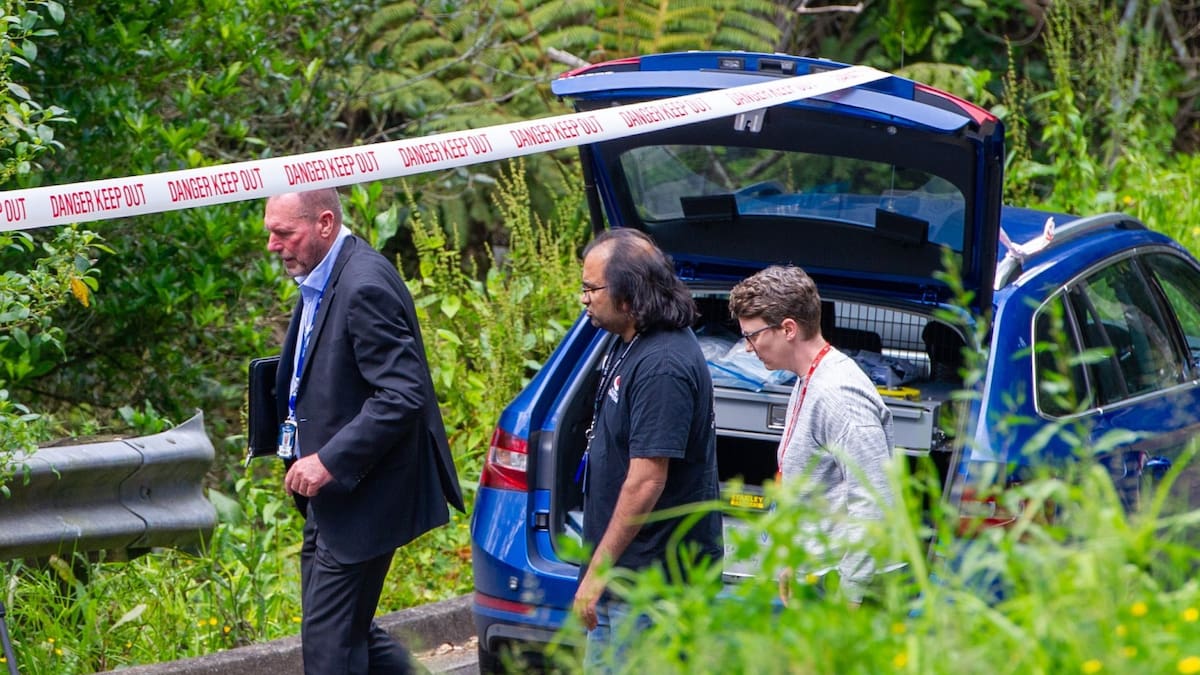
Detective Inspector Scott Beard (from left) and pathologists Kilak Kesha and Sinead McCarthy visit the bush area in Greenhithe where the body of Mei Han Chong was found in November 2023. Photo / Jason Dorday
Fellow pathologist Kilak Kesha, who examined Chong after her body was discovered already partially decomposing in the bush, determined her cause of death to have been blunt force head injuries. He counted 45 lacerations, abrasions and contusions overall, as well as a neck fracture.
“They’re all over her body, on every extremity, every surface, front and back,” he said.
Chong’s head injuries were so severe the tissue between the two hemispheres of her brain was torn, Kesha said, explaining such injuries are typically seen in car accidents, falls down stairs and stomping incidents.
The trial is set to continue tomorrow. It has been scheduled to last through the end of the week.
Craig Kapitan is an Auckland-based journalist covering courts and justice. He joined the Herald in 2021 and has reported on courts since 2002 in three newsrooms in the US and New Zealand.