
What happened was something Houston had never experienced in his 27-year career with horses. The horse launched itself into the air and flipped over backwards, landing on him.
“I’ve been on thousands of horses and been on horses that have reared, bucked, pulled, done everything, but I’d never experienced anything like this. There was no warning. One minute we were riding along and the next minute I had a horse on top of me. I felt everything in me breaking.”
Houston went to call 111 but his phone was smashed.
“I’ve since learnt that I could have used Siri to call 111 for me. We’ve tested it and it turns out that while the phone looked broken, it was still working. I wish I’d known that at the time.”
Instead, Houston hoped the horse would run home, alerting his young apprentice Leroy that something was wrong.
Steve Houston suffered severe injuries in an accident while riding at his property in Loburn, North Canterbury.
“Eventually I managed to get on to my knees and looked up to see the horse a little way down the paddock eating grass. That’s when I knew my only choice was to walk home,” he said.
The 1km walk was excruciating.
“I think it was the adrenaline that kept me going. My tummy was starting to get hot, so I had a fair idea I was leaking blood somewhere.”
By the time Houston got home, he couldn’t talk. His hand gestures said it all. Leroy called 111.
A first responder from Hato Hone St John arrived, but it was clear Houston needed the critical care and speed of a rescue helicopter.
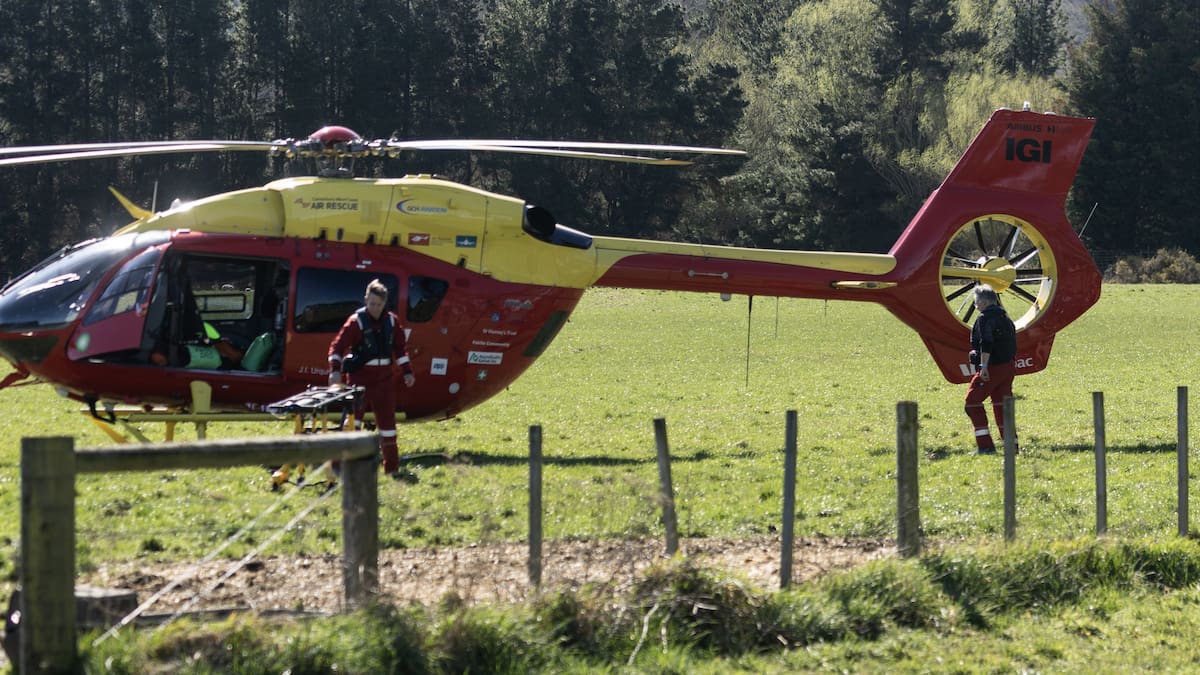
Leroy spoke with emergency services to direct the Westpac Rescue Helicopter to land at a neighbouring property, away from their young horses, and drove a quad bike to the helicopter to pick up critical care paramedics Juliet and Shane.
“The rescue helicopter crew brought a sense of calm to the scene. I was not in a good space but as soon as they started doing their thing, I closed my eyes and tried to relax. It was business time. The experts were there,” Houston said.
Juliet used a portable ultrasound machine to scan Houston’s belly, giving greater insight into the damage. Houston was given pain relief and then taken to the helicopter. He needed to get to hospital urgently.
Houston’s memory of the helicopter ride is a little blurry. Once he arrived at hospital, the team there sedated him so they could ascertain how many injuries he had. The list kept growing with every new scan.
Houston had broken 17 ribs, all 12 on the left-hand side.
“My left-hand side was mangled – there was nothing holding me together.”
Steve Houston catches up with the Westpac Rescue Helicopter crew who came to his aid.
Houston broke his collarbone, sternum and shoulder, and ruptured his kidney, liver and spleen in the incident. He also ruptured an artery that ran into his abdomen, which accounted for his hot tummy, and had trauma to his large bowel.
“I had all these different teams at the hospital. A bone guy, an organ guy, this bowel guy,” he said.
“They were doing all sorts of stuff, negotiating who got to operate first and figuring out how to fix me.”
Surgeons used five plates and 30 screws to reconstruct Houston’s ribcage. He was kept in an induced coma for 18 hours after the surgery. After 10 days in hospital, Houston continued his rehabilitation at home. It was challenging, but slowly his body healed.
In July, Houston had a further operation to remove the metal that had been holding him together. Since then, he has felt great.
To this day, Houston doesn’t understand why the horse reacted the way it did. When he sees a Westpac Rescue Helicopter in the sky, it takes him back.
“I get a chill when I see a red helicopter. I know someone’s in a bad way, but I’m 100% glad they’re getting the expert help they need,” he said.
“The rescue helicopter crew were incredible, absolutely awesome. I can’t thank them enough for how well they cared for me.”
From January to August this year, the Canterbury Westpac Rescue Helicopters have been called out on 438 missions – 24% of them to North Canterbury. 43% of missions have been for accidents, 23% are for medical emergencies, 21% are for urgent patient transfers and 7% are for search and rescues.