
If politicians had expended half as much effort trying to save our manufacturing base as Sting has in reworking The Last Ship, his ambitious 1980s-set musical lamenting the decline of the shipyards in his native Tyneside, perhaps we would still have a robust shipbuilding industry. After multiple iterations, including a short run on Broadway in 2014, his passion project, into which he has poured his heart, soul and dosh, has been refitted with a few new songs and a fresh book. As it briefly docks at Theatre Royal Drury Lane, with Sting himself in a lead role, it’s worth saluting the venture (and applauding its decent tunes), but it lacks a sufficient feel-good factor and goes overboard in its scale.
The 74-year-old star, born Gordon Sumner, has recalled growing up on a street in Wallsend under the shadow of the shipyards – and the actors here are dwarfed by the giant bow of a vessel, projected onto a customised screen, the effect of which is both awesome and oppressive. Visually, this is no sentimental portrait; apart from a swaying chorus-line of strikers, dance isn’t on the agenda. The evening, directed by Leo Warner, nails its gritty colours to the mast early on: simulated sparks fly as welders tend to the ship on scaffolding, amid a clanking din.
This life can crush and kill, but a whole world depends on it. When ruthless (boo-hiss Tory) politicians look to close down the shipyard as uneconomic, the fightback begins. Hope builds, in the form of the ship that meets our constant gaze: the “Utopia”.

The actors are dwarfed by the projected image of a ship, which is both awesome and oppressive in scale – Nienke de Groot
Playwright Barney Norris, drafted in to give the book another look, has stated that he felt it best to keep “out of the way of the music”. But I think he should have fought harder to trim the 25 or so numbers; although many are rousing, they lack the irresistibility of Sting’s best pop, or musical theatre at its epic finest.
We need to fix our sympathies on individual protagonists but though Declan Bennett’s haunted Gideon, returning home after 17 years, and Frances McNamee’s hard-bitten publican Meg, the girl he abandoned (and who had his child), warble about their emotional conflicts in a spirited fashion, as characters they feel rather generic.

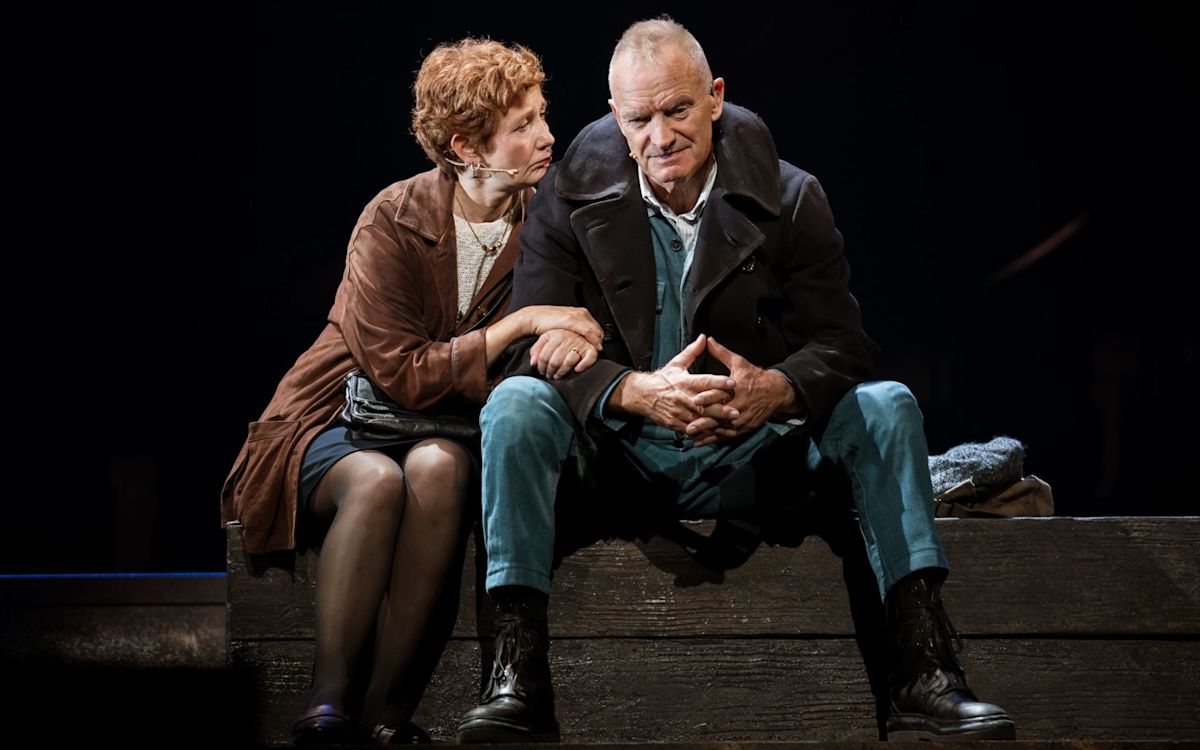
Reclaiming his Geordie accent, Sting sings half a dozen songs with a noble, steadfast air – Nienke de Groot
Reclaiming his Geordie accent and singing half a dozen numbers with a noble, steadfast air, a boiler-suited Sting ushers in welcome pathos as the dying foreman Jackie (joined by the reggae star Shaggy, at the opening performances, as a supernatural, somewhat superfluous “Ferryman”). Enlivening the scene, too, there’s a literary-minded worker and a feisty union rep.
Yet, this ensemble endeavour never escapes the shadow of its creator. Tyneside has one of our richest working-class songbooks, but that’s left untouched; are these folk singing from deep within or simply because they’re in a Sting musical? His presence, and his fans, will keep The Last Ship afloat in this far from blue-collar venue. But if Sting’s ambition is to fashion a show that will last, it’s a case of: back to the drawing-board.
Theatre Royal Drury Lane, London WC2 (thelastship-musical.com), until October 3