
Five proposed policy principles outline the action being sought from the Government.
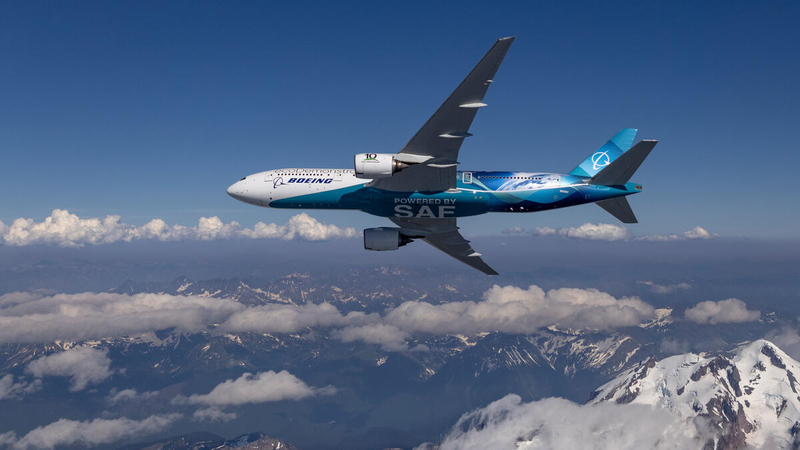
Pictured above: Boeing’s eco-Demonstrator flies on the highest available SAF blend. Photo / Supplied
A group of major aviation, aerospace and transport energy companies has stepped up calls for government action on sustainable aviation fuel (SAF)*.
The New Zealand SAF Industry Roundtable has presented five principles to ministers in an effort to guide the government’s approach to SAF:
putting New Zealand’s national interest first;aligning with regional developments while recognising New Zealand’s unique market and fuel security needs;providing clear and coordinated policy leadership;creating the conditions for investment and infrastructure development; andbuilding SAF readiness through strong industry-government partnership across the entire value chain.
The push comes as Australia progresses a range of renewable fuels, also known as low-carbon liquid fuels, initiatives. This includes consultation on demand-side measures and work to strengthen certification and emissions accounting systems, following its A$1.1 billion commitment to low-carbon fuel production last year.
Made from renewable or waste materials, SAF can be blended with conventional jet fuel for use in existing aircraft within approved limits. But it remains scarce and substantially more expensive.
“One of the clearest messages coming from international markets is that policy matters,” says Z Energy general manager of corporate affairs Haley Mortimer.
“We’re seeing SAF deployment is generally occurring where governments have provided clear and predictable policy frameworks.”
Mortimer says July’s SAF APAC Summit in Melbourne showed SAF moving closer to deployment in the region, particularly where policy has created demand and investment certainty.
For New Zealand, Australia’s progress presents both an opportunity and a risk. Australian production could eventually help to supply New Zealand, although delay could leave this country competing for investment and feedstocks.
The Roundtable brings together airlines, airports, aircraft manufacturers, fuel suppliers and infrastructure companies, including Boeing and Z Energy (Z). It wants a Government-led approach with coordination across the agencies involved.
Its principles seek clarity on how SAF is treated under the Emissions Trading Scheme, clearer certification rules, and an assessment of New Zealand’s production potential and infrastructure. It also supports cooperation with Australia that reflects New Zealand’s smaller market and fuel security needs.
The principles do not amount to a finished SAF readiness plan or specify a mandate, subsidy or requirement to use SAF.
“This isn’t about finding a perfect solution,” Mortimer says. “It’s about taking the next practical steps, bringing the right people together, and creating the conditions for investment and supply to develop over time.”
She says any requirement to use SAF would need to be matched by measures to increase supply. Otherwise, airfares and freight costs could rise more than they otherwise would, with passengers and businesses bearing at least some of the cost.
Publicly released advice shows the then-Energy Minister Simon Watts approved a SAF work programme in November 2025. By March this year, the Ministry of Business, Innovation and Employment (MBIE) was preparing talks with industry and Australian officials.
Mortimer says the programme was understandably put on hold as officials dealt with this year’s global fuel crisis.
New Zealand imports all its jet fuel and depends heavily on aviation for tourism, high-value exports and international connections.
In September 2022, Z imported 1.2 million litres of SAF for Air New Zealand through Marsden Point and the supply chain to Auckland Airport. The shipment showed the existing import and distribution system could handle SAF.
A 2025 Cyan Ventures study, supported by Boeing and Air New Zealand, modelled four pathways, including domestic SAF meeting 30% of the country’s jet fuel needs by 2050. Its conclusions are Cyan Ventures’ own, and the figures are modelled scenarios rather than forecasts.
It estimated this pathway could generate $1.3 billion in gross value added and create 5700 jobs by 2050, and that delaying that modelled pathway by five years could reduce the economic benefit by about $1 billion by 2050.
“There’s no debating the fact that this does cost money to set up a new industry,” says Dr Kimberly Camrass, who leads Boeing’s sustainability work across Asia-Pacific and India.
“But when we look at a holistic return-on-investment analysis, there’s more of a cost to delaying this for New Zealand.”
The report also says SAF could safeguard $4.1 billion in tourism revenue by 2050. That assumes 1% of tourism activity might otherwise be lost because of concerns about aviation emissions, though the report acknowledges there is limited evidence of how many travellers would change their plans.
The study estimated a 5% SAF blend in 2030 could add $0.60-$2.30 to a one-way Auckland-Wellington fare, and $1-$3 to an Auckland-Christchurch fare, with these costs being limited only if appropriate policy measures are in place. The increase would be materially higher on long-haul flights.
Camrass says policy design will determine how the additional cost is shared.
Z and Boeing agree imports will form part of New Zealand’s SAF supply, but differ on how much emphasis to place on producing it here.
“If you’re solely reliant on importing SAF, you can still experience the emissions reduction benefits associated with that fuel,” Camrass says.
But Boeing says domestic production could also create jobs, develop industrial capability and give New Zealand greater control over its fuel supply.
“You have the building blocks in New Zealand to really build this industry,” Camrass says.
However, Z sees opportunity across the Tasman.
“From Z’s perspective, our current view is that SAF is unlikely to be produced economically at scale in New Zealand,” Mortimer says.
“That’s why we see value in policy settings that support regional supply chains and investment opportunities across the Tasman.”
Z’s parent company, Ampol, is working with IFM Investors and GrainCorp to assess a renewable fuels facility alongside its Lytton Refinery in Brisbane, which could potentially supply renewable fuels to New Zealand in the future.
The proposed facility could produce up to 750 million litres of SAF and renewable diesel annually, although no final investment decision has been made.
Mortimer says complementary policy settings could help unlock a broader trans-Tasman supply chain, creating the conditions for investment, production and supply, rather than simply enabling imports. Renewable fuels produced in Australia could, over time, be supplied into New Zealand, while refineries in Southeast Asia may also provide another possible supply source.
“We’d welcome New Zealand being a fast follower on policy,” Mortimer says. “There is an opportunity to build on lessons from Australia, but any framework needs to be designed for New Zealand’s market, customers and supply chains rather than adopted wholesale.”
*SAF is an industry term used for a form of alternative jet fuel made using feedstocks such as forestry residues, municipal waste, or used cooking oils with the goal of reducing the lifecycle carbon footprint of jet fuel. SAF is most typically used by international airlines when blended with conventional jet fuel to form part of the overall fuel mix and is considered as a ‘drop‑in’ fuel, meaning it can be used in an existing aircraft fleet.