
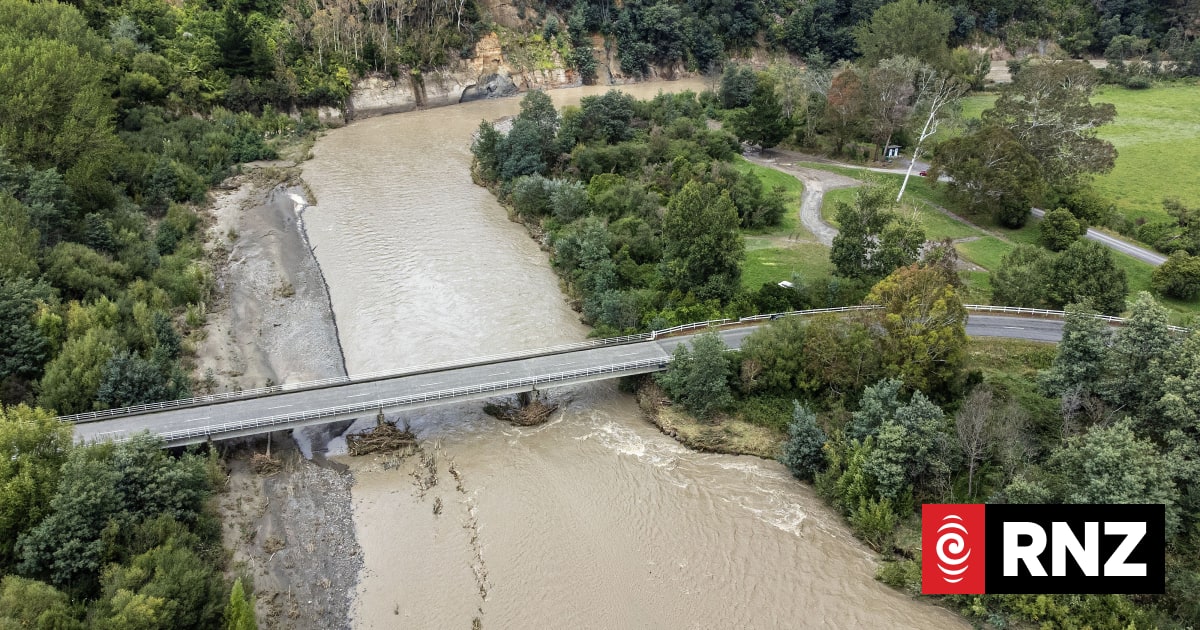
An investigation into two Manawatū-Whanganui rivers that flooded during Cyclone Gabrielle has brought landowners in the area some long-awaited guidance.
The Horizons Regional Council finished a nature-based solutions investigation on the Pohangina and Ōroua rivers, concluding they would continue investigating a “room for the river” approach, giving rivers more space to flood safely.
The then Ministry of Environment granted $300,000 for investigations into the channel symmetry, alignment and changes of the two rivers following Cyclone Gabrielle in 2023.
Peter Wells, chairman of the councils integrated catchment committee, said “this allowed us to conduct a study looking at how nature-based solutions, commonly known as the ‘room for the river’ approach, could be applied to the Ōroua and Pohangina rivers.”
Wells said the report was “one component of work” within the catchments and he acknowledged landowners in the area were “impacted heavily” by the destruction brought about by Cyclone Gabrielle and more recent weather events.
Jon Roygard, group manager of catchment operations, said the “room for the river” approach was a flood management strategy which focused on allowing natural river floodplains to move and shape.
“This strikes a balance between allowing space for the river to move, while still allowing for investment into hard engineering to protect people, property, businesses and infrastructure,” Roygard said.
Each catchment had a unique character according to Roygard and catchments around the motū were at various stages of implementing or investigating the approach.
The approach analysed “historic channel positions, geology, river processes, community and cultural values, and existing infrastructure within the floodplains” to then develop future-forward river management approaches and a fuller understanding of individual river channel habits, Roygard said.
He said this information was used to create a river management “envelope” – with the inside of the envelope capturing management lines, channel and buffer zones which were mapped out carefully to guide the council’s river management and improve efficiency, while areas outside the envelope were identified as being suited to more intensive river management works.
The regional council would continue investigating and engaging with landowners, and planned to explore the nature-based solutions approach in the lower Rangitīkei River.
Meanwhile, a more high-level scientific analysis would occur in the Mangatainoka River catchment and likely take years to complete.
LDR is local body journalism co-funded by RNZ and NZ On Air.