
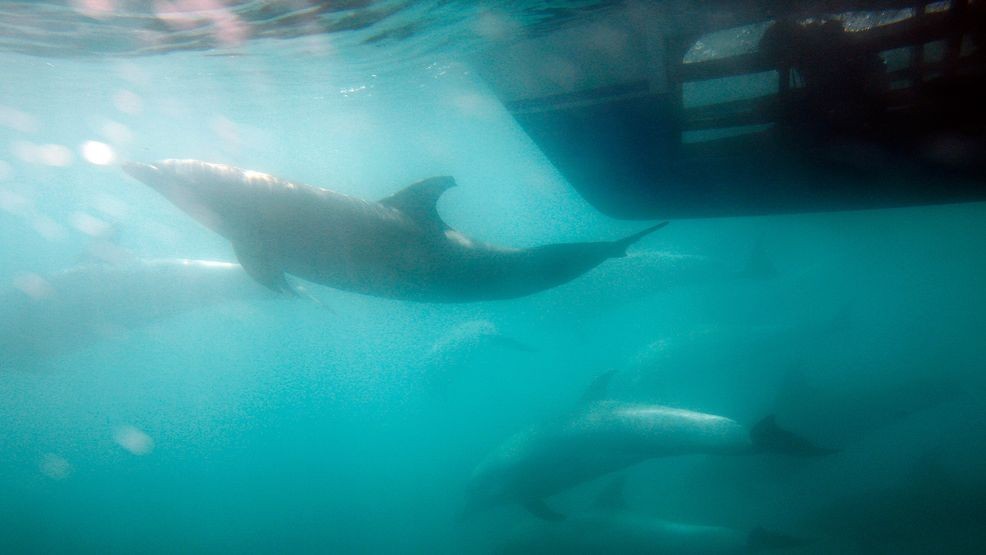
A bottlenose dolphin nicknamed Bubbles chases fish near Australia’s Great Barrier Reef until they throw up their meals — and then he eats the regurgitated food.
The behavior was documented in the journal Ecology and Evolution on September 13.
The study noted that it might be the first direct evidence of kleptoparasitism — stealing food obtained by another animal — in cetaceans, which is the group of marine mammals that includes dolphins, porpoises, and whales.
“Kleptoparasitism, the deliberate theft of food from other animals, is a widespread but usually facultative foraging tactic used by many taxa,” per the study. “It has rarely been documented in aquatic species, particularly marine mammals.”
According to the study, researchers recorded 20 encounters between 2021 and 2025 near Lady Elliot Island. In 11 encounters, Bubbles pursued a Bigeye Trevally until it vomited. He then ate the food while the fish swam away.
“Using photo-identification, all observations were confirmed to involve the same individual dolphin,” the study noted.
The dolphin, known informally as Bubbles by Lady Elliot Island Eco Resort staff, can be recognized by distinctive fin notches and a V-shaped scar on his right flank.
Video showed the dolphin scanning schools of trevally, focusing on a single fish and mirroring its turns during close pursuit. Researchers also recorded intense echolocation click trains and low-frequency sounds while Bubbles chased individual fish.
The dolphin was observed repeating the sequence as many as 10 times in 30 minutes. Researchers said they did not observe him eating the trevally themselves.
Scientists said the behavior appears to be a specialized, solitary feeding tactic, though more observations are needed to determine whether Bubbles learned it alone or whether other dolphins use it there.
The researchers said the tactic could provide an energy-efficient alternative to independent hunting. But they cautioned that its profitability remains unclear without additional data on Bubbles’ broader foraging behavior.