
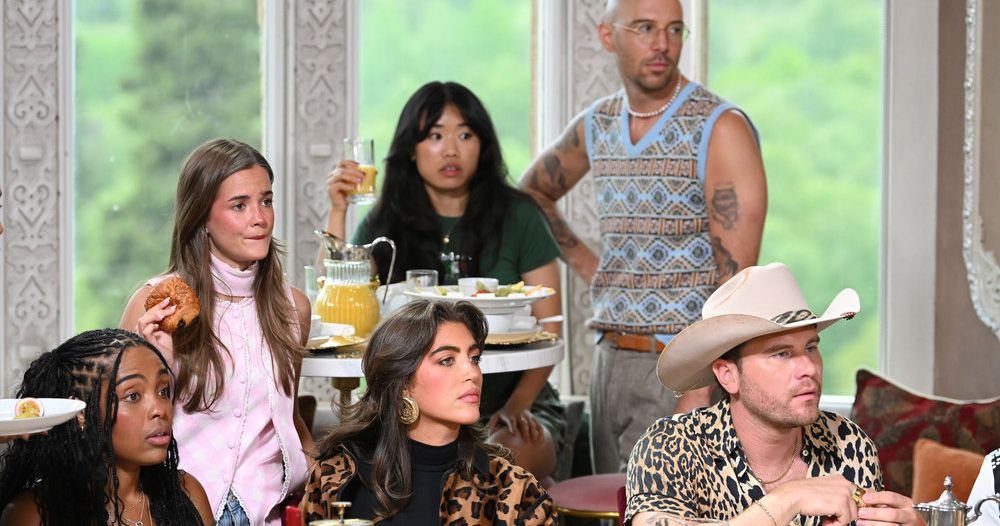
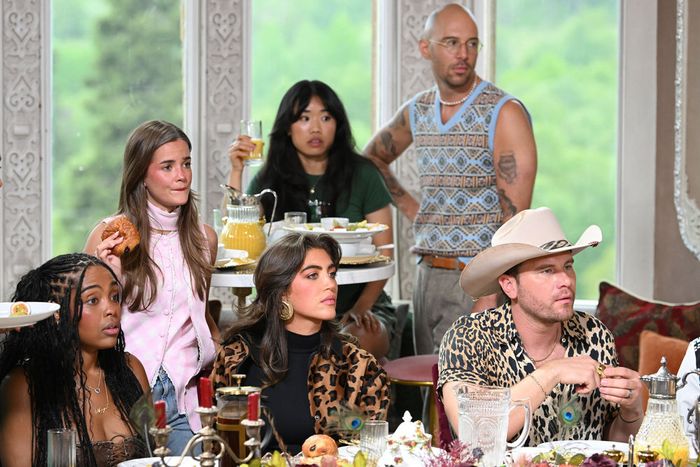
Last week, Alan Cumming’s cunning competition empire The Traitors unsheathed its most diabolical twist yet. After four seasons pitting RuGirls against Real Housewives and Love Islanders against Survivor castaways on Peacock, the castle welcomed 22 nonfamous fans to play the game in prime time on NBC with The Traitors: New Blood. Studio Lambert, the production company that films all the British and American versions of The Traitors on location at Ardross Castle in the Scottish Highlands, had already made four “civilian” seasons of The Traitors UK, filmed back to back with the American series. A civilian season for a U.S. network “felt like a natural fit” for the production team, explains director Ben Archard: “Once you’ve had so much success with something, it’s really nice to push yourself again. A new type of cast is a great way to do that.”
The result is a fresher, tighter version of the mischievous murder mystery with faster-paced episodes, a cast of unknowns vibrating with excitement, and an even more whimsical and campy tone than its sister series. It’s “part horror, part thriller, but also kind of part Harry Potter and fantasy,” says executive producer Mike Cotton. The season opens with the recruits meeting each other on a scenic train ride winding through the Highlands, a nod to the castle most Americans associate with the region: Hogwarts. And James and Oliver Phelps, who played the Weasley twins in the Potter series, now serving as Cumming’s groundskeepers. Archard, Cotton, and their colleagues explain how The Traitors made the leap to prime time.
When the U.S. Traitors premiered in 2023, contestants included both civilians and celebrities, from The Real Housewives of Beverly Hills’s Brandi Glanville to The Bachelorette’s Arie Luyendyk Jr. and Survivor royalty Cirie Fields, who would go on to win the whole thing. The three seasons that followed cast only celebrities, proven entities with big personalities, so populating New Blood presented a challenge: How to hook a brand-new audience without any recognizable faces? “We treated it like we were assembling a jury,” says executive producer Mike Cotton. “We wanted people from all walks of life that would have different skills they could bring to the game one way or another.”
In keeping with The Traitors’ Clue-like aesthetic, casting specifically sought out applicants with jobs that slotted them into murder-mystery archetypes. “You might have a lawyer,” Cotton says, or in New Blood’s case, a lawyer pretending to be a basketball coach; “a young starlet” — that is, a content creator — or “a writer, a classic murder-mystery character.” (One Faithful is an actual writer of murder mysteries.) But no one was locked into a particular role. The contestants “had no preconceptions of one another,” says Cotton. “They could turn up at that castle and be almost whoever they wanted to be.”
Each contestant ultimately had to pass what Cotton calls the “pub test”: Would you want to hang out at a pub with this person? In the case of gay Texan barrel racer Ben McDonnell or sassy 65-year-old novelist Sherry Kuehl, the answer is absolutely. Producers also wanted to ensure everyone in the cast was a fan of the show and invested in the gameplay. “We needed to know that they really knew the game inside out and were coming in with their own strategies,” says Cotton. Traitor Tomica Adams gave prime-time-level energy from the moment she walked onto set, eyes widening when talking to others on the train, screaming with glee when Alan emerged from a cloud of blue smoke, and, while sitting down for her entrance interview, pointing to the pile of gold doubloons, then to herself while waggling her eyebrows.
New Blood is the first Traitors show to air on American network TV, so it needed to appeal to a newer, broader audience that may not be familiar with the format while condensing the action into a 42-minute episode (much shorter than the flexible times allotted by Peacock and the BBC). “What we didn’t want to do for the shorter run time is pack everything in and lose the pacing,” says Cotton. The Peacock version of The Traitors usually follows a set cycle of one day in the castle: going to bed thinking you may be murdered, waking up to see who got eliminated at breakfast, then battling for your place, in your social game and in missions, so you don’t get banished at the roundtable. With New Blood, producers structured each episode to end on a cliffhanger. While that means some episodes don’t have every beat of the Peacock version, every episode will still include at least one roundtable. “That’s the heart of the show,” says Cotton.
New Blood sets itself apart from its Peacock counterpart because the civilians are much more invested in winning the $250,000 prize at the end of the show, “which made betrayal all the greater,” says Cotton. In many cases, they actually need the money: Faithful Abbey Benjamin hopes a win could help fund treatment for her daughter’s rare genetic disorder, while McDonnell wants to put the money back into his Texas farm. New Blood introduces new twists to gameplay to capitalize on that tension; this season, the Traitors have a $15,000 bounty on their heads, money that will be added to the prize pot every time the group banishes one. In recent seasons, savvier players have kept quiet at roundtables to avoid drawing attention to themselves. “Now, there’s a financial incentive for them to bring information to the roundtable and try to get someone out as quickly as possible,” says Cotton.
Field director Mark Drake, who oversees the New Blood missions, has heard the complaints about The Traitors’ structure. Before he joined the show, back when the U.K. version first started airing, “People would complain that they do all the interesting stuff in the castle, then ‘They go outside, they run around for a bit, and then they come back,’” he says. “For me, that can’t happen.” Thus, New Blood opens with one of the most creative missions yet, a massive pirate shipwreck in the loch that required the contestants to army-crawl through submerged decks to captains’ quarters, manhandle skeletons, avoid gunpowder explosions, and manipulate working elements such as a pulley to the crows’ nest. “You need the spectacle,” Drake says of introducing the show to network audiences. “It needs to look impressive. You need to have explosions. It should feel Hollywood.”
What sets The Traitors apart from competition series like Survivor or The Challenge is the cinematic, genre-ish angle to all of the missions. “You could just strap up iPhones and then it would be covered,” says Drake. But his team is always looking for the narrative. “In this case, it was very much a 1980s childhood adventure: The Goonies, that kind of stuff. How can we create that energy and that adventure and adrenaline?”
For New Blood, the scope of the missions had to be altered to accommodate things like ad breaks, which Drake says clarified how to get right to the twists or the moments that would affect the wider story. “Whatever happens in the mission, I want them to be talking about in the castle,” he says. His team designs and extensively tests the missions to ensure they’re doable for a 20-person cast ranging widely in age and ability. His team also needs to be prepared for any “twists and turns,” since they only have one chance to film the whole thing: no redos, pickup shots, or pausing the clock. Once Alan says “go,” they’re off — and for Drake, it’s crucial to keep the contestants immersed in “a real bubble” of gameplay, since “the more real that it is to the cast, the better” it plays out onscreen.
Drake describes the process as akin to filming an action movie but with regular people in lieu of stunt performers. Once the mission begins, his team of camera operators and story producers follow every player’s move and anticipate all approaches to the mission, which, once complete, also provides an opportunity to set up story lines for later. “There are oodles of boards, people going ‘Okay, that happened, and what does that mean, and what are the implications,’ all happening in real time,” he says.
Despite all the planning that goes into the missions, most of the show’s dramatic twists come out of organic gameplay. Because production can’t reshoot anything, the camera only has one chance to capture the drama. “It runs as live,” Archard explains. “From a creative point of view and a directing point of view, no one episode is the same.”
Take the “black banquet” from season four, when Yam Yam Arocho was accused of murdering Natalie Anderson and Kristen Kish in plain sight. As a Faithful, he was actually the murdered one, and as he shouted his innocence across the dinner table, Alan’s “guards” removed him from his seat and escorted from the room. None of that was planned, and it required producers and camerapeople to react to what was happening in real time. They accomplish this with a massive crew: up to 13 manned FX9 cameras, 45 or 46 Robocams in the castle, a crane team, a jib team, a mini-cams team, and a drone team. The setup stayed the same for the switch to NBC, allowing the crew to capture every tiny moment and efficiently craft the story for each episode. The missions also require adaptive thinking on the part of the directors and camera teams; Drake sends the field team daily briefs, but for most missions, there might be less than an hour of setup time before cameras roll.
Like in every season before, the Traitors are not chosen by production before their arrival at the castle. “We leave it pretty late,” says Archard. “It’s not something that’s predestined before they come in. Everyone’s got a shot.” The contestants’ individual interviews with Alan at the beginning of the season aren’t just exposition for viewers; they’re actually used by the producers to determine who the first Traitors should be. It’s one of many aspects of the show that may seem planned but is unfurling in real time on set. “We’ll sit in the office and think, ‘This twist is going to do this,’ or ‘This mission is going to do this,’” says Archard, “but it’s often the things that you don’t imagine in the office that turn out to be the most exciting.”
Sign up for the Vulture Daily
An entertainment newsletter for the pop-culture obsessed.
Vox Media, LLC Terms and Privacy Notice
Related