
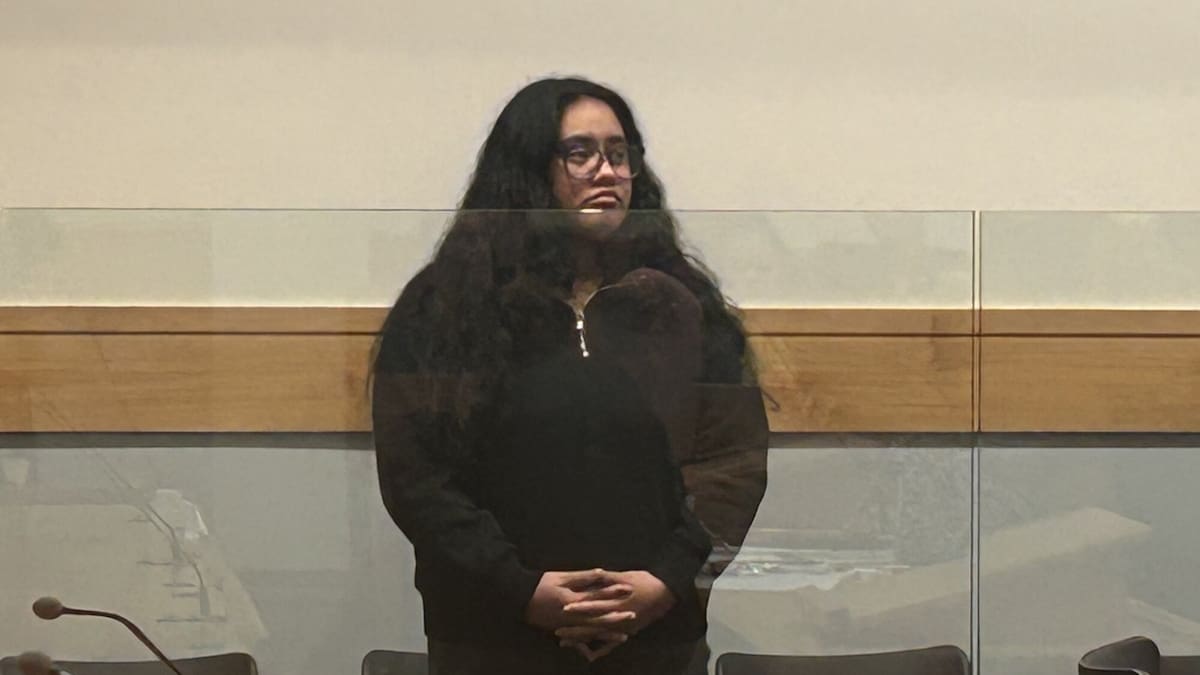
The court has heard that at the time of Tahere’s death he had been in an on-and-off relationship with Kaitāia woman Sunday Howard.
In March 2024, Howard was pregnant with Tahere’s baby, but they had broken up and she moved to Kaitāia to be with her sister.
Howard stayed in Kaitāia and had their son in July, when Tahere first travelled north to meet him.
They reconciled and Tahere drove to Kaitāia again on September 7 to visit her and their baby.
Howard had met Thompson about five years earlier while working in local kūmara fields and they built a solid friendship.
They often told each other of their struggles with their respective partners and that day, Thompson told Howard she should end things with Tahere.
Howard was firm in saying she wanted to work on the relationship.
Later that evening, the friends and others were drinking at Howard’s home, celebrating Thompson’s recent engagement and wedding plans.
Tahere, whom Thompson had not met, arrived about 10pm and, after spending time with his son, began arguing with Howard.
Howard believed Tahere wanted to drink rather than spend time with her and their son.
As she stood on the back porch stairs, she told him if he wasn’t there to help, he should “f*** off”.
At Thompson’s trial, Howard said Tahere was not angry and was instead sitting on a chair outside when he told her: “Go inside bro, you’re tired, bro”.
But within seconds, Thompson smashed a bottle and stabbed Tahere twice in the neck. He died that evening at Kaitāia Hospital.
The defence case was that Thompson was acting in self-defence because Tahere was allegedly acting aggressively and “bouncing around”.
But the jury did not accept her defence and found her guilty of murder.
Arthur Tahere was fluent in te reo and educated in Māori medium schools.
At today’s sentencing hearing, a representative of the wider whānau, Ngairo Tahere, said they did not want to focus on the defendant but on their loved one.
The whānau said from the moment they were informed Tahere had died, they were forced to grapple with government agencies that did not understand their deep beliefs in tikanga (cultural processes).
‘Weapon of injustice’
She said they tried their best, but the tikanga practices involving his tūpāpaku (body) did not sit alongside the “hostile environment” of a criminal investigation.
“We were forced to fit within an alien context and operated in a situation where it has been severed from mātauranga [Māori knowledge],” she said.
“His final journey has been a weapon of injustice.”
She said whānau waited seven hours for the release of his body and were granted only one stop on the way to Auckland, enabling them to carry out karakia.
“You would call it prayer; we would call it karakia. They are not the same.”
In Auckland for the autopsy, she said restrictions again cut them off from Tahere’s body.
A presentation in honour of Tahere and the many iwi, hapū and kura kaupapa he was tied to was played in court.
Mōteatea (chants) and whakataukī (proverbs) were played on behalf of Te Kura Kaupapa o Hoani Waititi, Te Kura Kaupapa o Whangaroa, Ngāti Manu and Hokianga.
A video was played of the moment Tahere’s tūpāpaku was returned to Hoani Waititi marae, where hundreds welcomed him home.
Hundreds of people welcomed Arthur Tahere home to Hoani Waititi marae, where he was a former student.
Crown lawyer Eilish O’Connor said Tahere was a much-loved son, brother, nephew and partner, and his son would never get a chance to know him.
O’Connor submitted Thompson acted with intent and had time to gauge where she should strike with the weapon.
“Her actions are not simply those of picking up an object. There were a number of deliberate steps taken to pick up and create a weapon.
“She created what she must have known to be a sharp and lethal weapon.”
‘This was not the plan’
Defence lawyer David Reece said Thompson does not accept she is guilty of murder but was exceptionally remorseful for Tahere’s death.
“If I could trade places with Arthur I would do so in a heartbeat,” she said in her letter of remorse, read aloud by Reece.
“I do not expect my apology to change anything. I wish with all my heart Arthur is still here for the people who love and care for him.”
Thompson’s mother filed a statement conveying her aroha for the Tahere whānau and her daughter, noting she had been lovingly raised and well educated.
“This was not the plan. My utmost aroha to you all,” her statement said.
It was also revealed that Thompson’s fiance suddenly died a month after Tahere was murdered.
Justice Natalie Walker acknowledged the Tahere whānau’s feelings and the presentation.
“You’ve conducted yourself with great mana through this process. It cannot be easy at all to hear the events that took the life of your taonga,” she said.
“I acknowledge the description, including the insult and indignation you felt in regard to tikanga, court and police process.
“It [the presentation] was a beautiful wide woven mat. His ancestors of many iwi, connections to Te Kura Kaupapa Māori o Hoani Waititi and the important part he played as a volunteer for Ngāti Manu in the environmental management group.”
Relating to his death, Justice Walker went through her assessment of Thompson’s ever-changing story.
“In one interview, you said he was either sitting or standing that you couldn’t remember … then you said because he was taller than you, you think he must have been sitting down.
“At trial you said he was definitely standing. You said he moved closer, leaned in and you looked into his eyes. You said he was threatening you, you said you wanted to push him away but you stabbed him.”
Justice Walker determined Tahere was sitting and noted Thompson’s claims that he was threatening her became more elaborate at trial.
“None of the witnesses heard him utter a threat. I do not find credible evidence Arthur made any threat.”
The judge said Thompson was caught in the crosshairs of an argument, but her actions were a “gross over-reaction in the most extreme and unnecessary way”.
Thompson was sentenced to life imprisonment with a minimum non-parole period of 10 years.
Shannon Pitman is a Whangārei-based reporter for Open Justice covering courts in the Te Tai Tokerau region. She is of Ngāpuhi/Ngāti Pūkenga descent and has worked in digital media for the past five years. She joined NZME in 2023.
Join the NZ Herald’s Open Justice team for Case by Case, a video and podcast series examining the disputes and decisions making headlines across New Zealand.