
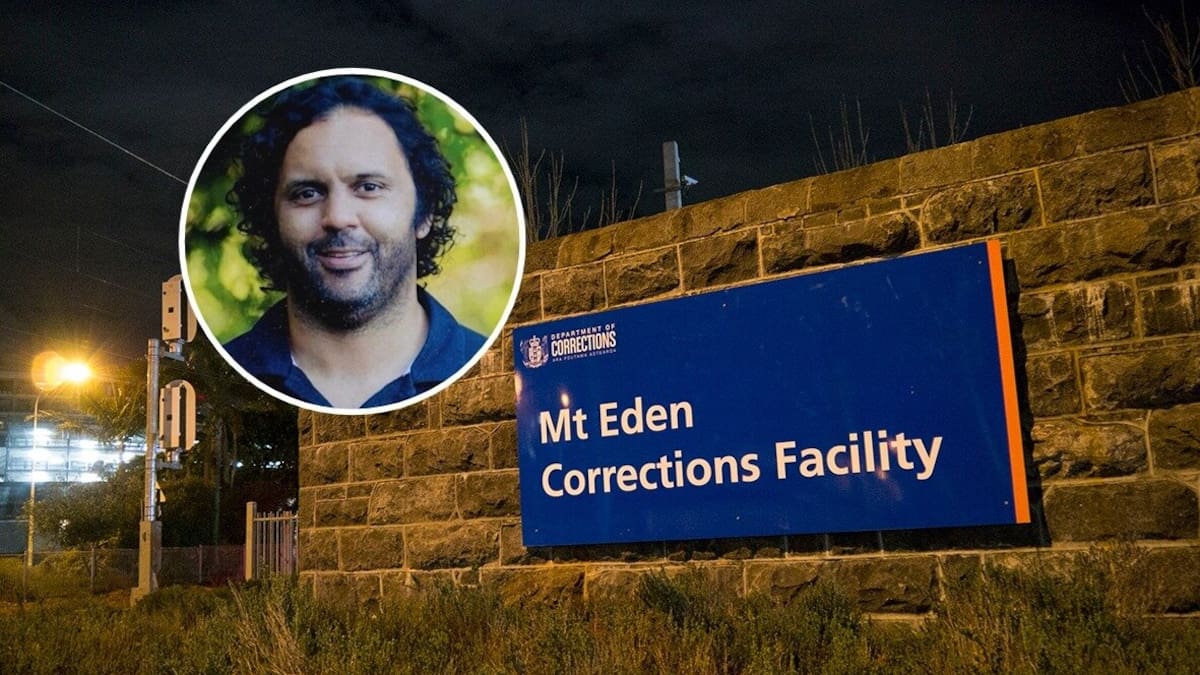
He had been deemed not guilty by reason of insanity in June for charges of murder and attempted murder, and he asked through his lawyer this week that he be released immediately into the community.
“I mean no disrespect to you, but that request is consistent with the delusional beliefs that psychiatrists have described,” Justice Simon Mount told him as he instead ordered Falesefulu to be held indefinitely as a “special patient” at the psychiatric facility.
Rob Fitzpatrick was killed at Mt Eden Corrections Facility last year after he was double-bunked with a psychotic inmate who had attempted to murder a stranger just weeks earlier.
“Your conduct involved violence of the gravest kind,” he added, describing the initial attempted murder attack as “extreme and gratuitous”.
And they weren’t isolated incidents, the judge said, describing a background of repeated violence and non-compliance with treatment for his schizophrenia.
“You remain profoundly lacking in insight,” he said. “You continue to regard your behaviour as justified.”
‘Prolonged’ attacks
Falesefulu was first taken into custody in the early morning hours of May 29 last year, after council workers found his first victim at a bus stop in Māngere.
The two first met and spoke briefly at the bus stop around 1.23am. For unknown reasons, they squared off into a physical confrontation 30 minutes later.
Falesefulu, who is large-statured, overpowered the other man after a short scuffle and forced him to the ground. He then stood over the other man and punched him in the head more than 30 times as he grabbed the collar of his sweatshirt. The victim at first tried to block the blows but was “quickly rendered unconscious”, court documents state.
“After that initial attack, and with [the victim] lying unconscious on the ground, Mr Falesefulu stood up and forcefully dropped his full weight onto [the other man’s] chest, landing on him in a seated position,” according to the agreed summary of facts.
“For the next four minutes, Mr Falesefulu, while seated on [the victim’s] torso, punched him over 100 times to the head with both fists. As he punched him, [the victim’s] blood spilt from his head and covered the sidewalk around him. At times during the assault, Mr Falesefulu tired and temporarily suspended his attack before regaining his breath and recommencing his assault on the unconscious [victim].”
He then walked away from the bus stop, leaving the victim still out cold and struggling to breathe. He was found 30 minutes later and rushed to the hospital in critical condition.
When arrested a short time later, Falesefulu claimed self-defence.
He would also claim self-defence almost exactly a month later, after killing his Mt Eden bunkmate.
Rob Fitzpatrick was killed on June 27 last year while at Auckland’s Mt Eden Corrections Facility.
The two had been assigned to the same cell on June 14. One day earlier, Falesefulu asked his lawyer to write a note requesting his own cell for safety reasons. The note was found in his cell on the day of the homicide, but it isn’t known if he had shown it to anyone, the summary of facts states.
Fellow inmates later described hearing banging noises from inside the cell for about 15 minutes, starting at 3.15pm that day.
The attack was described by officials as “sustained and prolonged” and resulted in Fitzpatrick suffering “catastrophic head wounds, compression injuries to his neck and blunt force injuries to his torso”.
“Mr Fitzpatrick’s blood was located throughout the cell, with a large pool on the ground around his head,” court documents state.
Falesefulu’s knuckles on both of his hands were bloody – an indication of how hard he had pummelled the other man.
‘He deserved protection’
In a heartrending victim impact statement, Fitzpatrick’s mother told the court through tears that she is haunted by the image of her son’s blood seeping out from the cell door.
“These words and the image are forever seared in my memory,” Dorothy Fitzpatrick said. “I scream every time I remember.
Dorothy Fitzpatrick and her late husband, Keith, previously told the Herald they were let down by the justice system. Their son’s death at Mr Eden Prison contributed to her husband’s decline in health and his death, Dorothy Fitzpatrick told a judge this week. Photo / Annaleise Shortland
“It’s usually a silent scream, but sometimes in the wee hours of the morning, if I’m alone in the house, the scream is as loud as I can make it. The horror of that will never go away. My son was so badly brutalised by you that it was a closed casket at his funeral.”
She said she clings to hope, “against all odds”, that her son was asleep when Falesefulu snapped and that he didn’t suffer prolonged terror at the other man’s hands.
Family described the victim as a university graduate who loved the band Guns N’ Roses, played guitar, played backyard sports and shared sweets with his sister’s children. The Whangārei resident left behind a son.
“I love his cheeky smile and his quick comebacks,” sister Julia Fitzpatrick recalled. “Rob had an unflappable positivity about life and would always be striving for more.
“Even when his own mental health declined, his determination kept him going.”
Rob Fitzpatrick was arrested twice in 2024 after violating a restraining order for a woman he had been sending unwanted messages for a decade. He spent some of the time in custody at a psychiatric facility, but he was also sent to Mt Eden for four months in late 2024 and early 2025.
Rob Fitzpatrick was killed on June 27 last year while at Auckland’s Mt Eden Corrections Facility.
Eventually, he was released on electronically monitored bail and showed encouraging signs of improvement as he received help under the Mental Health Act, his family said.
But he was arrested a final time in May last year after contacting one of the complainant’s friends with a message that read: “Hi [name redacted], coffee?”
The Fitzpatrick family has previously told the Herald they blame the death in part on failures by government agencies, including poor information-sharing between health services and Corrections.
“You have to question the common sense of people who are in the offices at Mt Eden prison,” brother Ross Fitzpatrick said of the decision to bunk a violent offender with his brother. “We just want to know why those clowns … signed off on this decision.”
A damning draft review by Health New Zealand seen by the Herald earlier this year found that Mt Eden’s forensic prison team – which includes specialist psychiatrists, clinical psychologists and psychiatric nurses – had “no information” about Falesefulu and no input on him being double-bunked with Fitzpatrick.
“There was no systematic understanding of arrangements for shared cells, and of the potential compatibility issues for cellmates,” the report stated.
On-call forensic psychiatrists had been unable to access important health records held by Corrections, the report found.
During her victim impact statement, Julia Fitzpatrick said her brother had been subject to “ridiculous monitoring” as the justice system took an “excessive punitive approach” to his non-violent, mental health-related offending.
“Rob had his struggles, but he should never have been held in prison,” she said. “His condition was treatable. I knew it was just a matter of time before we got our old Rob back.”
Siblings Ross and Julia Fitzpatrick believe failures by multiple government agencies culminated in the death of their brother, Rob, at Mt Eden Prison. Photo / Annaleise Shortland
While at Mt Eden he was awaiting a mental health assessment, which had been repeatedly rescheduled, so he could apply for bail. His family had expected him to get bail later that week.
“They should never have crossed paths,” she said, noting the chasm between the two men’s crimes. “Siitia viciously assaulted someone… My brother sent a text message to a cellphone asking someone to coffee.
“Rob deserved protection. I cannot comprehend that he was left alone in a cell with you.”
‘Grandiose delusional beliefs’
Falesefulu’s mental health issues were laid bare in a decision issued by Justice James MacGillivray in June in which he agreed with prosecutors, the defence and two psychiatrists that the murder defendant should be acquitted.
Over the course of a decade, he had been hospitalised eight times for schizophrenia that caused auditory hallucinations, paranoia, grandiose delusional beliefs and disorganised speech, the judge noted in his decision.
He was described by one psychiatrist as having been “governed by intense delusional beliefs of a persecutory nature encompassing a threat of being killed [and] of his food being contaminated”.
“He intended to attack his victims, but he did so under the delusional belief that he was defending himself,” Justice MacGillivray found. “While his actions were intentional, he was incapable of knowing that what he was doing was morally wrong.”
The case was transferred to Justice Mount to decide what happens next.
Judges are presented with three options for defendants who have been found not guilty by reason of insanity: indefinite detention as a special patient, court-mandated outpatient treatment or immediate release.
“He understands that it is extremely unlikely that Your Honour will take that route,” defence lawyer Amy Jordan said of her client’s wish to be released immediately. “I’ve explained it is almost inevitable that Your Honour will make a special patient order.”
She emphasised to the victims’ families that, although not guilty, her client would endure a “lifelong penalty” and will live at a facility not unlike a maximum security prison. Justice Mount agreed.
Justice Simon Mount. Photo / Dean Purcell
“The reality is a special patient can be detained much longer than someone subject to a life imprisonment sentence,” he noted.
The judge pointed out that one of the psychiatrists who filed supplemental reports for the latest hearing described an “overwhelming need” for a special patient order in light of Falesefulu’s ongoing mental health issues.
“An order for immediate release … would expose the public to an unacceptable risk of serious harm,” he explained.
In an unusual decision, the judge also issued an order restricting the media from running photos of Falesefulu with coverage of the case despite suppression having lapsed. The Herald argued against the order, noting that photos that Salesefulu posted of himself are already easily accessible online.
But running his photo next to a media article could exacerbate his persecutory delusions and put Mason Clinic staff at risk, the judge said, citing two letters from a treating psychiatrist.
Craig Kapitan is an Auckland-based journalist covering courts and justice. He joined the Herald in 2021 and has reported on courts since 2002 in three newsrooms in the US and New Zealand.
Tags:
- after
- as
- assigned
- attempted
- auckland
- blind
- Blood
- Cell
- custody
- eden
- falesefulu
- fellow
- fitzpatrick
- Headlines
- homicide
- injuries
- inmate
- junior
- killer
- leaving
- left
- message
- mt
- murder
- named
- News
- of
- partially
- pool
- prison
- robert
- severe
- Share
- siitia
- someone
- stop
- stranger
- text
- Top News
- Top Stories
- TopNews
- TopStories
- twoandahalf
- unconscious
- victim
- weeks
- with