
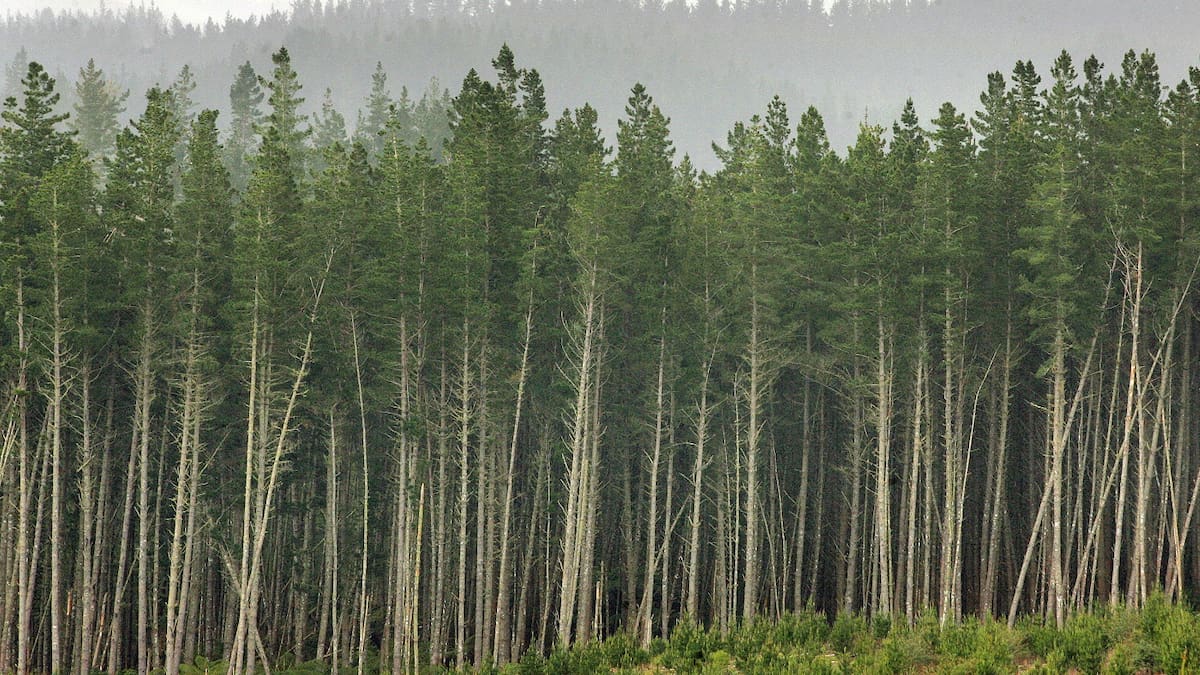
Yet not everyone was convinced.
Concerns about fire risk accompanied the expansion of pine forests, particularly in remote plantations where fires could spread rapidly.
At the same time, advocates argued that pine would become one of the country’s most important economic resources.
These newspaper reports below from 1931, 1938 and 1950 trace the debate, from warnings about fire danger to recognition of pine timber’s growing value to New Zealand’s economy.
Timber fires
Wanganui Chronicle, December 22, 1931
The recent fire on the Wanganui City’s Water Reserve raises the question of the desirability of planting pine trees upon country which is likely to be visited by an outbreak of fire.
Forestry experts declare that the best prevention for forest fires is to make sure that the fires don’t start, because in pine forests there is not a little difficulty in holding a fire in check.
The floor of the forest is covered with pine needles which are ready fuel for the carrying of an under-flame.
The constitution of a large scale pine forest under conditions which do not permit of constant supervision therefore does not appear to be altogether desirable.
The position alters to some degree when the object of planting trees is for shelter, on a farm, for instance.
The belt of trees round the paddock is of great advantage from a husbandry point of view, but in this regard, shelter is the main objective.
This can be obtained with a minimum of fire risk by planting trees which do not shed inflammable needles.
For instance, the Cupressus Lawsoniana gives dense shelter right down to the ground, is hardy and it would be impossible to set it on fire.
The Cryptomeria is also a very fine shelter tree.
These good shelter trees, however, do not provide a commercial proposition in so far as timber growing is concerned.
The growing of timber is an excellent proposition under given conditions, but it is as well, when planting trees for shelter, to bear the major purpose in mind, and the minimising of the fire risk as well.
Fire in plantation destroys 500 acre block of pine trees
Central Hawke’s Bay Press, November 23, 1938
Whakatane, November 21.
An extensive fire today swept through a plantation of 500 acres of yellow pine trees owned by the Western Yellow Pine Plantation Company, a Rotorua syndicate.
The trees, which were eight years old and ranged up to a height of 14ft., were destroyed.
No effort could be made to save the trees in the absence of fire breaks and owing to the rapid spread of the flames before a strong westerly wind.
The fire tonight is burning toward the Rangitaiki River, crossing scrub country in its course.
It has been prevented from crossing to some of the other plantations by fire breaks.
The plantation manager for the Whakatane papermills, Mr. S. Anderson, and his staff patrolled the boundaries of their block, while other men remained at headquarters in readiness for an emergency.
The fire break, which last summer saved this block, again turned the fire back.
The glare of the flames illuminated the sky for miles around early on Sunday morning and again tonight.
From Whakatane, which is 25 miles away, dense clouds of smoke were visible all day.
Value of pine trees to economy of Dominion
Central Hawke’s Bay Press, April 14, 1950
Masterton, This Day.
“The awakening of the New Zealand public to the value of pine trees in some way parallels the introduction of the potato to Ireland and barley to Scotland,” said the chief inspector of the State Forestry Service, Mr C. M. Smith, in a luncheon address to the Masterton Rotary Club.
Pine production had grown to be a great timber asset in New Zealand, though it had for many years been scorned.
The land used for production was of first importance.
The fields of food and timber production had to be related.
New Zealand mills had an output of 150 million feet of pine timber a year.
“This is the pine age and whatever our opinions about the beauty of the tree, production of pine timber will go on increasing.”
– Source: Papers Past