
They are concentrating on mainly wagyu and Angus genetics, Fisher said.
Some of the vast property is also used for commercial cropping – pumpkins and liquorice.
The 10-strong organic study tour was run by Buy Pure New Zealand and IFOAM (International Federation of Organic Agriculture Movements) Asia, a group that promotes regional organic markets.
The tour
Fisher learned about the tour from Brendan Hoare, managing director of Buy Pure New Zealand, who he knew had “really good connections” in China.
Along with Shengmu farm, the tour took in a trade expo and supermarkets to see where Chinese organic products ultimately go on sale to the public.
Organic steak in a Chinese supermarket.
“There is a huge difference in price compared with non-organic, but organic is a big seller,” Fisher said.
“They are prepared to pay a premium.”
He said online sales were also a big focus, promoted through social media “influencers”.
A four-hour flight from Shanghai, the Shengmu operation has a separate dairy company’s factories nearby that process its organic and non-organic milk into mainly UHT, powder and some yoghurt.
Fisher and the tour group visited one of the organic dairy units that the vast property is divided into.
It milks 8500 cows in two 90-cow rotary bail units that sit side by side in a single shed.
Continuous milking
The farm runs Holstein-Friesians from Australian genetics, with cows milked three times a day and the milking units operating 24/7.
Cows average about 43 litres of milk/cow/day, which Fisher said was about double the New Zealand production.
With nutritionists and veterinarians on-site, the milking cows are kept indoors all year round, with feed – lucerne and maize – cut and carried to them.
A rotary milking shed on Shengmu organic dairy farm in China.
The unit also included calf-rearing facilities.
Herd houses are fully temperature-controlled, with desert temperatures dropping to -20C in winter and hitting 40C in summer.
The unit the tour visited has a staff of 50, working in shifts.
Cupping is done manually, but removal is automated.
The farm runs off solar power, with most farm vehicles being electric.
Through advanced technology and solid-liquid separation, Fisher said every ounce of manure was transformed into value, with compost rebuilding fragile soils and liquid nutrients delivered via precision irrigation straight to crops.
“Methane from waste powers operations, solar infrastructure fuels the farm, and machinery is shifting toward electrification, creating an efficient self-sustaining ecosystem.”
“It’s designed for efficiency,” Fisher said.
“It’s self-contained and off the grid.”
A colourful building signifying Shengmu organic dairy farm in China.
Sound planning
Along with significant investment, he said plenty of thought and detail has been put into the project.
“They have shown the ability to scale up,” he said.
“New Zealand could learn a lot by that, just by getting on with it.”
Fisher said in future years the owners want to double the size of the operation.
The current property is extensively irrigated, with water primarily sourced from the nearby Yellow River.
He said the desert development involved the planting of a billion trees and grasses, planted in grids to counter sand encroachment.
“There’s good soil under the sand.”
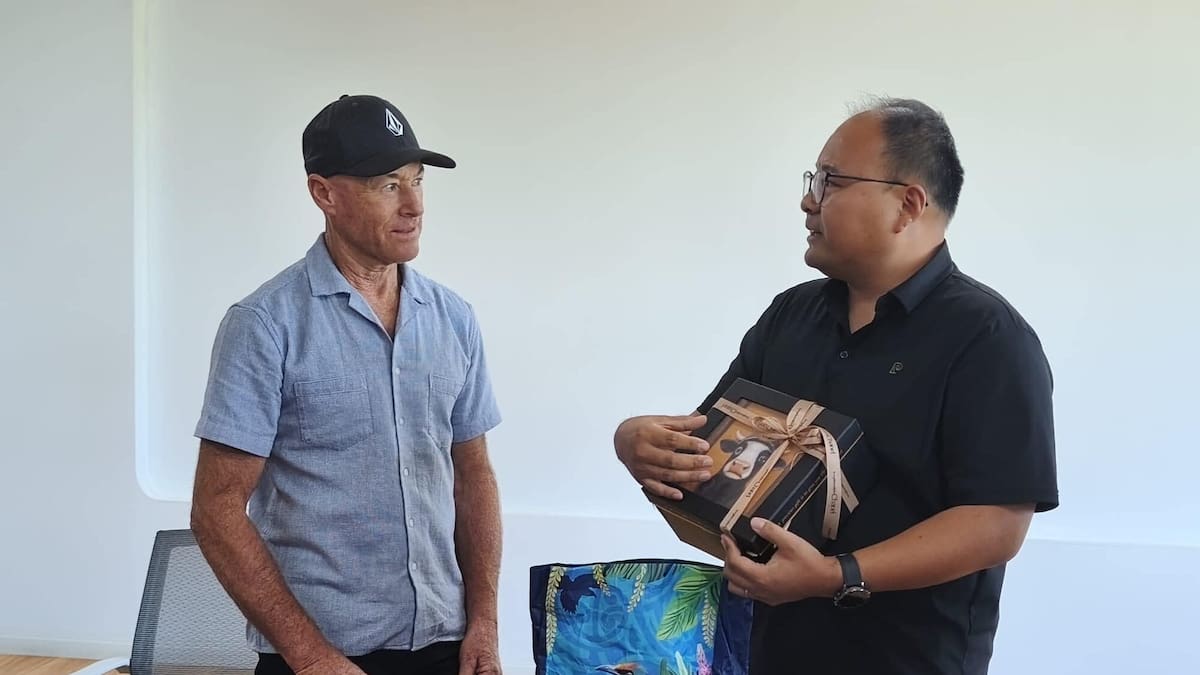
Waikato organic dairy farmer Gavin Fisher was part of a study tour of China.
Excess sand was sold off for roading in the development stage of the farm.
All of China’s dairy products are sold on the home market, with New Zealand continuing to be a major exporter there of both organic and non-organic dairy lines.
Fisher said even with developments like Shengmu, New Zealand still had a competitive advantage in dairying through its favourable climatic conditions and associated outdoor production, and genetic engineering-free status.
With long-time dairying industry connections, he said China had gained knowledge from New Zealand through expertise and innovation.
Back home at Elstow, Fisher and his wife Sheryn run 165 cows, plus several deer and beef cattle, on a 74ha third-generation family farm – Mountain View Organics – which he has milked on for 46 years.
Over the years, the Fishers have planted a diverse range of trees on the property – for shade, shelter and nutrient recycling – including fruit trees (feijoas and olives).
They also have their own brand, Off the Planet Organics, selling free-range eggs and fruit produce locally.