
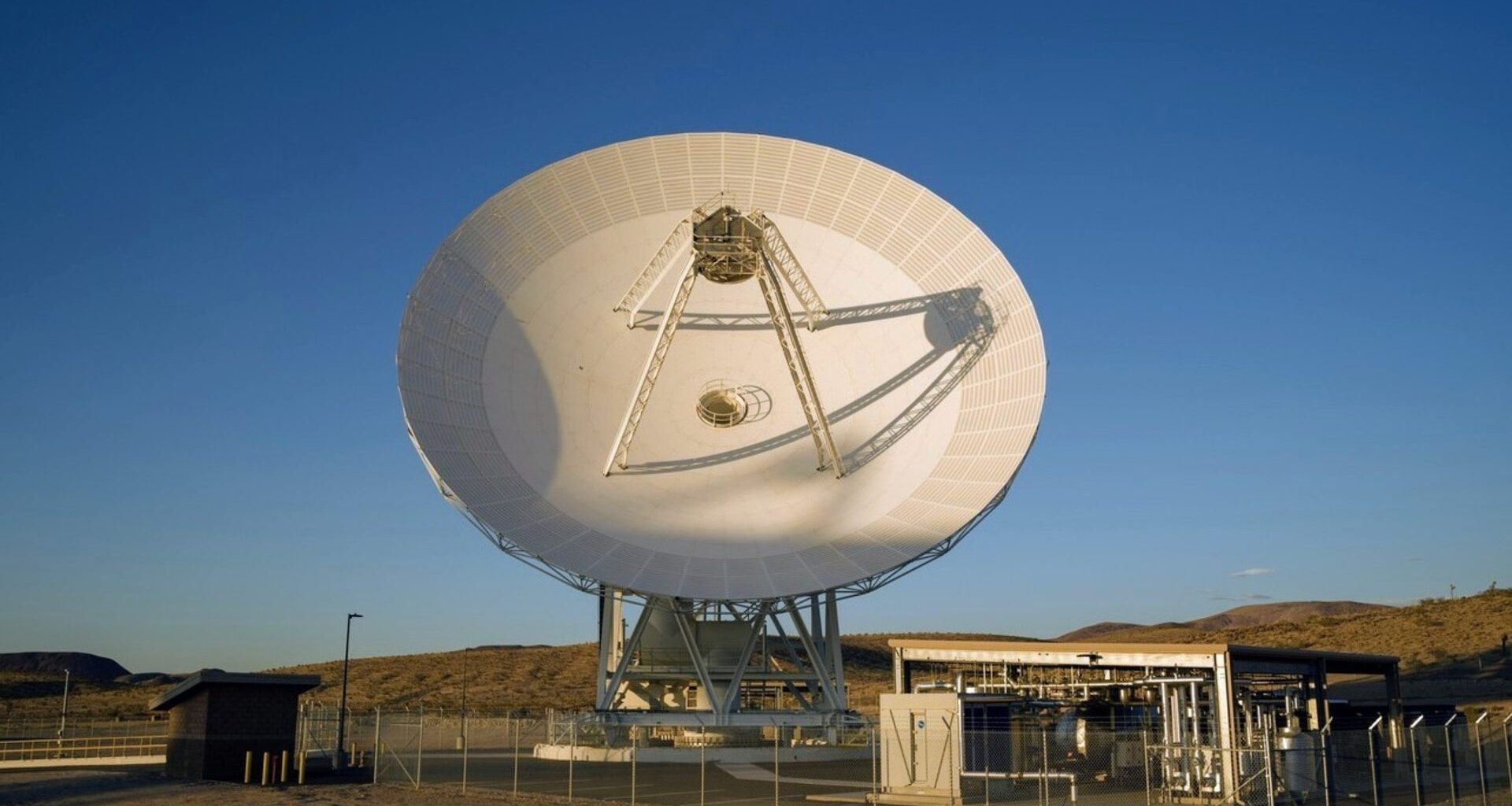
NASA just switched on a new 114-foot antenna in California to keep communicating with over 40 spacecraft across the solar system.
Right now, NASA is tracking more than 40 spacecraft. Some are on Mars. Some are near Jupiter and Saturn. One entered interstellar space more than a decade ago and is still calling home.
The spacecraft all depend on a small number of giant dish antennas scattered across three spots on Earth.
For years, those dishes have been stretched thin. Last month, NASA added another one.
A new radio antenna in the California desert switched on and started talking to spacecraft, giving the network some much-needed breathing room.
A new dish in the desert
NASA leadership, staff and dignitaries gathered at the Goldstone Deep Space Communications Complex near Barstow, California, for a ribbon-cutting ceremony.
This marked the completion of the new NASA antenna, called Deep Space Station 23.
NASA’s Jet Propulsion Laboratory (JPL) in Southern California will manage the new dish, which stretches 114 feet (34 meters) across.
It joins NASA’s Deep Space Network, which uses giant antennas at three complexes around the world, in California, Spain and Australia.
These antennas enable scientists to stay in touch with spacecraft exploring the solar system and beyond.
James Kenyon, associate administrator of NASA’s Research and Technology Mission Directorate, said the new dish supports where NASA is headed next.
“By expanding the Deep Space Network, we are strengthening the communications foundation NASA needs for the bold missions ahead – from exploring more of the Moon than ever before to peering deeper into the solar system,” he said.
“This new antenna will help us deliver on our national goals for space exploration and push beyond the limits of what once seemed impossible.”
The antenna is already busy
NASA scientists spent May through July testing Deep Space Station 23 to prove it could do the job. It began operations on August 3, when it started tracking NASA’s Chandra X-ray Observatory.
Since then, it has been in contact with dozens of missions, including the Mars Reconnaissance Orbiter, Psyche, Juno and Voyager 1, the probe that entered interstellar space in 2012.
Dave Gallagher, director of NASA’s Jet Propulsion Laboratory, said the antenna is a step toward a fully upgraded network.
“The addition of this next-generation antenna brings us closer to a completely modernized network that embraces advanced technology to ensure NASA’s leadership in deep space communications,” Gallagher said.
“After over 60 years of continuous operations supporting consequential missions, these upgrades prime the network for a new era of exploration. The teams that designed, planned, and built DSS-23 should be proud.”
Building for deep space
Building the antenna took a while. Construction began in February 2020, and engineers lowered the 133-ton metal framework that supports the dish into place and bolted it onto its base in December 2024.
After that, they attached the panels that reflect radio signals to and from spacecraft. It took months to calibrate the antenna so it could work smoothly alongside the rest of the network.
Germaine Aziz, who manages the Deep Space Network’s Aperture Enhancement Project at JPL, said the antenna itself wasn’t the hard part.
“The biggest challenge wasn’t actually constructing the antenna,” Aziz said.
“It was transforming a complex collection of mechanical, electrical, software, radio frequency, and infrastructure systems into a single, mission-ready asset.”
“Every subsystem must be integrated, calibrated, and verified to operate with extraordinary precision and reliability before it can support NASA’s deep space missions.”
Built for many missions
Deep Space Station 23 is a multifrequency beam-waveguide antenna, meaning it can pick up signals across several radio frequencies instead of just one, so it can support many different kinds of missions instead of being built for a single job.
Rather than packing the sensitive electronics onto the moving dish itself, the design sends signals down into a stable, climate-controlled room underground, where the equipment is easier to reach for repairs and upgrades.
It’s the fifth antenna at Goldstone, joining three other 114-foot (34-meter) dishes and one older 230-foot (70-meter) dish.
It is also the fifth of six new antennas built under the Aperture Enhancement Project, which began in 2009.
The network keeps growing
One more antenna remains before the project wraps up. Deep Space Station 33 is due to come online at the network’s Canberra, Australia, complex in 2029.
This will bring the total number of these 114-foot antennas across the whole network to 13.
Multiple 114-foot dishes can also be linked together, or arrayed, to match the power of one of the network’s 230-foot dishes.
These older dishes have been running at each complex for more than 50 years and are getting harder and more expensive to keep in good repair.
For now, Deep Space Station 23 has plenty of company to keep it busy. NASA’s list of active missions keeps growing, and each new one needs somewhere on Earth to call.
Information for this article was obtained from an online publication by NASA’s Jet Propulsion Laboratory.
—–
Like what you read? Subscribe to our newsletter for engaging articles, exclusive content, and the latest updates.
Check us out on EarthSnap, a free app brought to you by Eric Ralls and Earth.com.
—–