
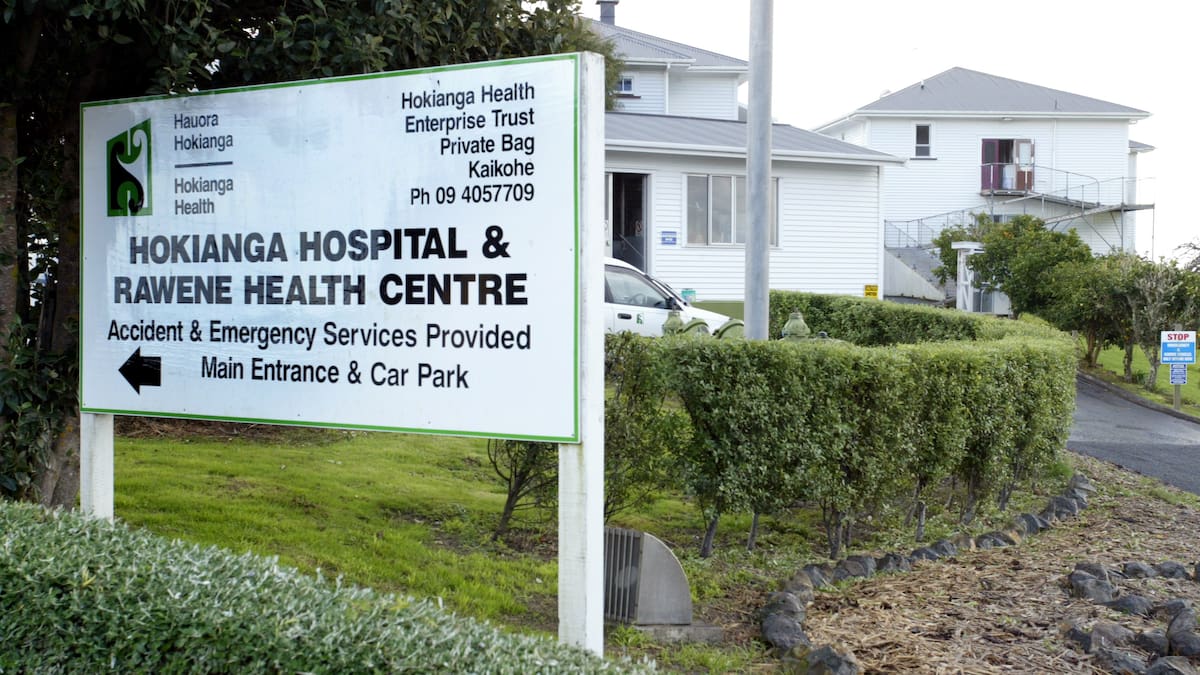
Now, the Health and Disability Commissioner (HDC) has found Rawene Hospital breached the man’s rights to care, particularly in falls risk assessments.
In a finding released today, the commissioner said the man’s GP reviewed him after a two-to-three-week decline that resulted in increased confusion, reduced interaction with his family, worsening mobility, pain without a clear cause and worsening incontinence.
The man was admitted to Rawene Hospital on October 27, 2021, for inpatient assessment and respite care, including a review of his support needs.
His wife told staff he was susceptible to falls and requested a side rail be placed on his bed, but that did not occur.
Documents provided to the HDC showed no falls risk assessment or consent form for the bed rail was completed by the hospital until several days after his admission.
On November 1, staff documented the man was unable to walk and about 3am the next day he was found in a frozen position near a roommate’s bed.
The notes did not make clear whether he was standing or sitting and the incident was not noted as a fall.
At 6.45am, the man was found on the floor after an unwitnessed fall and two hours later he had another unwitnessed fall, this time causing a laceration on his head.
Throughout the night, the man had been unable to pass urine and there was no documentation to show whether this was further assessed.
Neurological assessments were not carried out until some time after his last fall.
He was transferred to Whangārei Hospital, where a large intracranial haemorrhage was confirmed to be inoperable and he was sent back to Rawene for palliative care.
On November 5, he had another fall as his condition deteriorated and he died.
The family sent a formal complaint to the hospital but, unhappy with its internal investigation and response, complained to the HDC.
Health and Disability Commissioner Vanessa Caldwell found Rawene Hospital breached the Code of Health and Disability Services Consumers’ Rights and made several notes and recommendations.
Caldwell found multiple missed opportunities to identify the man’s falls risk and care planning was not completed in a timely manner.
“Clinical documentation regarding Mr B’s mobility status was inconsistent, which reduced clarity for staff and affected their ability to provide appropriate supervision and assistance,” she said.
“In addition, there was a failure to recognise and respond to changes in Mr B’s condition, including confusion, altered behaviour, and unsafe attempts to mobilise. These changes were not adequately assessed or escalated.”
Health and Disability Commissioner Dr Vanessa Caldwell made a number of recommendations. Photo / James Gilberd Photography
Caldwell also found his urinary issues were not followed up and consent for a bed rail could have been obtained early in his admission.
Rawene Hospital has since developed new restraint policies, education and training on falls risks, and redeveloped procedures relating to assessment and care planning.
The commissioner also recommended a formal written apology and evidence of the policy changes and training, including urinary retention, be provided to the HDC within six months.
A random audit of 15 patients over the past six months has also been requested to ensure records are clear and consistent.
Rawene Hospital acknowledged the family’s concerns and recognised “that this remains a deeply challenging and emotional process, and we extend our sincere aroha and respect to the whānau for their patience and engagement throughout this investigation”.
Shannon Pitman is a Whangārei-based reporter for Open Justice covering courts in the Te Tai Tokerau region. She is of Ngāpuhi/Ngāti Pūkenga descent and has worked in digital media for the past five years. She joined NZME in 2023.
Join the NZ Herald’s Open Justice team for Case by Case, a video and podcast series examining the disputes and decisions making headlines across New Zealand.