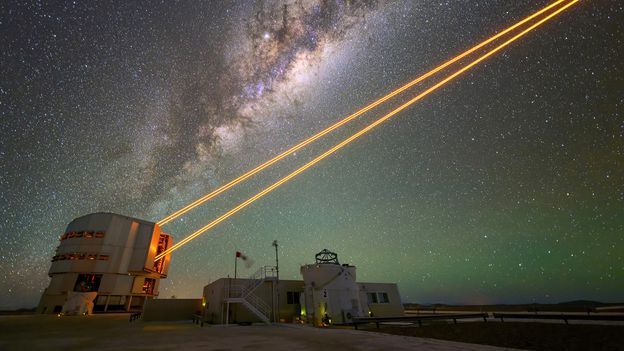
For adaptive optics to work, though, astronomers need a star as a reference point – a fixed point in the sky. And crucially, it needs to be bright. Why? “Imagine that you’re listening to a song, and you want to get the melody,” explains Bayo. “If the volume is low; if there’s more noise, or you only hear high or low pitch, then you may not be able to tell which song it is.” It’s the same with stars; a bright star provides more information to help correct the atmospheric distortion.