
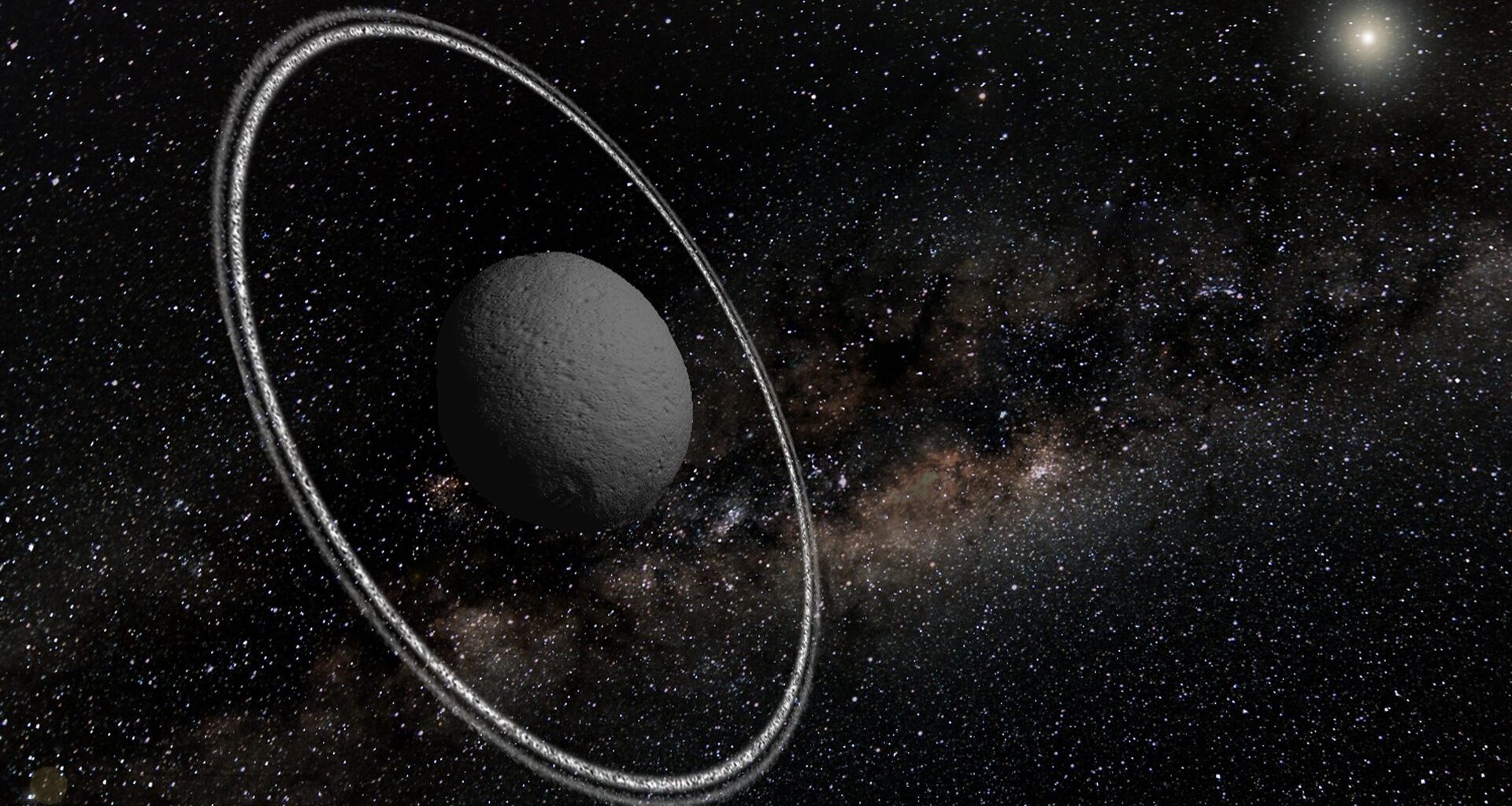
Chariklo’s rings changed between 2017 and 2022, the inner one denser and the outer one fading, and an unseen moonlet may be feeding both.
Rings were a feature of giant planets until 2013, when a star blinked twice on its way behind a world that is only about 160 miles (250 kilometers) wide. That world, Chariklo, orbits between Saturn and Uranus, and astronomers have since treated its two thin rings as steady. They aren’t.
Between 2017 and 2022, the inner ring became much more opaque while the outer one nearly faded from view. It is the first sign that a small body’s rings can change in just a few years.
The James Webb Space Telescope made the measurement on October 18, 2022, in the first stellar occultation ever planned for Webb.
Part of the difference might be Webb seeing in infrared where most earlier telescopes saw visible light, and the team said as much. But when the researchers modeled that, it couldn’t explain everything.
Pablo Santos-Sanz is a planetary scientist at the Instituto de Astrofísica de Andalucía (IAA-CSIC) in Granada, Spain, and leader of the study.
“We do not yet know the physical mechanism responsible for the opposite behavior of the two rings, and I think that is one of the most intriguing aspects of our result,” he told Earth.com.
A star blinked behind Chariklo’s rings
Chariklo is the largest of the centaurs, icy bodies orbiting among the giant planets. It orbits about 1.6 billion miles (2.5 billion kilometers) from the Sun, nearly 17 times as far out as Earth.
Its two rings circle about 240 and 250 miles (390 and 405 kilometers) from its center, and they’re far too thin and distant to photograph, even with Webb.
So astronomers wait for Chariklo to pass in front of a star and time how the starlight dips. Each ring blocks the light briefly, and the dip’s depth and length give its width and density. That is a stellar occultation, and it is how the rings were found in 2013.
Webb’s target was a faint star from Europe’s Gaia catalog. The telescope recorded its brightness more than three times a second, in two infrared colors at once. Seen from Webb, the star’s path missed Chariklo’s edge by about 4.6 miles (7.4 kilometers).
“Ultimately Chariklo itself missed the star, but both narrow rings crossed it,” Santos-Sanz said.
Predicting that path was hard, because Webb orbits a point nearly a million miles (1.5 million kilometers) from Earth. In the two months before the event, he said, the prediction shifted by about 70 miles (110 kilometers).
Chariklo’s inner ring blocked more starlight
The rings have names, C1R for the inner one and C2R for the outer. Ground telescopes had timed them in 2013, 2014, and 2017, so the team knew what to expect. The inner ring has been the dense one since the discovery, the outer one the faint one.
C1R came through clearly, with sharp spikes at each edge of its dip, indicating that the ring has sharp edges. And it blocked more light than before: about 43% of the starlight, compared with 30% measured in earlier occultations.
C2R did the opposite: in Webb’s shorter-wavelength color it was barely there, and in the longer one it didn’t show up at all.
Both cameras watched the same stretch of ring at once. The material along Webb’s line through it came out about 60% lower than the 2017 measurements.
“We knew very well what Chariklo’s rings had looked like in previous stellar occultations, so when we first inspected the data it was immediately striking that C2R was barely visible, while the inner ring, C1R, remained very clear,” Santos-Sanz said in his answers to Earth.com.
His team first checked that it wasn’t an instrument problem or a slip in the analysis, but after careful comparison with earlier occultations, it remained, he said.
A patchy ring can’t explain the change
The team weighed three explanations. The rings could be patchy, so Webb might have crossed a dense stretch of C1R and a thin stretch of C2R.
The rings could also have gained or lost material. Or the grains could block infrared light differently from visible light, making the same rings look different to Webb.
The researchers tested patchiness first, simulating rings of varying density around the circle and drawing random samples 10 million times.
Fewer than one draw in a thousand produced values as low as Webb’s for C2R, and C1R’s high readings were similarly unlikely. Patchiness alone probably isn’t it.
Testing other explanations
The infrared filter idea fit better, but only for the old data. Mixtures of water ice and rocky grains about a micrometer across, a hundredth the width of a hair, can reproduce the measurements from before Webb.
However, add Webb’s two colors and no mixture of ice, rock and carbon the team tried fits them all.
On the researchers’ reading, C1R’s opacity has genuinely gone up, suggesting the presence of more material. For C2R they are less sure, because clean profiles of the outer ring are scarce.
Unseen moonlet could feed Chariklo’s rings
The material didn’t simply move from one ring to the other: C1R gained roughly ten times as much as C2R lost. More material could explain the gain, or collisions that shattered larger particles into many smaller ones.
Neither ring has moved in nearly a decade, so something is holding them in place and replenishing them. For C1R, the leading idea is a rhythm with Chariklo’s spin: one orbit for every three turns of the body.
That rhythm can keep the ring narrow, but it also pushes the ring slowly outward, so an earlier study proposed a small, unseen moon just outside it.
Such a moonlet could share C2R’s orbit and shed material into it. The team estimates that material released at one spot on C2R would spread around the ring in about four months. That fits a ring being resupplied a little at a time.
“One particularly interesting hypothesis is the presence of a small, still-undetected satellite interacting with the rings,” Santos-Sanz said. It remains a hypothesis, he added, and more occultations from the ground and from space will be needed to understand it.
Other rings change too. Saturn‘s faint D ring has shrunk over decades, and the team thinks Chariklo’s outer ring may be a dusty, low-mass ring like it.
When the outer ring faded remains open
All of this rests on one observation that crossed each ring at just two points. The team can’t tell whether C2R has been fading gradually since 2017 or dropped suddenly at some point in the five years after.
The earlier ground measurements are too sparse and too uncertain to settle it, and they don’t rule out a decline that started before 2017.
If the outer ring really is losing material, that points to small grains, which sunlight’s pressure can push onto stretched orbits that cross the inner ring.
Something similar may be underway at Chiron, another centaur, where material has come and gone between occultations.
More monitoring is the plan
The team wants another occultation in visible light, so the comparison with older data is direct. Asked by Earth.com what comes next, Santos-Sanz said the plan is to keep monitoring.
“If we again find a more opaque C1R and a much weaker C2R, that would provide very strong evidence that the ring system itself is evolving with time,” he said.
Until that happens, the case that Chariklo’s rings are changing rests on 75 minutes of Webb data and ground measurements from 2013 to 2017 that don’t match it.
The full study was published in the journal Science Advances.
—–
Like what you read? Subscribe to our newsletter for engaging articles, exclusive content, and the latest updates.
Check us out on EarthSnap, a free app brought to you by Eric Ralls and Earth.com.
—–