
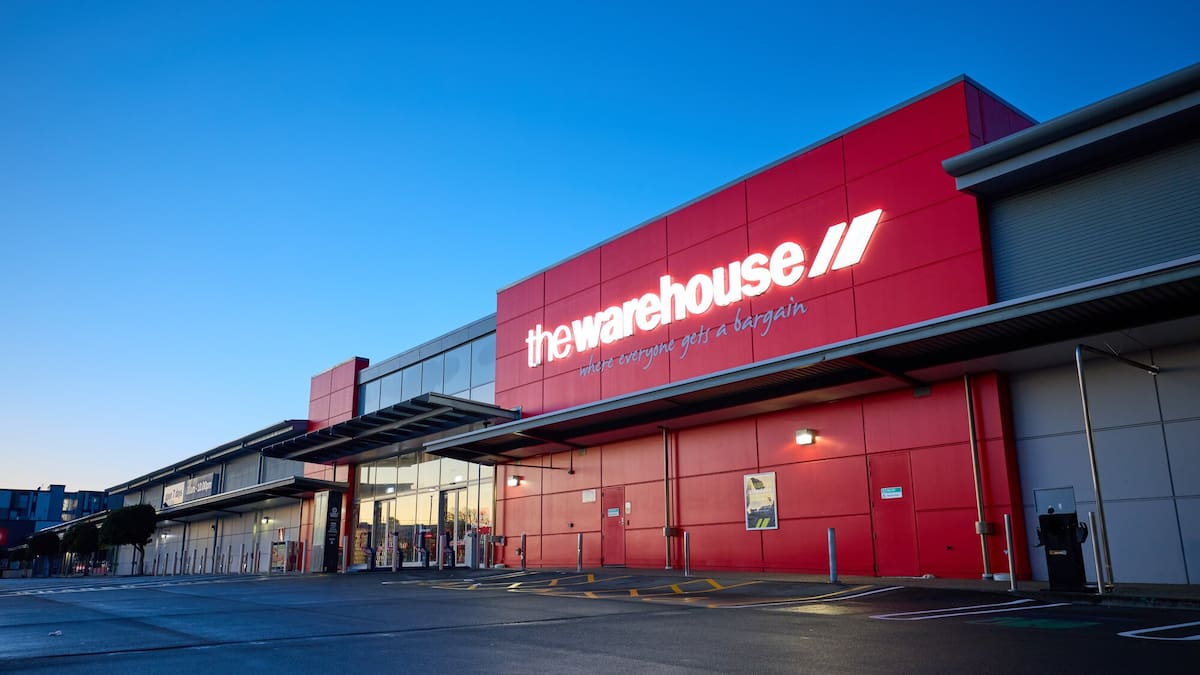
Overall, the group reported a 2026 net profit of $11.2m, up 506% from a net loss of $2.8m the year prior.
The Warehouse Group chief executive Mark Stirton said the performance of Warehouse Stationery and Noel Leeming helped the business fix the retail fundamentals within the Warehouse.
“We talked a lot about fixing the retail fundamentals all the way from the shop floor right into the buying decisions and how we move stock, and a lot of that hard work has really started to pay off in that fourth quarter. We start to see a lot of green shoots come through and from all that hard work,” Stirton said.
“At the same time, we’re investing again in stores, the brand, customer experience and growth. We’ve made a good start, but our ambitions are much bigger, especially for the Warehouse where we’re determined to earn back our place as New Zealanders’ first choice retailer.”
The Warehouse Group chief executive Mark Stirton.
The 2026 financial year delivered positives for the business, with net debt reducing from $96.1m to $17m, operating cash flow lifting to $193.5m, and the group’s cost-of-doing-business (CODB) down to 31.8% of sales.
On the group’s debt position, Stirton said the timing of the financial year played a part, with several outgoings on August 1.
Had the year ended a day earlier, Stirton said the group would have been in a cash surplus.
With an improved financial position, capital expenditure is on the cards, particularly for the Red Sheds.
“I’m very positive we won’t need to be in debt. What we choose to do with the capital is that we need to invest in our stores.
“A lot of our stores haven’t been touched in 15 years, so they’re tired and they really need some investment. How much of that cash flow are we going to have to reinvest back into stores is the key question for us.”
Stirton was also upfront about CODB reductions during the financial year, with the group stripping $29.8m in costs from the business.
Employee expenses reduced by $6.9m, with savings from the support office restructure and Tata Consultancy Services partnership partly offset by higher store and distribution centre wages driven by wage inflation.
IT costs also reduced by $12.6m, driven by lower support charges and more disciplined project activity.
The group has reduced its CODB by 80 basis points as a percentage of sales over the past two years, as it gets closer to its CODB target of 31% of sales.
Stirton said a large portion of that cost related to supply chain, and shared plans to optimise distribution centres, logistics and shipping for the group.
Reducing inventory is another focus, with 21.8% of the group’s inventory categorised as stock six months or older.
On whether the group can hit its target in the next financial year, Stirton said the business was up against rent and labour inflation.
“We’re up against that quite hard. Obviously we’ve made some choices around how we would perform our work, and some of it is in New Zealand and some of it offshore. I think there is still some work to do there, but it’s probably on the fringes.
“We now need to tackle the other bigger buckets of cost and also try and grow the top line. It’s really going to be about how we optimise the branch costs that sit in the branch contribution.”
The Warehouse has simplified its grocery offering to key staples, including eggs, milk and butter.
One area that can support top-line growth is a reprioritisation of higher-margin categories, something The Warehouse has acted on with a simplification of its grocery offering.
While no official figures were released on the category, Stirton confirmed to the Herald its sales contribution was roughly the same as last year.
The last time the group gave a breakdown of grocery’s contribution was in 2024, when it contributed 25.8% of the Warehouse’s wider sales.
With reform of the grocery market now an election issue, Stirton shared more on the group’s participation in the Government’s search for a new competitor.
“We obviously engaged with Government because there’s a lot of Kiwis who are calling for us to be the third supermarket. We’ve chatted about it several times.
“But we did an internal evaluation as to what could we be strategically, what job could we do for our consumers and for New Zealand more broadly. We felt that there were certain items that we were very good at, and there were other items that we were just never going to be good enough at.”
A key issue was supply chain costs, with Stirton acknowledging them as a barrier to entry into the sector.
He also pointed to the impact of infrastructure, recognising the cold chains and chillers structurally built into traditional supermarkets.
“Our stores aren’t designed for that. We also don’t have the logistics supply chain to support that.”
“For us, grocery isn’t just grocery food, there’s health, wellness, pet care and cleaning. We’re doubling down on those because we’re very good at that and we’ve seen traction in that space.”
The group will hold an investor day on November 2 to share more on its strategy for the next three to five years.
Stirton said attendees could expect more on a new store concept for the Warehouse, with a path back to the group’s historic profitability.
Tom Raynel is a multimedia business journalist for the Herald, covering small business, retail and tourism.
Stay ahead with the latest market moves, corporate updates, and economic insights by subscribing to our Business newsletter – your essential weekly round-up of all the business news you need.