
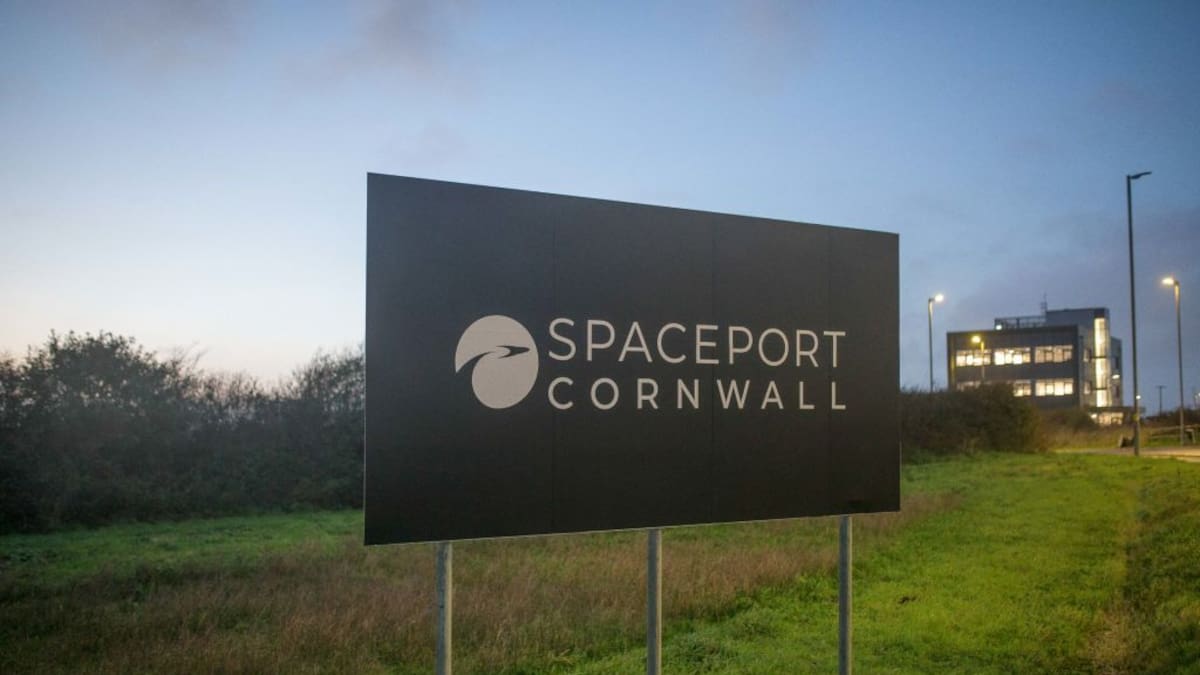
Spaceport Cornwall calling
“We’ve got three organisations coming over, each representing a different slice of space system,” British High Commission technology lead James Araci told the Herald.
“There’s RAL Space, the UK’s main space laboratory.” The initials stand for Rutherford Appleton Laboratory, named in part after New Zealand’s Sir Ernest Rutherford.
“Geospatial Ventures represents UK businesses. They’re a really cool, fast-moving Earth observation satellite data company and they do a lot of kind of infrastructure monitoring for airports and railway companies in the UK. They’re quite interested in seeing how New Zealand does things,” Araci said.
“And finally, we’ve got Spaceport Cornwall.”
Araci says the UK facility is similar to our Tāwhaki National Aerospace Centre – the runway and support facilities at Kaitōrete, south of Christchurch, used by Dawn Aerospace, Kea Aerospace and others for horizontal launches.
The UK delegates are “quite keen to encourage New Zealand firms who want to set up in the Northern Hemisphere to base themselves at Spaceport Cornwall and connect into the ecosystem there in the southeast of England”.
Sir Richard Branson’s Virgin Orbit operated out of Spaceport Cornwall, a horizontal launch facility hosted by a regional airport. Branson’s start-up (separate to his space-tourist-focused Virgin Galactic) attempted to get payloads to space via a rocket released from the underbelly of a Boeing 747. After it went bust in 2023, Kiwi space powerhouse Rocket Lab swooped in to buy Virgin Orbit’s manufacturing assets in the US.
Ironically, the New Zealand aerospace firm that personifies New Zealand-UK co-operation, Syos Aerospace, which operates out of Mount Maunganui and Fareham and last year won a £7.8m contract with the UK Ministry of Defence, doesn’t fall under the UK Space Strategy.
Syos founder Sam Vye will be speaking as part of the “Leaning into security and defence contracting” panel at the summit today, which will also feature the New Zealand Defence Force’s Air Commodore Andy Scott and the New Zealand Army’s Brigadier Matt Weston.
But Dawn Aerospace (whose uncrewed Spaceplane flies to 100km, or the edge of space) has attracted questions. The firm was peppered with questions by a member of the UK delegation during a site visit yesterday.
“However, High-Altitude Platform Stations (Haps) unmanned aircraft that operate in the stratosphere, like those developed by Kea Aerospace, are seen as valuable components of future Earth Observation projects,” Araci said in an email.
Hence, Dawn’s Christchurch stablemate Kea is on British visitors’ radar.
“The UK is looking to combine Space-based Earth observation data with data from Haps for climate and biodiversity monitoring. The UK delegation will be discussing ideas like this with Kiwi companies like Kea Aerospace.”
Such collaboration would benefit both countries, Araci said.
The UK delegation includes:
Ross Hulbert, head of engagement at Spaceport Cornwall; Dr Hugh Mortimer, associate director of the National Laboratories and Harwell Space Cluster manager at RAL Space; and Paul Bhatia, managing director of Geospatial Ventures
Chris Keall is an Auckland-based member of the Herald’s business team. He joined the Herald in 2018 and is the technology editor and a senior business writer. He has recently written about the size of the NZ aerospace industry and anticipated protests at this year’s NZ Aerospace Summit.