
It push Rocket Lab’s launch backlog to “beyond 100 missions”.
But the firm won’t say how many are for Electron and how many are for its much larger Neutron, for which it will charge US$55m per launch from next year.
Neutron will launch exclusively from the US.
Coming up for the ton
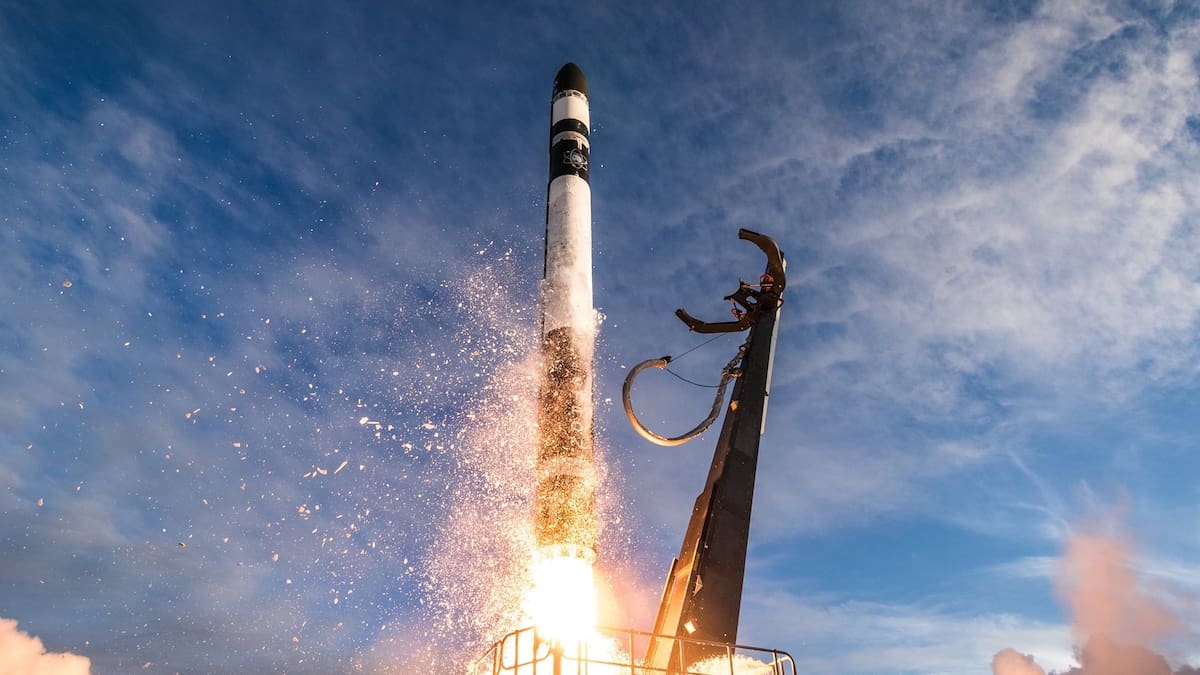
On September 25, Rocket Lab staged its 97th Electron launch since the rocket’s debut in 2017.
So far, there have been 18 Electron launches in 2026, putting it on track to beat its record of 21 set last year.
Rocket Lab hasn’t publicly set an Electron schedule for the 12 months ahead, but one contractor told the Herald they had been told to gear up for a launch every eight days, implying a potential doubling in frequency.
The 20 new missions for Synspective will take place between 2028 and 2031 and will take the number of Rocket Lab launches for the Japanese company to 47.
“Synspective was one of Electron’s earliest customers and together we have proven that tailored, dedicated launch is the fastest and most reliable path to scaling small satellite constellations,” Rocket Lab founder Sir Peter Beck said.
On September 22, the Wall Street Journal reported that SpaceX has stopped taking new orders for payloads on its workhorse Falcon 9 rocket for after 2028. Its larger Starship is to take up the slack, notwithstanding that Starship is yet to have a successful mission – although it came close earlier this week, reaching orbit before a propulsion failure cut its flight short.
This story was updated to reflect that Rocket Lab’s average selling price for an Electron mission has increased from US$7.5m to $US8.5m.
Chris Keall is an Auckland-based member of the Herald’s business team. He joined the Herald in 2018 and is the technology editor and a senior business writer. He has recently written about the British invasion of the 2026 New Zealand Aerospace Summit, the size of the NZ space industry, Syos Aerospace’s first institutional capital raise and how Christchurch is becoming a space city.