
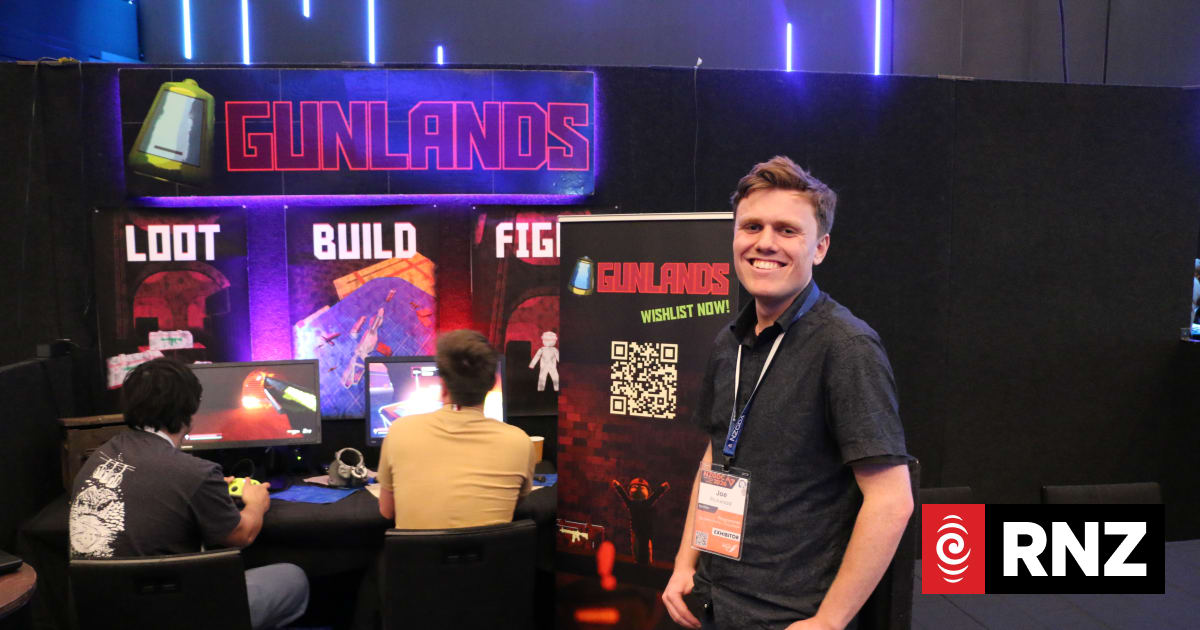
New Zealand’s video game development industry has the wind in its sails, with the industry reporting more than $1 billion of revenue in the past financial year.
The sector is growing rapidly, promising high-paying jobs and digital exports that don’t rely on under-pressure global supply chains.
And it seems that gamers overseas love kiwi creations.
Local video game development industry makes over $1 billion
Joe Rickwood is in his third year of studying game development at the Media Design School in Auckland.
“I’ve just always kind of liked creative stuff, and then my dad one day was like ‘hey you love video games, you love making things, this is kind of a cool career path you could do.'”
Despite the growth in the games industry, it was still tough for new graduates to find work, Rickwood said.
But he decided instead of looking for a job he was going to keep working on his own game and eventually start his own company.
“The games industry is an industry that you can succeed in, whether you have a job or not. A random person can go on Steam, and make a game and it makes a million dollars right?”
One of his tutors at the Media Design School is Rourke Gray-Mason, who said student numbers had doubled in the past five or six years, as interest in the industry grew.
He was also a game developer himself, and had last year received a travel grant from the government-funded Centre for Digital Excellence to show off his game, Dungeon Baller, at the WePlay event in Shanghai, China.
“The New Zealand booth was really adored. We had so many people coming through, lots of publishers were very interested in our game, we already have good trade relations with China so everything was super smooth.”

The New Zealand Game Developers Conference.
RNZ / Luka Forman
That overseas market was a big part of the New Zealand gaming industry’s revenue – 98 percent, according to the NZ on Air breakdown of companies that received the industry rebate.
Rory Rackham worked on one of New Zealand’s most successful games, Path of Exile, and was now running his own company called Hugenormous Games.
The number of independent game producers was growing, but it was still hard to break through, he said.
“It is real tough in game development. There’s a lot of experienced people being kicked out of their jobs. So those people are applying for positions. So for a new student… it’s a lot trickier. A lot of people are just going straight into the indie space.”
Figures from a survey by the New Zealand Game Developers Association sid the industry had surpassed $1 billion in revenue in the year to March, growing 32 percent year on year.
The Ministry of Business Innovation and Employment said it did not have independent data to back that up – but the 43 businesses that received a development sector rebate, which paid out $22 million last year, generated $829m in revenue. Not all studios were eligible for it.
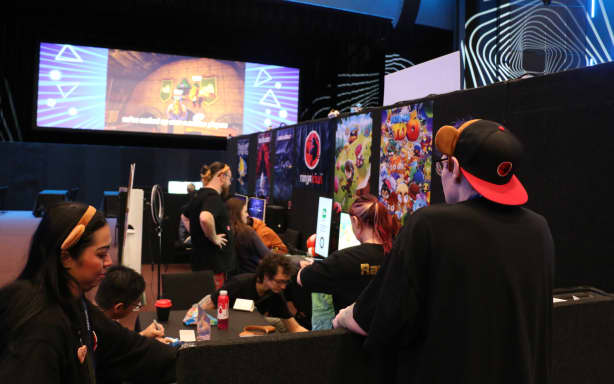
People preparing their store for the conference.
RNZ / Luka Forman
Chris Titford is the head of the creative department for Auckland Council’s economic development arm.
The council is involved in supporting Grid Auckland – a space in the Wynyard Quarter that provides support start-ups with mentoring and investment, he said.
“The gaming sector, it can employ people from a number of other creative industries. You need artists, designers, so we’re keen to support the growth of it.”
The Game Developers Association said the creative, digital and tech sectors combined now likely outperform the primary sector in their GDP contribution.
But MBIE said those sectors had not historically been grouped together, so it could not make a robust estimate of their contribution to GDP or projected growth.