
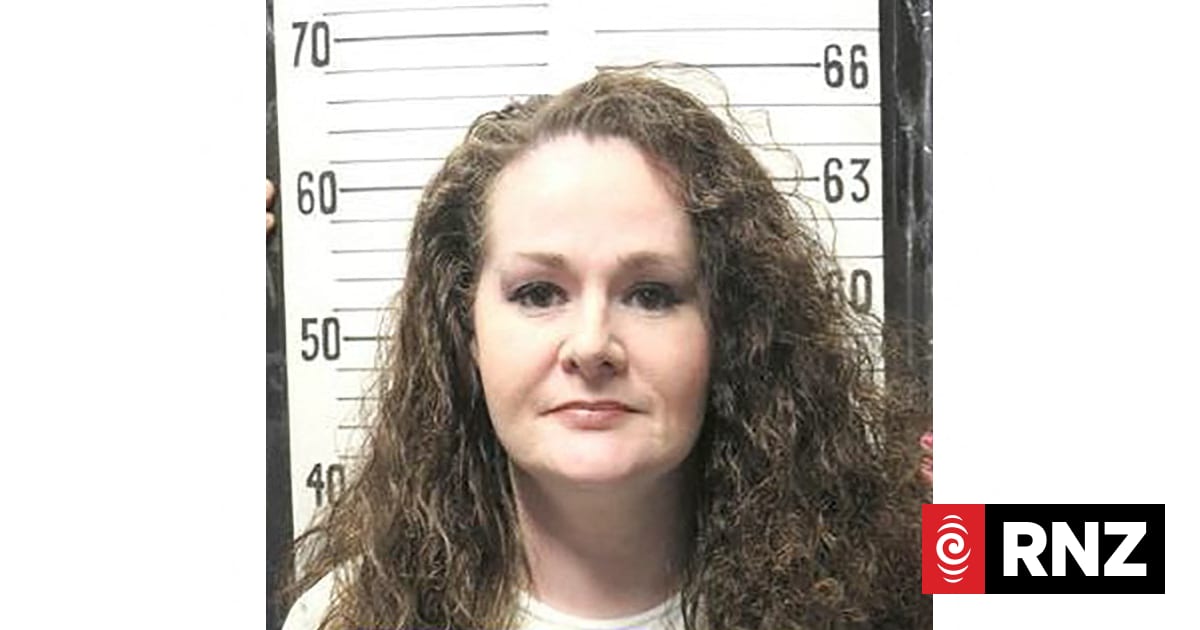
A woman on death row who received two doses of lethal injection drugs has been rushed to hospital after a botched execution attempt.
Christa Pike was scheduled to be executed at a maximum security prison in Nashville at 10am on September 30, local time.
Pike’s execution was delayed after a last-minute stay, with the Supreme Court ultimately clearing the way for it to go ahead a few hours later.
Her legal team said she was still alive more than an hour after the execution drug was administered.
“Tonight the State of Tennessee once again failed to carry out a lawful execution,” Pike’s attorneys said in a statement. “Christa is being treated at a nearby hospital. We have not been informed as to her condition.”
Witnesses were released from the Riverbend Maximum Security Institution, where the attempted execution was held.
Emergency service teams were then seen outside the prison and reportedly left the area with lights and sirens blaring.
Speaking to media, multiple witnesses from the execution chamber said “nothing we saw was normal”.
They noted the process was “abnormally long”, with the curtain being drawn at multiple points throughout the lethal injection being administered
Associated Press journalist Kim Chandler said she had witnessed many executions, but never one in Tennessee.
“I would say that Pike appeared noticeably awake as the execution began,” she told media outside the prison.
“The blinds were closed for the first time to the execution chamber at 7:46pm, they opened again at 7:49pm.
“Her mouth fell open a few times and she began to loudly snore. She gasped a few times.
“The curtain to the execution chamber closed for the final time at 8:06pm and she could be heard loudly snoring, clearly very alive, in the chamber until media witnesses were told to leave the area at about 8:53pm.”
Tennessee has since suspended executions for the rest of the year pending an investigation.
Pike, now 50, was sentenced to death for a murder committed when she was 18 years old.
She was convicted of killing Colleen Slemmer, a 19-year-old fellow student at a training program.
Pike said she had become convinced Ms Slemmer had been trying to steal her boyfriend, who was later sentenced to life in prison for his role in the murder.
Ms Slemmer’s family were set to speak outside the prison alongside Texas Department of Corrections officials.
Neither party appeared, and media assembled outside the prison for a press conference were told they had one hour to vacate the area.
Pike’s lawyers call for emergency stay of execution
Pike’s attorney’s have filed an emergency petition to halt and stay the execution.
Court documents alleged Pike was administered two syringes of the execution drug pentobarbital, but was still alive.
“Ms Pike has not lost consciousness and still has a heartbeat and is audibly snoring,” they wrote.
Her attorneys spoke to local media, saying she needed “immediate medical care”.
Prior to her execution, Pike said in a letter to NBC she was not afraid to die.
“I’m only nervous about the process,” she wrote.
In one of her final requests, she asked for an all-female execution team.
Her lifelong history of sexual abuse and violence, according to court documents, left her terrified at the idea of being held down by men in her final moments.
Her legal team had argued the procedure would be torturous, noting “small veins” and other conditions which made lethal injection difficult.
Tennessee’s history of executions
This is not the first time this year Tennessee has seen a botched execution attempt.
In May, death row inmate Tony Carruthers was given a one-year reprieve after the execution team failed to establish an intravenous (IV) line.
The team said they were unable to complete a back-up IV line or a central line, even after more than an hour of attempts.
According to Carruthers’s legal team, the execution team punctured him more than a dozen times while trying to establish the IV line.
Lethal injection, according to the Death Penalty Information Centre, has the highest rate of being botched.
In a 2022 annual review, the organisation found 35 per cent of the 20 execution attempts that year were “visibly problematic”.