
The Great Try
Season 1
Episode 6
Editor’s Rating
4 stars
****
East of Eden’s penultimate episode introduces the teen versions of Cal and Aron, and wonders what it means to be good.
Photo: Netflix
As someone who is forever thinking about the excellence of Tony Gilroy’s Andor, three words from that series kept running through my head while watching this penultimate episode of East of Eden: “Remember this: try.” Those words are written in “The Trail of Political Consciousness,” a manifesto by young anti-Empire rebel Nemik, and they go directly against Yoda’s “Do or do not, there is no try,” from The Empire Strikes Back. Gilroy was telling us that actually, life isn’t a series of binaries. You’re lucky if you get the opportunity to take multiple stabs at something, to start again, to keep throwing yourself into a cause. The entirety of your existence does not need to be defined as one experience. The world might put limits on you, but you don’t also need to put limits on yourself. Don’t do the work of the system for it. Dare to try.
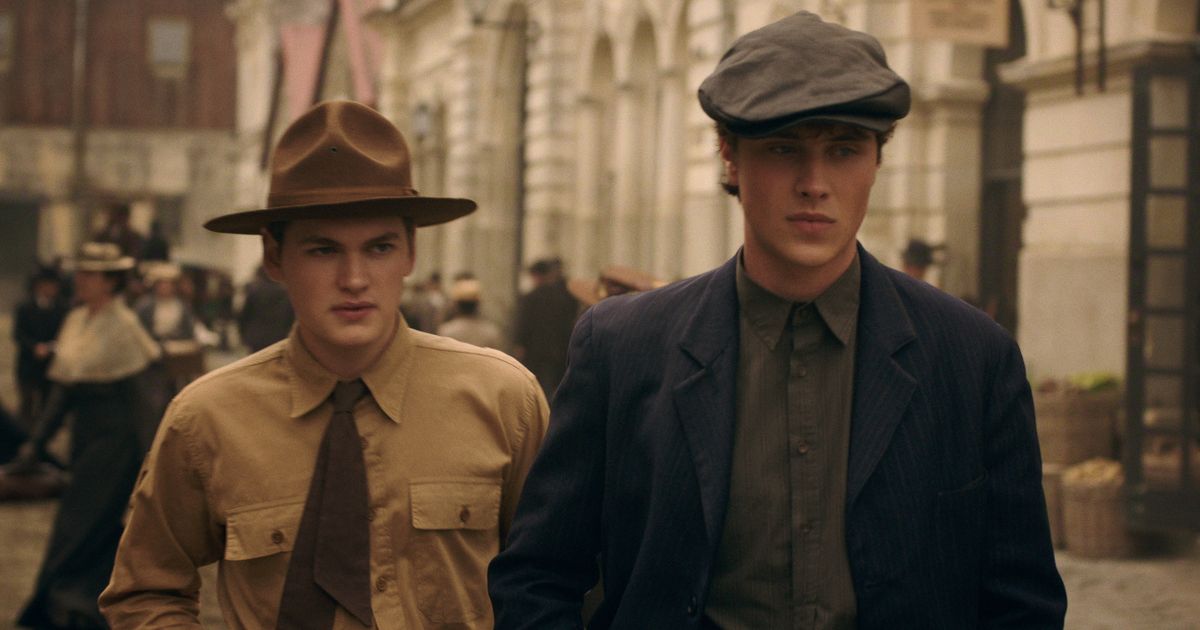
Nearly all of our East of Eden characters are at inflection points. Time marches forward. War is coming. Technology is advancing at a rapid clip. How are they going to meet this moment — through judgment and isolation, or camaraderie and involvement? How will they hold onto their morals in a time that is making it easier to abandon them? These questions involve Adam, Lee, and Kate, but mostly they concern Cal and Aron, who midway through the episode become teenagers played by Joseph Zada and Joe Anders. Zoe Kazan has talked about how budget limits cut the series from eight episodes to seven, and that squeeze is felt in “The Great Try.” With the brothers especially, there’s a little bit too much telling us via dialogue, rather than showing us with full scenes. What kind of “bad” things does Cal think about? In what ways has he not taken responsibility, as Adam says? How do the brothers relate to each other when they spend time together? It’s part of the text that Cal evokes Charles, and Aron evokes Adam, and there’s a family lineage that’s plaguing the boys. I just wish there was more interrogation of the theme in this episode, rather than repetition of it.
Let’s start with Lee, whose storyline in “Departure” gets its concluding chapter here. Whatever equality Lee hoped for in San Francisco, he doesn’t get it. To the white blonde man at the real estate office, Lee isn’t an American, and the guy refuses to rent him a space for his bookstore. When Lee steps back out onto the bustling streets of Chinatown, amid the red hanging lanterns and people in traditional clothes, he stands still, and everyone moves around him; they don’t register him at all. There’s tragedy in this image, but it’s another of East of Eden’s messages: don’t feel sorry for yourself. Lau says as much when Lee finally meets with him. Lee had avoided Lau for years, we learn, because he was embarrassed by his work as a domestic, and he thought Scholar Lau would be disappointed. But Scholar Lau is really Lucky Lau running a baccarat game, and he won’t accept Lee’s self-pity or his disapproval of how Lau is living. “Are you so much a child still to think anyone gets the life they planned? Make what you can with what you have,” Lau advises him. Go back to the home where he felt like he belonged. Try again with the bookstore another time. “Life, if you’re lucky, is long.”
That’s the new mindset that Lee brings back to the Trasks, who were lost without him. (Adam doesn’t know how to wash dishes, bless this utterly useless man.) Lee will no longer allow himself to feel lesser in this family to whom he’s devoted his life. He’ll take Adam’s offered raise, but more than anything, he wants free rein over the household, and Adam’s acknowledgment that Lee is raising Cal and Aron correctly. “Try harder,” Lee says when Adam insists that he’s been a more present parent, and I love the rhythm of this conversation between Christopher Abbott and Hoon Lee, how they measure each other’s words in a calm, adult argument. And I also love that Adam doesn’t treat Lee like he’s a failure for not opening the bookstore, and Lee doesn’t treat himself like he’s a failure for not opening the bookstore, his “great try.” A dream doesn’t die if it’s impossible. It can be put away, like a treasure in a jewelry box, to be reconsidered down the line. There’s such beauty in that idea, and such grace. (When Cal touched Lee’s hand and said “Lee, you came home,” is about when I started crying.)
“The Great Try” then jumps forward four years, from 1912 to 1916; the boys are now 15 years old, and further apart than ever. Aron is inseparable from Abra and helps Adam at his ice plant. Cal is a poor student — “If I tried, people might expect something of me” — and frustrated with how little time he gets to spend with his brother. (Is he jealous of Abra for hogging Aron’s time, or Aron for hogging Abra’s time? Discuss.) And when Cal tries to help Adam with his “big try” business idea to transport California produce across the country in refrigerated train cars, Adam shuts him down. I’m assuming if Adam knew what that rejection would inspire Cal to do, he probably would have let the boy assist. But instead, Cal ends up wandering the streets of Salinas, and then — after learning from Adam’s old ranch hand Rabbit that the proprietor of Kate’s is “poor old Trask’s” wife — inside the brothel. Kate sees Cal, Cal sees Kate, and their shared look is pained, shocked, bittersweet, all those ugly things that Adam never wanted his sons to experience but that Cal now is, because Adam never told them the truth.
Kate has her own problems. Four years after Charles’s death, she’s still hearing his voice, which has become half-conscience, half-devil on her shoulder, and one of the employees who knew her from Faye’s, a woman named Ethel (Amelia Reynolds), is back in town, threatening to spill her theory that Kate killed Faye. Kate gets her muscle Joe (Brad McMurray) and the judge that she has incriminating pictures of to bounce Ethel from town, but Charles is her paranoia, all those worries she’s kept at bay for years finally beginning to crawl up her spine. “She could come back,” Charles whispers, and I wrote in my notes, “She’s losing it.” Kate has all kinds of leverage on people, but she wasn’t prepared to be genuinely threatened, just like she wasn’t prepared for Adam to actually walk away from her back in 1911. And she certainly wasn’t prepared for Cal to find her, this boy she abandoned and never thought about again.
Kate’s conversation with Cal is another version of the conversation she had with Adam, and again, Kate’s thrown off by the honesty of the Trasks, the guilelessness. Florence Pugh plays Cathy’s “Oh, you like them” as if she means to mock Cal for loving Adam and Aron, but in the face of Cal’s innocence, her cruelty is embarrassing. It’s only when she is honest — quietly telling Cal, “Christ, no” in response to his “Don’t you ever wish that you hadn’t left?” — that she genuinely hurts Cal. Her steadfast rejection, coupled with her teary admission of the “meanness” Cal fears so much (“I fooled every one of them, just when they thought they could tell me what to do”), tears this boy apart. The truth tears Cathy apart, too, seen by how quickly she tosses back a little bottle of something — some sort of sedative, maybe morphine? — after Cal leaves. Charles’s voice warns Cathy, “Don’t drink too much,” but Cathy already feels too far gone.
And maybe Cal is too far gone, too. His conversation with Cathy seems to wipe away an earlier lesson Lee tried to give him about how he’s not his ancestry. Lee had insisted, “Whatever you do, it will be you who does it,” but the choice Cal makes to hoard beans in order to sell them at a markup later on, as the Great War progresses and Europe starts running out of food, isn’t altruistic. His entrepreneurial ambition is driven by wanting to show up Aron, who is horrified at the idea of being poor after Adam loses most of their money on a failed shipment of lettuce to New York. Cal isn’t doing all this out of the goodness of his heart. He’s doing this to get one over on his brother, and war profiteering (which Adam was disgusted by) is a particularly nasty way to do it. All of this leads to a question that East of Eden is circling broadly, but that it wants us to answer for ourselves: How do you teach morality? The Trask boys are meant to represent a spectrum of good to bad, but as they’re encouraged to make individual choices, that also opens up the possibility of evil choices, selfish choices, destructive choices. How do you reconcile the power of free will with its ability to harm other people? Just having a choice doesn’t mean the choice you will make is correct.
• In the book, we don’t follow Lee to San Francisco; he leaves, and then he’s back, telling Adam, “Nothing happened to me. I got lonesome … Isn’t that enough? … I don’t want a bookstore. I think I knew it before I got on the train, but I took all this time to make sure.” I appreciate how much time the series devotes to his excursion, and to giving us another father-and-son moment between him and Lau.
• Joseph Zada plays young Haymitch in the upcoming adaptation of The Hunger Games: Sunrise on the Reaping, and you should check him out in the Australian series Invisible Boys, about four queer Australian teens struggling to live authentically in their conservative community. Joe Anders (Kate Winslet’s son) was in the recent Cape Fear adaptation on Apple TV, but there is no world in which I can recommend that to you.
• Kate’s whole madam look, from her underarm hair to her little sunglasses, is perfect. Also, the show Cal sees in the brothel reminded me very much of how the Théâtre des Vampires are introduced in Anne Rice’s Interview with the Vampire, feeding on a human victim onstage in an orgy of sex and violence. Kate’s “It’s not always so clear who is doing the sacrificing and who is sacrificed” only added to that vibe for me.
• Do we think Mad Men got the storyline in which Roger refuses to fund his son-in-law’s refrigerated-truck investment from East of Eden?
• An important Lee moment: Cal admits to him that he knows who Kate is. A heartbreaking Lee moment: When Adam says to Cal that he’s never had anything but a bad father, and Lee, who was watching their conversation, quietly walks away. Adam, who the hell do you think Lee is, if not the boys’ good father?
• Aron whining, “I’m a poor kid” … what an asshole.
Sign Up for the Vulture Newsletter
Entertainment news, for the pop-culture obsessed.
Vox Media, LLC Terms and Privacy Notice