
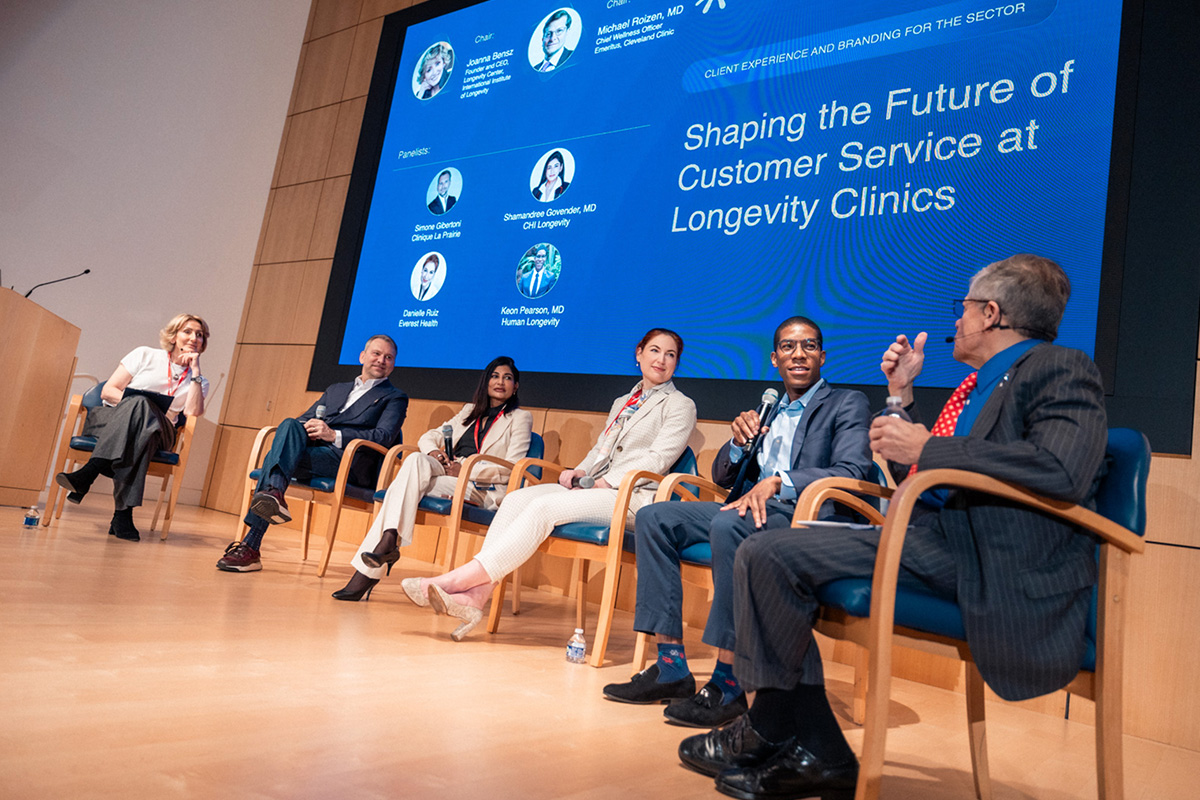
The 4th Roundtable of Longevity Clinics meets at the Buck Institute to shape the evidence and standards longevity medicine still needs.
The Roundtable of Longevity Clinics returns to Novato this October for its fourth outing, and the invitation this time carries a slightly different tone: less “come and see what’s possible,” more “come and show your working.” On 17 and 18 October, the International Institute of Longevity and the Buck Institute for Research on Aging will once again gather the clinicians, founders and technology providers actually running the sector’s clinics – rather than merely theorizing about them.
Four years ago, the questions on the table were foundational: does this field need standards, and who gets to set them? This year’s program suggests the sector has moved past asking whether, and is now grappling with how – examining diagnostics that actually change clinical decisions, AI tools built to support judgement rather than replace it, and business models stretching from stand-alone clinics into hospitality, employer benefits and wellness destinations. Whether that expansion signals maturity or mission creep is rather the question this year’s Roundtable seems built to answer.
Longevity.Technology: Four editions in, and the Roundtable of Longevity Clinics has stopped needing to justify its own existence – which is itself a data point worth noting. What began as a modest gathering of clinicians comparing notes has become something closer to an annual audit of an entire commercial category, in the same California room each year, growing a little more institutional each time. The questions have shifted accordingly. Early editions asked whether longevity clinics needed shared standards at all; by the fourth, the more interesting question is why so few have arrived, and whether hospitality suites, wellness destinations and employer benefit schemes are quietly redefining what a “clinic” even means faster than anyone is agreeing on how to regulate one. This year’s program leans into that tension rather than away from it – putting diagnostics, AI oversight and exosome marketing claims in the same room as movement, joy and Blue Zones philosophy, then asking the public to vote on who did it best. Whether that produces convergence or simply a more sophisticated disagreement remains, as ever, the Roundtable’s real subject.
Built for clinics, not conferences
The program itself signals the shift. Opening sessions survey the longevity clinic landscape as it stands in 2026, before moving straight into Navigating Challenges, Embracing Opportunities – a panel discussion built less around inspiration than around the unglamorous business of keeping a clinic solvent, defensible and clinically honest all at once. Clinic leaders will trade lessons from practice, flag where the field still lacks alignment, and pick over the perennially uncomfortable relationship between clinical responsibility and commercial sustainability. Patient expectations and regulatory environments differ wildly by country; the operational headaches, it turns out, mostly don’t.
 Last year’s line-up boasted a formidable roster – speakers and panelists from the 3rd Roundtable of Longevity Clinics, chaired by Dr Eric Verdin For those who haven’t opened the doors yet
Founders still shaping a concept get their own runway here, with sessions built around the decisions that quietly determine everything downstream: which diagnostics actually support a clinical decision rather than merely decorate a client report, how to explain uncertainty to a patient without losing their trust, which business models hold up once the novelty wears off, and where AI genuinely earns its place in a clinical workflow rather than being bolted on for the brochure. None of it is glamorous. All of it is the difference between a clinic and a concept.
The invitation extends beyond clinicians and founders to the solution providers, technology companies and hospitality operators building the infrastructure around them. For this group, the Roundtable functions less as a conference than as a concentrated room of potential partners – a chance to meet some of the world’s most recognized clinics directly, rather than through a cold outreach email, and to work out where a genuine collaboration might actually fit.
Where the science meets the exam room
Dr Eric Verdin, President and CEO of the Buck Institute, opens proceedings alongside Joanna Bensz, founder and CEO of the International Institute of Longevity, before chairing the principal roundtable of clinic leaders himself and delivering an update on the Institute’s own research. Around them sits a speaker list heavy on people who have actually done the thing under discussion: Dan Buettner of Blue Zones, Dr S Jay Olshansky, Dr Nathan D Price, Dr Jamie Justice of XPRIZE Healthspan, and Dr Smith L Johnston III. Operating clinics bring the ballast – Fountain Life, Chi Longevity, Longevity Center, Cleveland Clinic, Ornish Lifestyle Medicine, Everest Health, Clinica Neleva, Human Longevity and Sheba Longevity Center among them – which is rather the point of a roundtable built around practitioners rather than podium theorists.
Clinics, hospitality and the employer’s easy yes
The agenda pushes well past the stand-alone clinic model, into performance centres, hospitality partnerships, wellness destinations and employer health programs – territory that raises as many governance questions as commercial ones. The Easy Yes: How Longevity Becomes a Benefit Every Company Can Offer takes that head-on, examining the evidence and financial modeling required to persuade an employer, or an insurer, that prevention is worth underwriting. It is one thing to build a clinic; it is quite another to build the case that someone else should pay for it.
Separating signal from sales pitch
Diagnostics sessions dig into biological-age measurement, epigenetic analysis, glycan-based biomarkers and microbiome testing, with TruDiagnostic, GlycanAge and Viome contributing – the through-line being which biomarkers are genuinely actionable, rather than merely measurable. Everest Health, Human Longevity and the Methuselah Foundation will present outcomes from an individualised longevity program running in an actual clinical setting, a useful corrective to conference discussions that rarely make it past theory. Dr Robin L Smith takes on the sharper end of the credibility question directly in The Truth About Exosomes and Peptides: Facts and Fictions – precisely the kind of session a field this young cannot really afford to skip.
Last year’s Roundtable drew a full room – clinicians, founders and technology partners, all under one roof AI joins the chat – a cautious invitation
Reya AI, Longevitix and Guava Health bring the technology discussion into diagnostic interpretation, personalisation and patient engagement between consultations, with the safeguards required to keep professional judgement in charge rather than sidelined. Dr Michael Roizen offers a live demonstration of AI agents in clinical practice; Jamie Justice returns to explore what XPRIZE Healthspan’s pipeline of innovation might mean for the coming decade of care. The question underneath all of it stays consistent: not whether AI belongs in a longevity clinic, but where, exactly, its usefulness ends and its risk begins.
Beyond the biomarker panel
Buettner and Olshansky turn to lessons from the world’s longest-lived communities – movement, diet, purpose, social connection – while a panel on joy and happiness, featuring Dr Marc Brackett, makes the case that emotional wellbeing belongs in this conversation rather than at its margins. Sessions on space medicine, elite sport and sleep round out the physical side, with Smith L Johnston III, Dr Kristen Holmes of WHOOP and representatives of the Red Bull Athlete Performance Center exploring recovery and resilience from angles most clinics rarely get near. The underlying question is a fair one for any clinic to ask itself: capacity and biomarkers matter, but do they add up to a life someone actually wants to live longer?
Prizes, and a public vote
The Roundtable closes its 2026 edition with awards spanning five categories – Longevity Scientist of the Year, Longevity Personality of the Year, Longevity Clinic of the Year, Longevity Diagnostics Company of the Year, and Longevity Innovation of the Year – with voting open to the wider WhatsApp community rather than leaving the decision entirely to the insiders’ room. It is a small thing, in the scheme of a two-day program, but it does something the rest of the agenda can’t quite manage on its own: it puts the audience, not just the panel, inside the credibility question.
Where that leaves the sector
None of this converges on its own. Shared principles, transparent clinical methods, professional education and meaningful outcome measurement don’t emerge from four good conferences – they emerge from clinics actually adopting them, adapted to whatever regulatory and cultural context in which they operate. The Roundtable can only put the conversation in the room; what happens with it afterwards remains, as it has for three editions running, entirely up to the people in that room.
Bring your clinic’s next chapter to the Roundtable. The 4th Roundtable of Longevity Clinics takes place 17–18 October 2026 at the Buck Institute for Research on Aging, Novato, California, with a global invitation extended to clinic leaders, founders and the businesses building around them across Europe, the Americas, Asia-Pacific, the Middle East and Africa. Explore the full program and book your ticket here.
Photographs courtesy of Roundtable of Longevity Clinics