
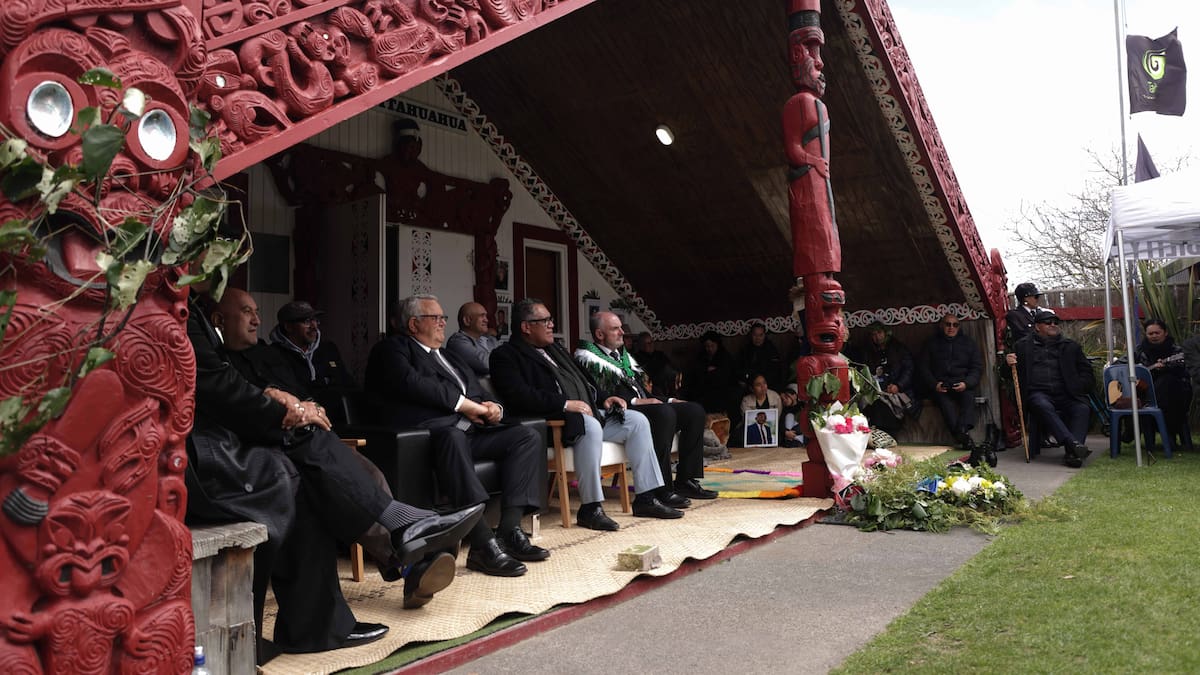
In his final speech as a politician, Rurawhe said he had wanted to leave quietly but his colleagues had insisted he at least give a valedictory speech. He used that speech to thank the scores of people, each by name, who had worked for him or helped him in his electorate of Te Tai Hauāuru, which he held for almost a decade, and as he rose to become Speaker of the House.
Kīngitanga spokesman Rahui Papa told the Herald the Rātana Church, for which Rurawhe was a stalwart follower, and the Kīngitanga were close.
“We were always together. [Rurawhe] wasn’t one of those ones who would get up on the marae or talk to the press, but he would do his mahi in the background.”
Papa said the Kīngitanga told Rurawhe as he entered Parliament that “we can’t see the dog in you”, questioning whether he had the combativeness to succeed in an environment that often thrives off such behaviour.
Labour’s Te Tai Hauāuru candidate in this year’s election, Te Pūoho Kātene, said Rurawhe went on to prove that people did not have to become hard, loud or combative to be an influential politician.
Labour’s Te Tai Hauāuru candidate Te Pūoho Kātene speaks at the tangi. Photo / RNZ
Kātene, who is contesting the seat against incumbent and Te Pāti Māori co-leader Debbie Ngarewa-Packer and National’s Coral Raukawa, said he aimed to serve as a political leader with the same grace as Rurawhe.
Rurawhe was remembered as a man who was at times underrated but had commanded almost universal respect for his oratory and conduct in the House. He was a beautiful, kind and gentle leader who had staunchly advocated for kaupapa Māori causes.
Hipkins, who had changed his campaign schedule to attend the tangi, said he witnessed Rurawhe raise his voice once in Parliament while Speaker in the Labour Government’s last term. It was in response to former National MP Jami-Lee Ross “causing a bit of trouble”.
“I saw Adrian gesture to him to sit down. Jami-Lee Ross was just ignoring him. At a force I had never heard before, and have never heard since, Adrian yelled at him, ‘e noho!’
“Jami-Lee Ross was absolutely stunned and he stood there for a minute and sat down. Adrian said afterwards, ‘Well he wasn’t listening to me in English, so I thought I would see how te reo Māori went’, and then he giggled and walked off.
Adrian Rurawhe was Speaker during the Labour Government’s last term. Photo / Mark Mitchell
“It is the only time I have ever seen him raise his voice in Parliament because for all of the rest of the time, he had this amazing ability just to look at you and you would know whether or not you were doing the right thing.”
Hipkins said a few months ago the party had farewelled him from Parliament.
“He did not indicate to us that he was unwell. He did not indicate to us until only the last few days, for many of us, that he had been unwell. But I think that is a testament to the sort of personality he was – he didn’t want to burden anybody else with struggles, he didn’t want anybody else fussing over him.”
Former Labour MP Poto Williams was in the House during Rurawhe’s rare moment of raising his voice.
“It was just brilliant. He was generous and he was respectful and he was all of those things, but when he needed to draw attention he had the capacity,” she said.
“We all listened, and we all sat down. It was the ultimate kind of teacher moment.”
There were tears and ringing cries of karanga from women in pare kawakawa at the tangi, but there were also lots of jokes from the speakers – often MPs recounting the times Rurawhe had thrown them out of the House.
Speaker of the House Gerry Brownlee spoke of Adrian Rurawhe’s legacy at the tangi. Photo / RNZ
Speaker Gerry Brownlee said Rurawhe had made a “significant impact” on most of the political lives of the MPs who had met him. Addressing Rurawhe directly, Brownlee thanked him for “everything he has left as his legacy on the Parliament of New Zealand”.
That legacy included the two pou that stand outside Parliament, which had been Rurawhe’s initiative.
“Everyone has said he had that gentle nature, that firm nature – the truth is – sitting in the chair [when he was Speaker] he was able to use his temperament and his gentle persona to terrify people.
“A number of times I took Points of Order [a motion in Parliament to question conduct or proceedings in the House] that I thought were very important and Adrian would sit there [as Speaker] with a smile on this face just looking at you, which basically meant – sit down you idiot. That gentle authority, I think, brought to Parliament a dignity that has been a challenge to maintain.”
Former Labour MP Aupito William Sio said Rurawhe was a “good friend and a gentle giant”. The pair ran what they called “the Jasmine club”, a social club for their colleagues who wanted a break from Parliament, usually over a Chinese meal with a beer or whisky on the side.
“He had this silent mana about him – he wasn’t loud, but you always knew he was present,” he said.
“Parliament can change people, but it never changed him every though he reached the highest position in Parliament – becoming the Speaker. It never changed him.”
MP Willow-Jean Prime, visibly emotional after the tangi, said she was proud of Rurawhe, who had become the second Māori Speaker of the House.
“His whānau asked me as a relation of his in Te Tai Tokerau on his Rudolph / Rurawhe whakapapa to place the kākahu around his shoulders and that’s the kākahu he wore in Parliament whenever he was in the speaker’s chair,” she said.
“It was a huge honour and privilege from me from his shoulders. We are all so proud of Adrian.”
Julia Gabel is a Wellington-based political reporter. She joined the Herald in 2020 and has most recently focused on data journalism.