
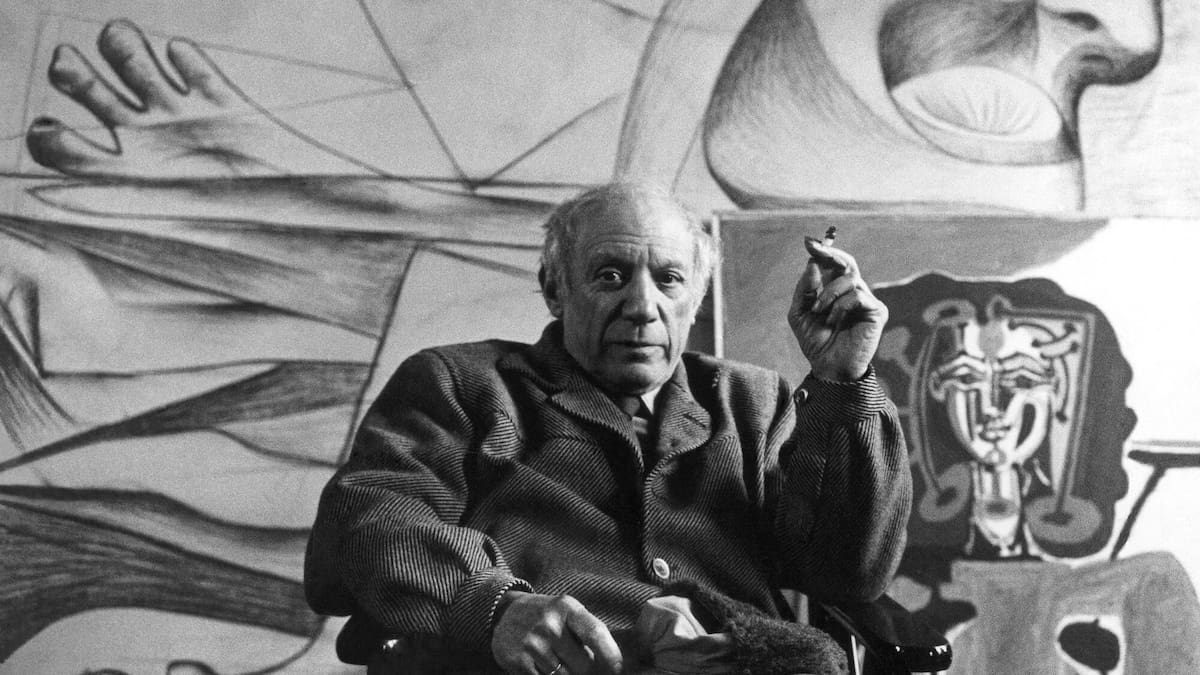
Picasso: Designed by Paul Smith features dozens of the artist’s tortured, complex and colourful works. Photo / Vinciane Lebrun, Voyez-Vous, courtesy of the Musée national Picasso-Paris
Co-curated by Matthiesson and members from the Musée National Picasso-Paris, the exhibit will hold the largest number of Picassos ever in Aotearoa at one time. From paintings and prints to drawings, ceramic works and sculptures, the 80 works have been drawn from key periods in Picasso’s career: his sombre Blue Period, where he painted in cool hues; the perkier Rose Period, warmed up with shades of orange, pink and red; then the masterstroke, the advent of Cubism delivering fractured canvases in giddying perspectives.
Renowned British fashion designer Sir Paul Smith dreamed up the layout of the exhibit. Gallery-goers will be treated to 15 visually contrasting rooms, where Smith has boldly experimented with lighting, colour and patterned walls to mimic the artist’s signature motifs of stripes and harlequin prints.
One room, dedicated to the artist’s obsession with bullfighting, is painted a fiery red, making a brilliant contrast to his many elegant black and white bullfighting drawings. Other highlights include the room dedicated to Picasso’s many interpretations later in his career of Edouard Manet’s Luncheon on the Grass (1883), which is a vivid green room with artificial grass underfoot. If Smith’s brief was to have fun with Picasso – mission accomplished.”
Pablo Picasso’s Le Déjeuner sur l’herbe d’après Manet, 1960, oil on canvas. Photo / GrandPalaisRmn (Musée national Picasso Paris), Mathieu Rabeau, Press Service, Auckland Art Gallery Toi o Tāmaki
Sadness as a gift
Picasso, who trained as a painter in his native Spain, arrived in Paris as a teen. Too poor to afford to live in the glamorous centre of the city, he ended up in Montmartre, which at this stage was no more than a “shanty town”, says Matthiesson.
“He arrived as an outsider on the outskirts of the city. Housing was cheap and congested, yet he enjoyed the company and collegiality of many other artists. The poor and dispossessed were all around him. The Blue Period picks up on this aesthetic.”
In Portrait d’homme [Portrait of a man], winter 1902–03, we see a solemn young man painted in only blue hues with an equally blue, blank expression. Picasso later revealed the identity of the sitter as “a sort of madman one saw in the streets”.
Pablo Picasso’s Portrait d’homme, 1902-1903, oil on canvas. Photo / GrandPalaisRmn (Musée national Picasso-Paris), Mathieu Rabeau, Press Service, Auckland Art Gallery Toi o Tāmaki
During Picasso’s Blue Period (1901-1904), the artist was on the poverty line and had lost close friend Carles Casagemas to suicide, triggering a depressive era that lasted several years.
Charmer, cheater
The iconic portraits of women Picasso produced over his lifetime demonstrated both his love of women and his wariness. Throughout his career, he often reduced women to archetypes, viewing them as either divine goddesses or suffering figures.
His first wife, Olga Khokhlova, was the daughter of a Russian colonel and from a well-to-do family; she met Picasso in 1917 while dancing with the Ballets Russes in Paris. Mindful of Khokhlova’s sense of propriety, Picasso’s early portraits of her, including Portrait d’Olga sur un sofa [Portrait of Olga on a Sofa] summer 1918, consciously avoided the distortion of the Cubist style, instead reintroducing a sense of timeless classicism. Until things went sour.
“His deteriorating relationship coincided with his adoption of surrealism and its emphasis on revealing subconscious thoughts,” Matthiesson explained. And portraits that were, let’s say, not as flattering.
Marie-Thérèse Walter, yet another model in Picasso’s life, was just 17 when she met 45-year-old Picasso. He kept his affair with the golden-haired, voluptuous teen secret, remaining married to Olga, who had borne his first child, Paulo.
Matthiessen says the young Marie-Thérèse was “quietly seductive”, and love-struck Picasso painted many erotic pictures of her.
The pair ended up having a child together, Maya, who features in the work, Maya à la poupée, 1938.
Maya à la poupée, 1938. Photo / GrandPalaisRmn (Musée national Picasso-Paris), Adrien Didierjean, Press Service, Auckland Art Gallery Toi o Tāmaki
“If something or someone captures his attention, he wants to devour it; once he gets inside their skin, he tends to move on and is quite unsentimental about it. Those obsessions could sustain him for five to seven years.”
La Lecture, 1932, depicts Marie-Thérèse Walter, relaxing with a book upon her lap. The figure appears as a web of interweaving lines and coloured areas that mesh the body and chair together. This overlapping of planes creates a new perspective typical of Picasso’s reinterpretation of Cubism in the 1930s.
Another work in the show, Buste de femme au chapeau, 1939, was based on his lover and muse, French photographer and painter Dora Maar. He painted many portraits of the fashionable Maar wearing hats during the late 1930s and 1940s, capturing her quirky style and the tension of wartime Paris.
It was Dora Maar who set out to seduce Picasso this time, says Matthiesson.
“There’s this general perception that he was a user, but women also went out of their way to win Picasso’s attention. Dora Maar was a challenge – she was steeped in psychoanalytic theory and was super avant-garde. She had masochistic tendencies and was only interested in difficult, challenging art. It’s Dora Maar who is credited with getting him interested in politics.”
Pablo Picasso, Buste de femme au chapeau rayé, 1939. Photo / GrandPalaisRmn (Musée national Picasso-Paris), Mathieu Rabeau, Press Service / Auckland Art Gallery Toi o Tāmaki.
Yet again, it doesn’t last.
By 1943, Picasso met the tall, beautiful Françoise Gilot, also an accomplished painter and 40 years younger than Picasso. Françoise was with Picasso for nearly a decade and bore two children, Claude and Paloma, before leaving him, much to his fury – the only woman to have done so.
An abstract thinker and collector
“Picasso was always interested in images from outside his own culture that would allow him to break away from conventional forms of perception, such as ancient Iberian sculptures, African masks and Oceanic images. He looked to the imagery of other cultures to reinvigorate his own,” says Matthiesson.
“He was a magpie, taking bits and pieces of inspiration from other artists, animals, objects, children and everyday life. You could see his art as a visual diary; he dated almost everything he made, right down to the time. We know where he was and what was consuming him daily.”
The day he purchased two sculptures would change the course of his art forever.
“He was offered two Iberian sculptures, a head of a man and a woman; what he didn’t realise is, they had been stolen.”
The artist studied these heads intensely in his studio, taking note of their simplified, geometric facial planes; this examination would catalyse his transition from classical painter to Cubist pioneer, offering multiple perspectives of his subjects.
Buste de femme ou de marin (Étude pour “Les Demoiselles d’Avignon”) is a preparatory painting for this first Cubist masterpiece, Les Demoiselles d’Avignon, 1907. The work shows recognisable influences from the Iberian heads, which were eventually, anonymously, returned to the Louvre, as Picasso was concerned about the consequences of being in possession of stolen goods.
Buste de femme ou de marin (étude pour “Les Demoiselles d’Avignon”), 1907. Photo / GrandPalaisRmn (Musée national Picasso-Paris), Adrien Didierjean, Press Service, Auckland Art Gallery Toi o Tāmaki
The Pied Piper
Picasso also fostered intense relationships with animals, says Matthiesson. They frequently leaped on to his canvases, appearing as symbolic figures like minotaurs and the half-man-half-goat creature known as the faun or satyr; these alter egos representing the duality of humanity, male sexuality and a return to nature.
The artist even had a real-life goat to study. Esmeralda shared his home in Cannes and was much loved by Picasso, who morphed her into experimental sculptures.
Birds appear throughout his work too. The owl motif was common in his paintings and ceramics and based on a real-life bird.
“The injured owl had been given to him in Antibes; he bandaged it up and raised it in his studio. The owl becomes a guardian-type figure in his work,” says Matthiesson.
He painted doves as well (he named his daughter Paloma – Spanish for Dove) and, of course, bulls.
“He somehow manages to capture the essence of the animals he paints. The bullfighting works portray the test of masculinity – and reflect his Spanish heritage and his fond memories of going to bullfights with his father,” Matthiesson explains.
Tête de taureau, 1931, saddle and handlebars (leather and metal). Photo / GrandPalaisRmn (Musée national Picasso-Paris), Mathieu Rabeau, Press Service, Auckland Art Gallery Toi o Tāmaki
The father who yearned to see as a child
Following the birth of his much-awaited first child, Paulo with Olga in 1921, Picasso embraced fatherhood. He delighted in depicting his young son playing with animals and toys. Fatherhood offered the artist a child’s view of the world again.
“He envied children for their innocent and primeval way of seeing the world.
He’d often get down on the floor to play with his children; this led him to paint from this perspective.”
As Picasso famously said, “It took me four years to paint like Raphael, but a lifetime to paint like a child.” Perhaps his children and his many lovers aided him in this ambition. They never had a choice.
Picasso: Designed by Paul Smith is on exhibition at the Auckland Art Gallery from October 10, 2026, to February 1, 2027.