
There was a small illustration before the first away game, when a club official pulled Corica aside. He asked the coach – referring to him as “Gaffer” – what personal gear and clothes he would require for the trip. The next day, when Corica arrived at the team hotel – after a swift journey on the bullet train with the squad – his bag was already in his room, dispatched earlier.
It’s a reminder of the size of the operation – and organisation – at Yokohama, regarded as one of the biggest clubs in the J-League, which is the second-biggest league in Asia, only behind the financially bloated Saudi Arabia competition.
“The scale of everything is so different … just bigger than we are used to,” Corica says. “When we went for a pre-season training camp, there were 75 people on the trip. Basically everyone. And the coaching; Danny is my assistant but he has four coaches under him. Everything is really well resourced. You’ve got everything at your disposal to give yourself a good chance.
Former Auckland FC coach Steve Corica is now at Yokohama F. Marinos in Japan. Photo / Yokohama F. Marinos
Big challenge
The Herald catches up with Corica and Hay in downtown Yokohama – close to the harbour and a short stroll from the famed Chinatown area. After the first few weeks in hotels, both are in their own apartments and enjoying life in one of Japan’s biggest cities.
“We love it here,” Corica says. “The food, the lifestyle … the people have been great. We’re under no illusions; there’s a big challenge on our hands and that was part of the reason we’re here. There’s a lot of expectation at this club and they’ve had a few lean years. We’ve come in with our eyes open knowing all of this and it’s how we turn it around. But so far, so good.”
Corica and Hay arrived in late June and quickly realised the magnitude of the club. They headed off to the pre-season camp in Miyazaki – around 1200km from Tokyo – staying at a plush resort, with the 75 players, staff and officials in tow, while fans turned up at the training ground most days.
“Basically, everyone was there,” Corica recalls. “There were so many people we had to have two settings for dinner. The main group would come in at a certain time, then when we finished another group would come in, office people, other staff. It was crazy and it took us quite some time to work out who everybody was. And all the players have their own rooms when we go away – no one has to share here.”
Steve Corica was a popular figure at Auckland FC. Photo / Photosport
Language barrier
Compared to the A-League, the language barrier is one of the biggest hurdles. From team meetings, individual chats, training and game day, Corica and Hay need to get their message across. They are picking up some Japanese – “Danny is making more progress than me,” laughs Corica, but communicating via third parties is the reality.
“There are three designated translators and at least another couple that can help,” Corica says. “There’s a few players that understand no English and so if you’re trying to get something across, it’s all hands on deck.
So you have lots of people buzzing around. We would traditionally keep our changing room in Auckland with limited numbers and then around the bench limited numbers, but here it’s a little bit like organised chaos because you’ve got extra people around all the time.”
It’s particularly noticeable on match days, with staff needed to relay messages from to players on the pitch, or to the upcoming substitutes.
Steve Corica and Danny Hay need to utilise multiple translators in their coaching roles at Yokohama F. Marinos. Photo / Yokohama F. Marinos
A different level
Football is booming in Japan. The revolution started with the advent of the J-League in 1993, before the 2002 World Cup, co-hosted with South Korea, which was a major spark. From an initial 10-team J-League, there are now three divisions and 60 professional clubs across Japan.
“Each club has maybe 25 or 30 professional players so more than 1500 in total,” Japanese football journalist Wataru Funaki explains. “This is our foundation to develop the national team and the youth. And so many Japanese go to Europe now. Ten years ago there was maybe 30 or 40 players [there]. Now we have more than 100 players and in the top divisions like Premier League, La Liga, Serie A and Bundesliga. And many players come back; they bring their standard, their quality and experience so young players can understand what it takes to be a top player. It’s a great cycle in the last 10 years.”
Understandably, it’s a big step up from the A-League.
“It’s on a different level,” Hay says.
The league is generally regarded as the best in Asia, alongside the Saudi Arabia league and the Korean competition, and usually ranked in the top 15 globally. That shows in every measure, from the fan groups to the payroll. There are 34 players in Corica’s squad, not including the youth and academy ones.
“Normally when we play 11 v 11 [at training], we wouldn’t have many players left over and would probably get some from the reserve team,” Corica explains. “Here, we’ve got like six or seven players that miss out and another five injured or in rehab.”
There are also the little details, including travel. They usually meet at a hotel next to the Yokohama Shinkansen station, then are whisked by bullet train to the relevant city, before stepping into another hotel nearby.
“It’s so comfortable compared to flying,” Hay says.
Meanwhile, the official Marinos team bus has been dispatched a day earlier, to be there in the city to transport them to the match.
“The organisation is amazing,” Corica agrees.
That extends to the daily lunch at their training site, prepared by a team of chefs. As well as miso soup, a salad bar and fruit there are three mains – fish, a chicken or beef dish and then pasta or noodles.
“Players can have all three,” Hay says. “We only get two because they look at us and go, ‘You don’t need any more than two’. But yeah, we are not going hungry here.”
A few hundred fans will often attend training sessions and Corica has 10-15 journalists at midweek media sessions, with at least double that attending matches.
Former Auckland FC assistant coach Danny Hay is loving his time in Japan with Yokohama F. Marinos. Photo / Yokohama F. Marinos
Early splash
Yokohama was a founder member of the J-League in 1992 but its origins can be traced back to 1972, when the team was established as the Nissan Motors Football Club. The organisation, still majority owned by the car-making giant, have been Japanese champions on nine occasions, five times in the J-League era.
Yokohama reached great heights under Ange Postecoglou – who took them to their first title in 15 years in 2019 – then a second-place finish in 2021. Fellow Aussie Kevin Muscat continued the success, with another championship in 2022 and a runners-up medal the following year. However, since the start of 2024 there have been five different head coaches, including two Australians – Harry Kewell and Patrick Kisnorbo – and tougher times, with league finishes of ninth and 15th in the past two seasons.
“[Yokohama] lost the strong culture made by Ange,” Funaki observes. “And then we had players coming from other clubs who maybe didn’t have the quality. Steve Corica has told us he wants to make the culture strong again.”
Corica is aware of the challenges. He inherited a squad – “we have some good players” – and needs to make the best of what he has got. His initial focus, along with Hay, was developing the fitness base and a strong mentality.
“Obviously we would have liked more time in pre-season but we’re learning a lot,” Hay says. “We’re learning about the staff, the players, their mentality, who buys into what, who you can trust.”
Corica made an early splash when he included 16-year-old midfielder Shin Miidera in the first match – the youngest player to feature in a J-League season-opener. The teenager scored, then got the winner in the third game against Vissel Kobe, who had been champions in two of the previous three seasons.
“He had a good pre -season,” Corica recalls. “So l left a couple of foreign players on the bench and gave him a chance. It was like water off a duck’s back. He’s a top little player.”
According to Hay, Corica deserves credit: “People have told us if Steve wasn’t here, he [Miidera] might still be in the youth [under-18 team] this season.”
Despite Miidera’s efforts, Yokohama lost that opening game 4-3 – after being up 3-1 in the second half – in front of 65,000 fans, creating an incredible atmosphere.
“We were very good for 60 minutes and then the wheels fell off,” Hay says. “It didn’t help that seven players were affected by cramp.”
They rebounded the following week with an important 1-0 win on the road, then took down Kobe – thanks to Miidera’s beautiful volley – in an early statement performance. After eight games, Yokohama are sixth in a congested ladder, five points off top and one place outside an Asian Champions League berth.
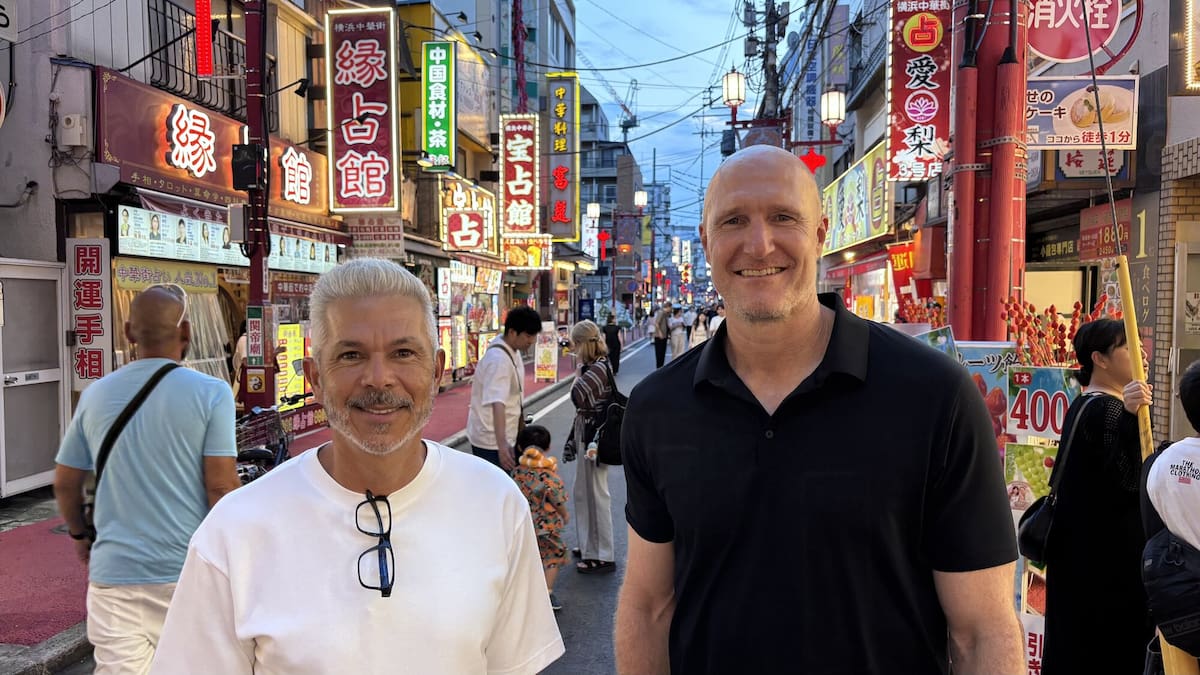
Steve Corica and Danny Hay in Yokohama’s Chinatown. Photo / Michael Burgess
Great expectations
So far, life is good, especially being in such a buzzing metropolis but without the full-on intensity of Tokyo.
“Yeah, I can’t get enough of it,” Corica says. “It’s just so different where we’re living and what we have on our doorstep. And you know, you’re two minutes walking down into a subway and then can be in Shibuya in 45 minutes. So it’s great. The only downside is that family is so far away … you can’t just nip over to Sydney.”
There is pressure from an expectant fanbase, though Corica has made a strong early impression.
“I’ve seen good reaction from the fans,” Funaki says. “He is the best coach for rebuilding the team, I think. He’s a very realistic person and has great experience. Especially Auckland FC, where they were making the club from nothing.”
There will be a grace period from the club hierarchy, with an understanding that there is considerable work to be done after the relative struggles of the last two years, but that won’t last forever.
“They have still got expectations,” Corica admits. “They want to make [Asian] Champions League this year, which is going to be tough. We’re enjoying it so far but obviously it comes down to results and that’s what you get judged on. We are aware of that … it’s just about getting the team going.”
Michael Burgess has been a Sports Journalist for the New Zealand Herald since 2005, covering the Olympics, Fifa World Cups, and America’s Cup campaigns. He is a co-host of the Big League podcast.