
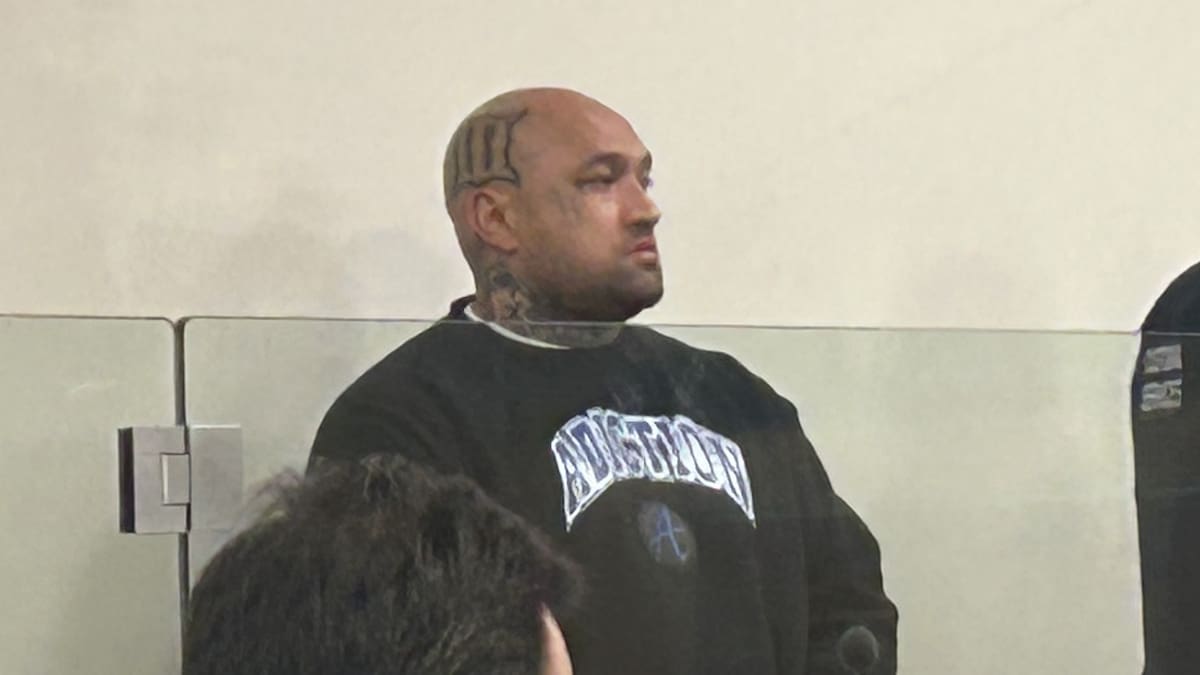
As he returned to Auckland District Court last week for the latest sentencing hearing, Judge Claire Ryan said his failure to take advantage of the second chance meant the landscape had changed since the 2021 appeal decision in his favour.
“He remains a high risk to the public, to the point we’ve crossed that Rubicon that five years ago the Court of Appeal wasn’t willing to cross,” Ryan said. “This is a man who only last year had a [parole-required] safety plan, which he ignored.
“These kids were screaming. They were terrified. You can’t take away from that. He had a safety plan. He ignored it.”
And it wasn’t a one-off lapse in judgment, she noted. When police executed a search warrant at his home last September, six months after the aggravated burglary, they found a 3D-printed AK-47 “clone” – a weapon that would have been illegal even if Lisipa had a proper firearms licence.
Salemona Lisipa has spent the vast majority of his adulthood in prison, a judge noted at his latest sentencing. Photo / Craig Kapitan
At that point, he was recalled to prison to resume the sentence he had been paroled for. His latest sentence will be served cumulatively with that one.
There’s no question, the judge noted, that the 37-year-old had a difficult upbringing that put him on the state care-to-prison pipeline.
But at this point, the protection of the community must take precedence, she said.
‘Not a successful reintegration’
Lisipa, the court noted, has spent the majority of his adult life in prison. He had 18 Youth Court notations and an equally lengthy adult history, including 10 aggravated robberies.
He had a “formidable history of serious offending” before his 2017 spree, the Court of Appeal noted in its seven-page decision in 2021.
That spree included the robbery of a Glen Eden shop in which he smashed a glass cabinet with a hammer and took nine mobile phones; an assault with intent to rob in which he pointed a shotgun at bank tellers but left without any loot after security screens were deployed.
Police later released CCTV footage of the failed heist.
There was also an after-hours TAB burglary with a hammer in which workers locked themselves in a back room as he took $2000 from the till; the aggravated robbery of another TAB in which he threatened workers with a screwdriver and stole $16,000; and an unsuccessful burglary of the same TAB on another occasion.
He used stolen vehicles to travel to each heist, it was noted.
Lisipa denied the allegations but an Auckland District Court jury found him guilty.
Those crimes were committed nine months after Lisipa was released on parole for three aggravated robberies. He had been sentenced in 2010 to seven years’ imprisonment with a minimum term of three years and nine months. He served the entire term.
And in 2006, at age 17, he had been sentenced as an adult to two-and-a-half years’ imprisonment for two robberies and four aggravated robberies.
“Yours was plainly not a successful reintegration into the community,” Judge Gibson noted in 2019 of the offending two years earlier. “Innocent members of the public and employees at legitimate businesses were clearly placed at risk by you.”
Judge Gibson noted Lisipa’s “fairly blase” attitude towards his background and “calculated” offending, along with his methamphetamine use, made the 2017 crime spree somewhat “inevitable”.
“You have had plenty of opportunities to try to rehabilitate yourself,” Judge Gibson said.
At the most recent sentencing, Judge Ryan quoted her colleague at length, describing Judge Gibson’s remarks as “prophetic”.
‘Prospect of a different future’
While Judge Gibson had plenty of documents about Lisipa’s criminal history, he was not given an independent cultural and background report.
Such reports, which were more commonplace before lawmakers cut public funding for them in 2024, are intended to humanise defendants by showing how their often-traumatic backgrounds shaped them.
New reports are not typically allowed for appeals, but the Crown did not oppose the appellate panel considering Lisipa’s background.
It showed Lisipa had started showing behavioural issues as early as 10, when he helped form a street gang.
He was expelled twice starting in intermediate school and later joined two of his siblings in the Crips gang. He was sent to boys’ homes in his early teens, followed by youth justice facilities and eventually prison.
“His life went on a criminal trajectory as a result of wrong choices made when very young,” the Court of Appeal noted, agreeing with the report writer that there was a sense of hopelessness from Lisipa because of him having been “institutionalised”.
“He knows no other real life and in his short periods of release he struggles to cope,” the appellate panel wrote. “His life history has left him with limited skills to assist.”
But he was “beginning to gain insight”, the report writer said.
“This insight includes remorse for victims but also awareness of what he personally has missed out on,” the Court of Appeal said.
“There is said to be some awareness of a need to change.”
Rather than snuffing that potential for change, it should be nurtured, the judges decided.
The appellate panel said Judge Gibson’s decision to uplift Lisipa’s sentencing by 18 months for his prior history was “stern” but not uncalled for in the circumstances.
However, the district court judge’s decision to impose another “stern” uplift of six months for having offended while on bail was deemed excessive and quashed.
Additionally, the panel allowed a 5% reduction for the background report and his interest in rehabilitation. It brought his end sentence to 12 years and 10 months. His minimum period of imprisonment, which had been the maximum allowable two-thirds of his sentence, was quashed and replaced with the standard one-third requirement.
Serial robber Salemona Lisipa was caught on CCTV robbing an Auckland bank in 2017.
The panel noted the Parole Board still might make Lisipa serve his entire sentence, described as a “safety valve” if he didn’t show genuine efforts at rehabilitation.
“However, there is as noted the prospect that Mr Lisipa may be seeking a different future and it would be unfortunate if access to assistance with that transition were blocked,” the judgment stated.
“Faced with a person as plainly institutionalised as Mr Lisipa, and presented with some prospects of change, we consider it correct to foster that opportunity, albeit against the background of what remains a necessarily lengthy sentence.”
The resulting 10 months he spent on parole in 2024 and 2025 was the longest he had stayed out of prison in his adult life.
‘Where’s the chicken?’
“I’m here to deliver the chicken.”
That is what Lisipa said in February last year after he parked in the driveway of a stranger’s home and walked up to the front door.
Two adult sisters went to the front door, one holding an infant, and told him he must have the wrong address. The woman holding the baby attempted to push the door shut, but Lisipa had already positioned his body halfway in the doorway and pushed back.
He shut the door behind him after he entered the house, with the likely purpose of trying to reduce witnesses, Judge Ryan said.
“Where’s the chicken?” he asked the women repeatedly. “Where’s the money?”
The mother started screaming and told her children to do so as well, hoping neighbours would hear.
“Be quiet,” Lisipa ordered as he pulled a weapon out of his side bag.
Court documents state the weapon was “either a knife or a gun”, but Lisipa later said it was a knife and the judge agreed to give him the benefit of the doubt since there was no proof otherwise.
Lisipa then put the knife away and focused on a victim’s purse, removing a phone and wallet. He decided to abandon the endeavour after the children continued to yell for help.
However, the vehicle he had parked in the driveway wouldn’t start and he fled on foot. Police later found a case for an airsoft gun in the car.
‘Nothing changes’
Defence lawyer Luke Elborough told Judge Ryan last week that his client didn’t realise children were in the home. But he clearly could have chosen to leave immediately when he saw the children, the judge responded, noting Lisipa instead decided to pull out the weapon.
The lawyer also submitted to the court a letter of apology from Oranga Tamariki confirming that Lisipa’s time in state care had been a traumatic experience.
Serial robber Salemona Lisipa sits in the dock at Auckland District Court while defence lawyer Luke Elborough (foreground) addresses the judge at his sentencing. Photo / Craig Kapitan
The defendant’s family described him as someone who still has a great deal of potential and hope despite his history and the most recent setback.
Elborough said Lisipa had been working at a fresh start, remaining abstinent and starting a water-blasting business. But pressures mounted and he slipped after running into an old acquaintance from the criminal underworld, the court was told.
Judge Ryan ordered a sentence of three years, taking into account the sentence he is already serving. She agreed with prosecutor Ruby van Boheemen that Lisipa should serve at least half of the latest sentence before he can apply for parole.
The new sentence won’t start until completion of the punishment or parole for his 2017 crimes.
Lisipa still has a genuine desire to turn his life around, his lawyer said. But Judge Ryan responded that the assertion needs to be viewed with some scepticism given its repeat nature.
“Every time he offends he expressed some sort of remorse … and every time nothing changes,” she said. “I don’t know what I can do to make him change. I know other people have tried.”
Craig Kapitan is an Auckland-based journalist covering courts and justice. He joined the Herald in 2021 and has reported on courts since 2002 in three newsrooms in the US and New Zealand.