
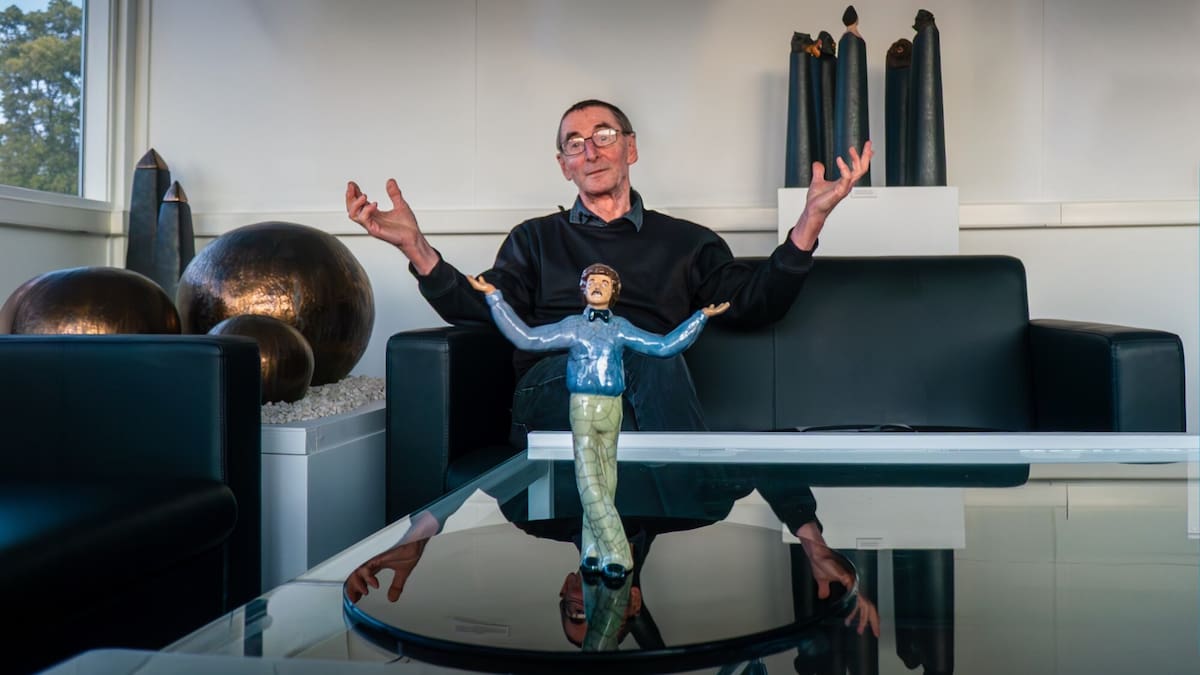
Farley said Vessel was their fourth film featuring Whanganui artists.
Writer and producer Melita Farley said the feature documentary Vessel followed artists being reunited with their art in Quartz, New Zealand’s only museum dedicated to studio ceramics. Photo / Double Farley
“We don’t just do artists, but that’s been a big draw in Whanganui because people are really interesting.
“Showing people that there is beauty and enjoyment in life, even though things can be difficult sometimes.”
Rudd opened the Quartz Museum of Studio Ceramics in 2015, using money from the sale of his Castlecliff house.
The museum, in the brutalist Munford House on Bates St, showcases historical works from the inception of studio pottery in Aotearoa in the 1920s to today.
Current exhibitions include works by John Crawford in A Remembered Reflection, ending in December, and Curious Creatures by Mark Rayner, which ends this month.
“A lot of people in Whanganui have never been to the museum, and I’ve been open for 11 years now,” Rudd said.
“I don’t know what the next thing will be. I’ve been funding this place for 11 years, I can’t keep doing it.
“The [Rick Rudd Foundation] has found some money to pay someone three days a week, most weeks of this year, but that is finishing very soon.
“I have been able to take some time off because of that. I’ve done three workshops around the country and a week ago I went up north to [Auckland Studio Potters].
“I really want Whanganui to embrace this place, just as they do the Sarjeant Gallery.”
Rudd hoped for a positive response to the film.
“It takes you through my making of one work from beginning to end, and there’s some wonderful people talking about this place.”
Melita Farley and Kevin Double run Double Farley Creative Partners. Photo / NZME
Double said the film was a chance to see New Zealand’s ceramic legacy, and the man behind it, up close.
“Rick has spent decades safeguarding New Zealand’s ceramic legacy, often out of the spotlight,” he said.
The couple’s first film, Set in Stone (2017), followed the reconstruction of the Pākaitore Māori War memorial. It won the DocEdge Award for Best New Zealand Emerging Filmmaker and second place for Best NZ Feature Film.
Their other projects include Richard Wotton: Moments Later, a short film about the Whanganui photographer, and a film about Ron Fisher’s Whanganui record shop, You Can’t Just Sell Records.
Farley said it took a year to edit the 75 hours of footage for Vessel.
“We approached Rick quite a long time ago, originally, and said we’d really like to make a film about you.
“Eventually Rick kind of relented and said, ‘Yes, you can come and film’.
“We’ve also talked to quite a few of the potters who had significant works in Quartz as well.
“The way we film, we tend to work with what’s there, and the story emerges. We’re very grateful for people allowing us into their lives to that extent.”
A previous ceramics collection at Quartz Museum of Studio Ceramics. Photo / NZME
The film received no external funding, Farley said.
“We did apply to the Film Commission but, just like everybody else, there is very little funding available for the arts at the moment.
“We don’t make money from our documentaries, but we love making them, and we love sharing kind of a slice of Whanganui with the rest of the world.”
It would be pitched to film festivals and television providers worldwide.
“We do have some more films on the back burner at the moment, but we’re always seeing interesting things around.”
Attendees can stay after the screening for a Q&A with Rudd, Farley and Double.
Farley said they wanted as many locals as possible to see it on the big screen.
“So we’ve made it pay what you can.”
Doors open at 6.45pm, with the screening at 7pm. Entry is cash only.
“Lidded non-alcoholic drinks and zero-mess snacks are welcome during the screening.”
Quartz is open Tuesday to Sunday, 10.30am to 4pm, with more than 1100 works on show.
Noam Mānuka Lazarus (Ngāti Whātua o Kaipara) is a multimedia journalist at the Whanganui Chronicle.