
According to the company’s financial statements posted to the New Zealand Companies Office, the local arm reported total sales of $47.7 million in 2025, up 6.4% year-on-year.
However, the company reported a net loss of $203,668 for the year, down from a $1.2m profit the year prior, after expenses including distribution increased from $10.3m to $12.1m.
New Balance DTC director APAC Jonathan Clark was in New Zealand to open the new store.
New Balance DTC director APAC Jonathan Clark said that while New Balance had grown, resonance in New Zealand had lagged behind.
“One of the five strategic pillars [for New Balance] is DTC first. What that’s grounded in is a recognition that ultimately the stores are the brand. You walk into any mono-brand environment and it’s a tangible realisation of what that brand represents. For us, we want to create those emotional connections through to customers,” Clark said.
“New Zealand has been a market that we’ve been in business for about 30 years. It took us a little longer than we’d like to find the right store. We wanted to do a couple of things, we obviously need to hit all of the financial benchmarks, but we also wanted this store to do a brand job.”
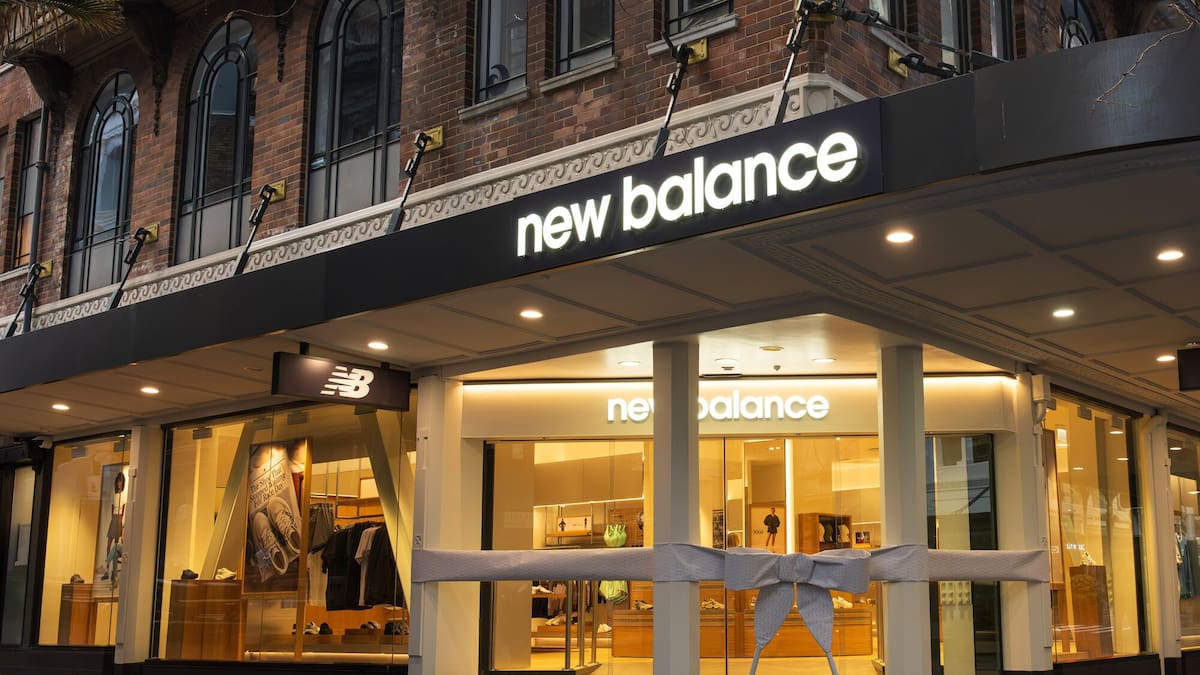
Clark said the new permanent full-price retail store would fill the corner site on Vulcan Lane and Queen St in Auckland’s CBD, sitting close to 300sq m.
The ground-floor site at 1 Vulcan Lane was formerly home to jewellery brand Michael Hill, which has since moved to 94 Queen St.
The store will showcase a broader product mix, with at least 50% of the space dedicated to apparel.
Clark said the store would look markedly different to most sports stores in the market, saying the business spoke with about 8000 customers globally to design the format.
Key differences include a noticeably lower assortment density, at least a third lower than its competitors, designated seating facing each other for greater customer interactions, and zero screens throughout the store.
The Queen St store is noticeably different to other sportwear retailers in the market.
The product assortment will largely be genderless and category-less, with the exception of a fixed portion dedicated to running products.
Clark said for the brand to live at the intersection between sport and culture, it had to offer head-to-toe solutions for customers.
The business had been searching for a permanent site for more than two years, according to Clark, with the site’s size a key factor in its decision.
“The prime consideration we look for in a retail site is what is our traffic volume and what is the composition of that traffic. Do we actually have retail traffic? Particularly on a high street and a mall, it’s largely retail traffic. Then it’s a question of what are the demographics and do we have the right audience there for us.
“The growth in traffic we’ve seen in Queen Street will play a reasonably significant part in the store. The return of tourists and the facilities like the City Rail Link we anticipate will support further traffic growth. But we looked at the fashion street down the end of Vulcan Lane, the profile of that customer, the volume of traffic and the growth, and it all lines up to be a pretty promising location.”
Clark, who has worked for New Balance for the past 20 years, said it was a challenging time to be in the sports industry, hinting at competitor Nike’s experience as a clear example.
Nike was removed from the S&P 100 on September 21 after almost 18 years, and its share price has dropped nearly 80% from its 2021 peak, with revenue down 10% over the past two years.
Unlike Nike’s former strategy, Clark said the business’ wholesale partners were integral to the brand, allowing them to reach customers conveniently and giving them the opportunity to choose.
New Balance is expected to surpass $10 billion in global revenue, making the brand the third largest in its category behind Nike and Adidas.
Despite confidence in its wholesale partners, Clark confirmed more dedicated retail stores were on the way, suggesting three other locations would likely be added to the network.
As for where, he suggested Auckland had the capacity for two more stores, specifically name-dropping Sylvia Park Shopping Centre as a likely candidate, alongside a dedicated store in Christchurch.
Looking ahead, Clark said the brand had several goals, with running a key category it needed to win at.
“The global ambition is, and we’re pretty close to it, is to be the clear number three global sports brand on the planet. That piece of work, particularly coupled with this growth in lifestyle that has fuelled our growth for the last five years, is the bullseye for us.
“Then we have to navigate our way through the geo-uncertainty and soft consumer confidence so that we can continue to show up in a way that is compelling and brand first for customers, avoid the noise and the discounting and all the other reactionary tactics that you see from the trade.
“Those are going to determine the next few years for us.”
Tom Raynel is a multimedia business journalist for the Herald, covering small business, retail and tourism.
Stay ahead with the latest market moves, corporate updates, and economic insights by subscribing to our Business newsletter – your essential weekly round-up of all the business news you need.