
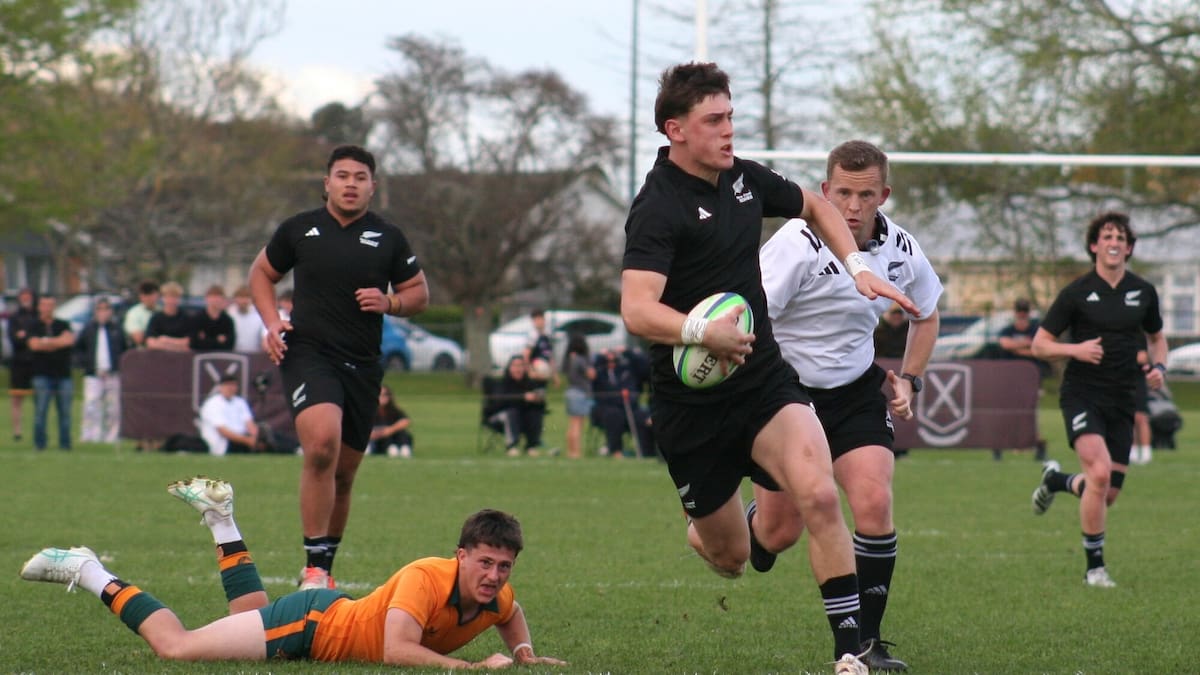
In other matches, Taranaki U19 beat Tonga U18 55-7 and New Zealand U18 Barbarians savaged Samoa U18 90-3, after leading 40-0 at halftime.
The classy Australia U18 outfit have now taken their unbeaten run to 14 matches and celebrated their fourth successive victory over New Zealand Schools, in getting home six tries to five.
In an up-tempo contest which swung on a handful of critical plays, New Zealand led three times, and regularly looked more creative on attack, which was quite the turnaround from last year when they suffered two traumatic losses in coughing up 136 points.
Australia’s advantage primarily came from their rolling maul and a structured game plan in kicking for territory to get into scoring positions.
However, they also needed their captain Justice Taumoepeau – who has been on the radar of union and league scouts since he was 13 – to conjure up an amazing superhero try-saving tackle five minutes from time to be certain of victory.
By contrast, New Zealand Schools crafted some classic tries from their backs, with fullback Jack Brock, left wing Matt Fleming (2), centre Nico Stanley and replacement halfback Carlos Nordstrom all crossing the chalk.
New Zealand Schools winger Matt Fleming on his way to scoring his second try against Australia U18s.
While frustrating to lose at home, the New Zealand camp’s mood was far from downcast with coach Kane Jury proud of his team.
“We’ve got a really good hard-working group of young guys and that was an awesome performance,” Jury said.
“I thought we had some really awesome attacking moments and defensive moments too.
“Personally, I thought we played the better footy on both sides of the ball and put them under pressure. There were just little small moments where we didn’t control.
“I’d like to think that what people saw today was a game where we were really trying to represent how Kiwis want to play, spin the ball and run free.
“As much as we want to win, I think what we’ve done here has probably restored a bit of belief from people outside of our group that we have talented rugby players here in New Zealand.”
New Zealand Schools made a promising start in the fourth minute when fullback Brock went over in the corner after tidy phase play.
Australia had an easy try out wide to wing Taj Scarr shortly after and then the first of two maul tries to hooker Oliver Smith.
New Zealand Schools increasingly seized the initiative and in one surging move, with first five-eighths Fletcher Cooper dancing like Fred Astaire, looked destined to score until blindside Solomone Halaufia dropped the final pass.
They drew level at 12-12 when Cooper executed a pinpoint crossfield kick for left wing Matt Fleming to collect and score.
Co-captain Nico Stanley about to score for New Zealand Schools. Photo / Bruce Holloway
Then came a further sensational try to centre Nico Stanley after a delightful inside ball from Cooper for a 19-12 halftime lead.
Smith picked up his second maul try early in the second half to take his tally of these to five in two matches in Hamilton.
But if this is to be the future of prolific try scoring in international rugby, is it worth addressing the value of rolling maul tries?
After input from Cooper, Fleming showed his pace and strength to scorch 50m for his second for New Zealand.
Lock Harrison Asi levelled at 26-26 for Australia and they added two further tries for a comfortable margin in the final minutes, though Nordstrom squirmed over in the final play of the match.
New Zealand were disrupted by injuries. Wing Kobe Nahrrun had a gruesome finger dislocation early but stayed on, Brock departed in the second half with Finn Hurley going to fullback, while Stanley twisted his ankle in a tackle, was strapped, and seemed to have diminished mobility after that.
Cooper uncharacteristically missed a penalty and conversion he would usually nail, but is clearly a generational talent and an excitement machine at first five-eighths.
From New Zealand’s perspective, it’s a helpful omen for next year that the greatest prodigies in the New Zealand backline, Cooper and Fleming, are both Year 12s capable of so many moments of flair.
The pair first forged a friendship at Condor Sevens last year as two rare Year 11s, and Cooper seemed to intuitively know where the Westlake talisman might be.
That’s significant, because more established combinations are one of the prime benefits Australia enjoys from being able to mainly select from a handful of competitions in Queensland and New South Wales, whereas New Zealand Schools’ talent comes from far and wide.
Australia also run an annual Super U16 competition as well, which allows their players to play together (and against each other) well in advance of the U18s.
Australia U18 have now beaten New Zealand Schools four consecutive times. For context, the Wallabies have never beaten the All Blacks successively that often. Their best effort is three in 1929, 1998 and 2000 and 2001.
The Australia Schools/U18 record for most wins in a row is 19 and they have won 200 of 272 games across various iterations.
Australian defenders tackle hard-charging New Zealand Schools blindside flanker Solomone Halaufia. Photo / Bruce Holloway
New Zealand Schools: 1. Julius Toimata (Wellington College) 2. Lucas Goodman (Feilding High) 3. Tevita Fakava (Feilding High) 4. Kelekolio Makasini (Otago Boys’ High) 5. Jay-Morris Rawiri (St John’s College, Hamilton) 6. Solomone Halaufia (Hastings Boys’ High) 7. Te Ariki Rogers, (Rotorua Boys’ High) 8. Carter Pirie (Napier Boys’ High) 9. Nikora Mata’afa (St Thomas of Canterbury) 10. Fletcher Cooper (St Patrick’s College Silverstream) 11. Matthew Fleming, (Westlake Boys’ High) 12. Cruz Kea Cameron (St Kentigern) 13. Nico Stanley (Auckland Grammar) 14. Kobe Narruhn (Mt Albert Grammar) 15. Jack Brock (Southland Boys’ High).
Subs: 16. Max Hammond (Gisborne Boys’ High) 17. Liam Newfield (Christchurch Boys’ High) 18. Lennox Kopelani (St Andrew’s) 19. Donncha McNamara-Taele (St Patrick’s College, Wellington) 20. Luchian Opperman (Rosmini College) 21. Carlos Nordstrom (Hamilton Boys’ High) 22. Zy Woodham (Timaru Boys’ High) 23. Finn Hurley (Southland Boys’ High).
Australia U18: 1. Mark Falaniko-Peterson. 2. Oliver Smith. 3. Isaiah Sheck. 4. Harrison Asi. 5. Jack Burton. 6. Hunter Reich. 7. Justice Taumoepeau (c). 8. Tahj Smith. 9. Flynn Farrell. 10. Wilson Ruthven. 11. Taj Scarr. 12. James Smith. 13. Taione Taka (vc). 14. Aidan Wunsch. 15. Jack Plamondon.
Subs: 16. Aiden Luke. 17. Iliyaz Viliamu. 18. Hasani Bloomfield. 19. Jack Calleja. 20. Bareek Kleine-Deters Ausage. 21. Izak Holmes. 22. Jack Proctor. 23. Faf Krueger.
Australia U18 40 (Scarr, Smith 2, Asi, Bloomfield, Holmes tries; Ruthven 5 cons) New Zealand Schools 33 (Brock, Fleming 2, Stanley, Nordstrom tries; Cooper 4 cons).
Getting to the point
New Zealand have conceded 40, 55, 81 and 38 points in their past four defeats to Australia. But before 2023, their highest scores conceded were:
1979: England, 4-23.1992: Ireland, 27-25.1997: Australia, 23-27.2014: Australia, 34-24.
The 1979 England Schools team that toured Australia and New Zealand won 12 of 13 games and thrashed New Zealand 23-4 in the “test” in Pukekohe. Nigel Melville later became the youngest player to captain England in a senior international against Australia in 1984.
The halfback played 13 tests and has since been a prominent administrator. Other notable internationals were Bristol loose forward Andy Dun and Toby Allchurch (born in Karachi, Pakistan). All Black and Kiwis league international Dean Kenny and Canterbury fullback and New Zealand cricketer Rod Latham were the most prominent New Zealand players.
The 1992 New Zealand Schools team featured 12 internationals, including 10 future All Blacks. It required two tries from Carlos Spencer in the unusual position of second five-eighths and a last-play, 45m penalty from Jeff Wilson to beat an Irish side that had won seven of eight games on their tour and featured future internationals Anthony Foley, Jeremy Davidson, Jonathan Bell and Conor McGuiness.
Alister Campbell, Ryan Cross, Adam Freier, Julian Huxley, Steve Kefu, David Lyons, George Smith and Phil Waugh were future Wallabies from the 1997 Australian Schools team that snapped New Zealand’s record 23-game winning streak between 1991 and 1997.
Despite a gallant comeback at Jerry Collins Stadium in Wellington in 2014, Australia failed to beat New Zealand. Izack Rodda was a future Wallaby in the Aussie team that opposed a New Zealand side captained by future All Black Rieko Ioane.
The Bronze Boot
The Bronze Boot was inaugurated in 1992 by John Blondin and his publishing company Rugby Press International (Australia).
It is awarded to one player from each team “For the most constructive player in a Schools Test series”. It is now seen as the most prestigious award for test matches between the Australian and New Zealand Schoolboys.
This year, the boot was awarded to New Zealand Schools co-captain and openside Te Ariki Rogers after the win over Australia Schoolboys. (The Australian recipient was still unconfirmed.)
Many Bronze Boot recipients have gone to represent the Wallabies and All Blacks.
In 2001 when New Zealand and Australia didn’t play each other the award was instead bestowed upon the best players in the England v Australia Schools tests won by England 17-7 at Ballymore in Brisbane.
*Denotes those who went on to play for the Wallabies and All Blacks.
2026
Australia: To be announced.
New Zealand: Te Ariki Rogers, Rotorua Boys’ High School.
2025
Australia: Treyvon Pritchard, Anglican Church Grammar School.
New Zealand: Logan Pratt, Auckland Grammar School.
2024
Australia: Edwin Langi, Eastern Suburbs Rugby Club.
New Zealand: Cohen Norrie, Sacred Heart College, Auckland.
2023
Australia: Not awarded.
New Zealand: Ollie Mathis, Hamilton Boys’ High School.
2019
Australia: Josh Flook, Brothers Rugby Club, Nudgee*.
New Zealand: Cam Church, St Kentigern College, Auckland.
2018
Australia: Luke Reimer, Barker College, NSW*.
New Zealand: Blair Murray, New Plymouth Boys’ High School.
2017
Australia: Lachlan Lonergan, Trinity Christian College, ACT*.
New Zealand: Devon Flanders, Hastings Boys’ High School.
2016
Australia: Opeti Helu, Newington College, NSW.
New Zealand: Sione Havili, Auckland Grammar *(Tonga).
2015
Australia: Harry Johnson-Holmes, Merewether High School, NSW*.
New Zealand: Alex Fidow, Scots College.
2014
Australia: Connor Moroney, St Joseph’s College, Gregory Terrace, Queensland.
New Zealand: Patelesio Tomkinson, Otago Boys’ High School.
2013
Australia: Jack McCalman, The Kings School, NSW*.
New Zealand: Akira Ione, Auckland Grammar School, Auckland*.
2012
Australia: Jonah Placid, Toowoomba Grammar School, Queensland.
New Zealand: James Tucker, St Bede’s College, Christchurch.
2011
Australia: Will Miller, The Scots College, NSW.
New Zealand: Ardie Savea, Rongotai College, Wellington*.
2010
Australia: Tim Donlan, St Ignatius College, NSW.
New Zealand: Matt McGahan, Mount Albert Grammar School.
2009
Australia: Liam Gill, St Joseph’s Gregory Terrace, Queensland*.
New Zealand: Sam Cane, Reporoa College, Bay of Plenty*.
2008
Australia: Ed Quirk, Brisbane State High, Queensland.
New Zealand: Blade Thomson, Gisborne Boys’ High School.
2007
Australia: Rob Horne, Georges River Senior Campus Oatley, New South Wales*.
New Zealand: Charlie Ngatai, Gisborne Boys’ High School*.
2006
Australia: Rodney Ma’a, Westfields Sports High School, NSW.
New Zealand: Luke Braid, Tauranga Boys’ HS.
2005
Australia: David Pocock, Anglican Church Grammar School, Queensland*.
New Zealand: Zarhn Commerer, New Plymouth Boys’ High.
2004
Australia: Richard Stanford, The Scots College, NSW.
New Zealand: Victor Vito, Scots College, Wellington*.
2003
Australia: Tahjon Mailata, St Joseph’s College, Nudgee, Queensland.
New Zealand: Aaron Bancroft, Marlborough Boys’ College.
2002
Australia: Daniel Halangahu, The King’s School, New South Wales.
New Zealand: Liam Messam, Rotorua Boys’ High School*.
2001
Australia: Tyrone Smith, St Edmund’s College, ACT.
England: Benjamin Durham, Pate’s Grammar School.
2000
Australia: Luke Doherty, Iona College, Queensland.
New Zealand: Ben Atiga, Auckland Grammar School, Auckland*.
1999
Australia: Daniel Heenan, Marist College Ashgrove, Queensland*.
New Zealand: Cameron McIntyre, St Bede’s College, Christchurch.
1998
Australia: George Smith, Cromer High School, NSW*.
New Zealand: Jerry Collins, St Patrick’s, Wellington*.
1997
Australia: Phil Waugh, Sydney Church of England Grammar School, NSW*.
New Zealand: Carl Hayman, King’s High School, Dunedin*.
1996
Australia: Lachlan Grant, St Joseph’s College Nudgee, Queensland.
New Zealand: Ashley Barron, King’s High School, Dunedin.
1995
Australia: Nathan Franks, Knox Grammar School, NSW.
New Zealand: Quintan Sanft, De La Salle College, Auckland* (Samoa).
1994
Australia: Sean Hardman, Nudgee College, Queensland*.
Wales: Neil Watkins, Neath College.
1993
Australia: Tom Bowman, The Scots College, NSW*.
New Zealand: Carlos Spencer, Waiōpehu College, Levin*.
1992
Australia: Nick Harvey, The Kings School, NSW.
New Zealand: Jeff Wilson, Cargill High School, Invercargill*.
History and uncertainty for New Zealand Māori U18
New Zealand Māori U18 have now recorded seven consecutive wins and enjoy a 13-3 record overall, after their stirring victory over Australian Schoolboys.
Delighted New Zealand Māori U18 head coach Kahu Carey said beating Australian Schoolboys was a key emotional moment.
“When we beat New Zealand Schools two years ago, it was quite monumental,” Carey said.
“But ever since we started, we’ve just been year on year on year, knocking off a challenge no matter what gets put in front of us.
“We beat the Barbarians first, then we beat the schools, now we have beaten a tier one nation with a so-called third team. And we are now a proven pathway to the New Zealand U20s.
“For us it’s definitely an enjoyable moment because we just know this age group well. We know how to do Māori well, grow their identity and you can see the results.
“You’d be hard pressed to find a more passionate team that plays together as one.
“It’s one of those things, when you look at Māori All Blacks and those tapu performances from the Liam Messam’s and the Jono Gibbes’ – they just bring special, special moments.
“That’s all we tried to drive into these boys – if they understand what it means to be Māori, they’re going to reap the rewards.”
Eli Wharepou made a big impact when he came on as halfback for New Zealand Māori. Photo / Bruce Holloway
Victory also marked a bittersweet moment for Carey, who feared for the future of the Māori development programme, with future plans up in the air through structural and budget reviews.
The Hamilton camp was the only confirmed Māori activity set to proceed this year. Even though the girls won Māori Sports Team of the Year last year, there was currently no equivalent programme budgeted on the female side, Carey said.
“This is the one and only opportunity we’ve had this year for our programme … so what next year looks like, I’m unsure.
“But we know what we’re doing is right, because the results speak for themselves.”
Carey’s contract with New Zealand Rugby has now ended.
It was an unusual match against Australia Schools given the manner in which it unfolded, with Māori spending much of the first 30 minutes defending fiercely and the game scoreless.
And as much as the Māori attack flourished in the second half, that opening stanza of sustained defence was equally noteworthy.
New Zealand Māori teammates celebrate with Tommy McQuoid after his brilliant solo try.
The Māori pack was smaller, but stood up, while it needed one-on-one try-saving interventions from wingers Tommy McQuoid and Malachi Emmett, and centre Casey Wright.
Meanwhile, lock Ryder Thompson, Silverstream’s first Māori rep since 2018 and Hamilton Boys’ High’s Year 11 No 8 Isaiah Edwards were bruise-inflictors.
Carey was quick to draw a colourful analogy with pā defences during the New Zealand land wars of the 19th century.
Australia eventually broke through with a try to fullback Will Taylor in the 32nd minute.
Then the more mercurial side of Māori rugby kicked in.
There was a brilliant high-ball take from Wright, a surging run from fellow midfield back Taowaru Waititi, and a couple of phases later fullback Campbell Bibbie scored from a kick-through for 7-7 at halftime.
Bibbie was a tournament standout. He has played halfback, first five-eighths, and fullback in the Rangitoto College First XV and his instincts for being in the right place at the right time, combined with versatile skills, make him a compelling prospect.
His ability to leap and secure high kicks is especially intriguing, given New Zealand is suffering a dearth in this area at present, with even Will Jordan struggling.
Australia regained the lead with an intercept try to left wing Davi Nemer Rodrigues, but Māori halfback Paice Mitchell-Hopa broke through untouched to score under the posts – 14-14.
Then came the Tommy McQuoid Show as he carved up the Australians with pace, guile and brilliance.
Carey said it hadn’t done any harm that the team’s cultural adviser had traced McQuoid’s Ngāpuhi tribal lineage back 12-13 generations during the camp to help him understand his identity and links to iwi royalty.
McQuoid wouldn’t have looked out of place performing 32 fouettés in Swan Lake with his spinning, weaving and breathless 40m dash for Māori’s third try.
You just hope he can replicate similar excitement wherever his senior career takes him. Because as a schoolboy player, he’s been a favourite of these weatherbeaten correspondents. Whakahihiri (sensational).
First-five Keanu Simpson played his part. As well as the initial surge for the pivotal try for Mitchell-Hopa, he also kicked two penalties from over 40m in the 64th and 70th minutes, the second in off the post, pushing the Māori into a comfortable lead.
Replacement halfback Eli Wharepouri also had a centre-stage moment, brilliantly breaking to set up replacement hooker Synton Bowden for a try.
Wharepouri, from Rosmini College, only came to Carey’s attention after his lively showing in the North Harbour 1A final – another benefit of schools north of the harbour bridge allowing broadcast coverage of matches.
Carey: “After what he did in that North Harbour final, I thought, I need that in my toolbox too – and he was spot-on in doing it on the national stage as well”.
Māori were also well served by Mitchell-Hopa, out of Palmerston North Boys’ High, where First XV coach Dan Turnock noted his rugby league background had brought a strong defensive dimension to his game.
He has also worked hard on his speed to the ruck, passing and decision-making.
Australia snared a consolation try on the final whistle to lock Zeki Langi.
Of the Australians, captain Lane Edmonds is from Ipswich Grammar School, 40km from central Brisbane. It is a decorated sports school which has produced NRL Premiership winners Sam Walker (Sydney Roosters), the Walters brothers (Steve, Kevin and Kerrod), Grand Slam tennis champion Roy Emerson, and Wallaby Rugby World Cup-winning openside David Wilson (79 tests, 60 wins).
Barnstorming No 8 Soane Ta’ai was the only student from a New South Wales state school selected in the 30-strong squad.
Three were from Queensland, including livewire winger Davi Nemer Rodrigues, who grew up playing football in Brazil and has balanced rugby league and basketball commitments.
David Harvey, who was born in Brisbane and played for the Western Force in Super Rugby, was also capped by Brazil.
Australian winger Noah Jury and New Zealand prop Lennox Kopelani were teammates in the Melbourne Rugby Union Football Club Unicorns Under 6 and 7 team.
New Zealand Māori U18:
1. Mason Barry (Rotorua Boys’ High) 2. Jackson Hill-Brown (St Paul’s Collegiate) 3. Elliot Wilson (Southland Boys’ High) 4. Ryder Thompson (St Patrick’s College Silverstream) 5. Enzo Kyle (Christchurch Boys’ High) 6. Sol Anderson (Auckland Grammar) 7. Carlo Isaac, Havelock North Rugby Football Club 8. Isaiah Edwards (Hamilton Boys’ High) 9. Paice Mitchell-Hopa (Palmerston North Boys’ High) 10. Keanu Simpson (Sacred Heart College) 11. Malachi Emmett (Mount Maunganui Rugby Club) 12. Taowaru Waititi (Rotorua Boys’ High) 13. Casey Wright (Whangārei Boys’ High) 14. Tommy McQuoid, (Tauranga Boys’ College) 15. Campbell Bibbie (Rangitoto College).
Subs: 16. Synton Bowden (Hamilton Old Boys) 17. George Hemopo (Kelston Boys’ High) 18. Frano Chaplin (Christchurch Boys’ High) 19. Paihia Kaho (Nelson College) 20. Amjayden Mauga (Dilworth College) 21. Eli Wharepouri (Rosmini College) George Kneebone (St Bede’s) Ethan O’Donovan (St Bede’s).
Gulf in class
Samoa had the size and physical ability to compete, however, they suffered from a dearth of rugby IQ and their match against a useful New Zealand Barbarians U18s was of limited benefit for either team.
Notwithstanding the massive gulf in class between the teams, the match did at least allow Kelston Boys’ High’s Max Talbot to show his wares at first five-eighths.
New Zealand Barbarians U18s: 1. Oliver Groenewald (Sacred Heart College) 2. Santino Naufahu (Grammar TEC Rugby Club) 3. Harry Baddington (Wellington College) 4. Junior Slade (Pakuranga United Rugby Club) 5. Kitiona Talaepa, (Petone Rugby Football Club) 6. Solomone Tuitupou (Takapuna Rugby Football Club) 7. Cesc Keith (Massey Rugby Football Club) 8. Kane Shedlock (Brisbane Boys College) 9. Axel Daken (Petone Rugby Football Club) 10. Max Talbot (Kelston Boys’ High) 11. Eric Miller (Palmerston North Boys’ High) 12. Alapati Tusa Soagia (Hautapu Sports Club) 13. Triumph Voice (Hastings Rugby & Sports Club) 14. Josh Shore (Lincoln University Rugby Football Club) 15. Noah Rogers (University of Waikato Rugby Club).
Subs: 16. Caleb Collins-Polata (St Andrew’s College) 17. Deon Fifita (Hamilton Boys’ High) 18. Sean Burgess (Hautapu Sports Club) 19. Poliko Javaan Faalialia (Southland Boys’ High) 20. Luke Goodman (Hautapu Sports Club) 21. Matt Harris (College Rifles Rugby Football Club) 22. Viliami Rongokea Tupou (Kia Toa Rugby Football Club) 23. Chanel Filiva’a (Clifton Rugby Football Club) 24. Reuben McIntyre (Stoke Rugby Football Club) 25. Reid Palmer (Lindisfarne College) 26. Niko Boylan (Southern Rugby Football Club) 27. Jett Timbrell (St Andrew’s College).
Disagree with anything here? We welcome alternative viewpoints. Email us at nzschoolboyrugby@gmail.com.