
 Credit: Unsplash.
NASA’s Perseverance rover has found evidence that the same patch of Jezero Crater was soaked not once, but at least three separate times—first by groundwater, then possibly by lake water or another shifting groundwater system, and finally by hot fluids coursing through fractures underground.
Every wet episode gave the rocks another chance to react, change, and potentially preserve signs of ancient habitable conditions. The minerals left behind include carbonate and silica, both prized by astrobiologists because they can trap chemical traces of past life.
The findings turn Jezero’s so-called Margin Unit from a simple ancient shoreline into a geological crossroads where different water systems kept returning to the same rocks over Mars’ deep history.
Water Was Here
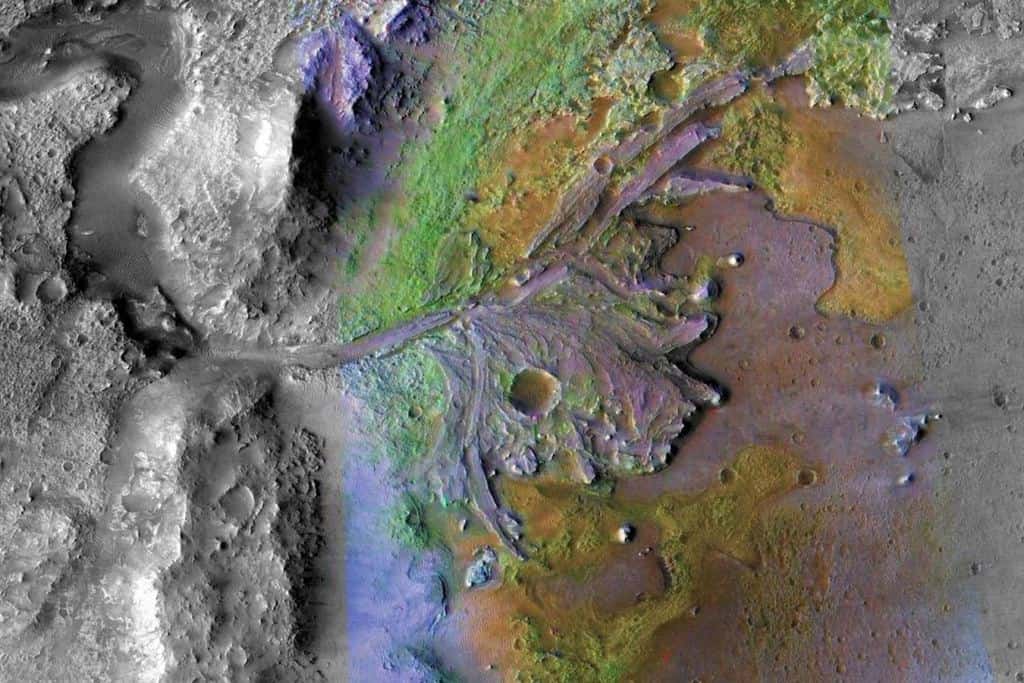 Jezero Crater on Mars, showing the ancient river delta where water once flowed into a lake. Colors highlight mineral deposits detected from orbit, including carbonates and clays altered by water. Credit: NASA/JPL-Caltech/MSSS
When Perseverance reached the Margin Unit in September 2023, scientists expected sedimentary rocks laid down around Jezero’s ancient lake. Orbital observations had shown unusually strong carbonate signatures, one reason researchers considered the site promising for preserving possible biosignatures.
Instead, the rover found that much of the unit began as igneous rock rich in olivine, apparently formed as magma cooled slowly underground. At higher elevations, those rocks remain comparatively pristine. Lower down, beneath a proposed ancient lake level, the rock is fractured and chemically transformed.
Using Perseverance’s mast-mounted SuperCam, which fires a laser at rocks and analyzes the light from the resulting plasma, researchers studied more than 185 bedrock targets. The team reconstructed three major alteration events. First, neutral-to-alkaline, CO2-rich fluids moved through fractures and produced carbonate. Later, lower-pH water—perhaps Jezero’s lake itself—remobilized some of that carbonate and left silica in newly opened pore spaces. Finally, younger fractures filled with calcium-sulfate and fluorite-bearing veins, which the researchers interpret as evidence of late hydrothermal circulation.
 Panorama of the Margin Unit, a geologic area that hugs the inner edge of Jezero Crater’s rim. Credit: NASA/JPL-Caltech/MSSS
“Before we arrived at the Margin Unit, the main hypothesis—derived from orbital observations—was that the carbonate seen from orbit formed from interaction with the lake that existed in Jezero Crater,” Candice Bedford of Purdue University, the study’s lead author, said in a statement. “But now we know that this location became a sort of crossroads for aqueous systems.”
The team can tell which events came first, but not yet when they happened.
×
Thank you! One more thing…
Please check your inbox and confirm your subscription.
The Search for Past Life on Mars
 Diagram of the Jezero Crater, showing Perseverance’s tracks. Credit: NASA/JPL-Caltech/University of Arizona/JR/VRVis
None of this is direct evidence that life existed on Mars. But repeated water-rock reactions can make a place considerably more interesting to astrobiologists.
On Earth, when water reacts with olivine, the chemistry can release hydrogen, an energy source for some microbes. The process can also leave behind carbonate and silica, minerals capable of preserving chemical or microscopic traces of life. Earlier research into Jezero’s carbonate-bearing rocks and their biosignature potential found that groundwater and hydrothermal environments could themselves have offered habitable conditions.
The new findings also fit a broader picture emerging from Perseverance. A 2022 study of Jezero’s crater floor found igneous rocks that had interacted with water. A 2025 analysis of more than 90,000 PIXL measurements identified evidence for several distinct stages of fluid alteration across Jezero.
Another striking result came in 2025. A Nature study of the Bright Angel formation reported organic carbon associated with unusual iron-, sulfur- and phosphorus-bearing minerals. Researchers flagged those findings as possible biosignatures, while cautioning that nonbiological processes could also produce them and that only laboratory analysis could resolve the question.
The Margin Unit now adds another piece: the same terrain was exposed repeatedly to chemically different waters. Perseverance has also collected rock cores there for possible return to Earth, making these rocks especially valuable targets for future laboratory searches.
“If there is one thing I have learned after 10 years working with Mars rovers, it is that Mars constantly throws surprises at you,” Bedford said. “It is very rare that things are as we expect them to be from orbital data.”
Jezero Crater’s history was intricate. Water kept rewriting the rocks—and each rewrite left another chapter in the story of whether ancient Mars was ever more than merely wet.
The study was published in the journal Communications Earth & Environment.