
Back to Article List
Early on the 6th, our satellite passes in front of the solar system’s largest planet in a relatively rare event.
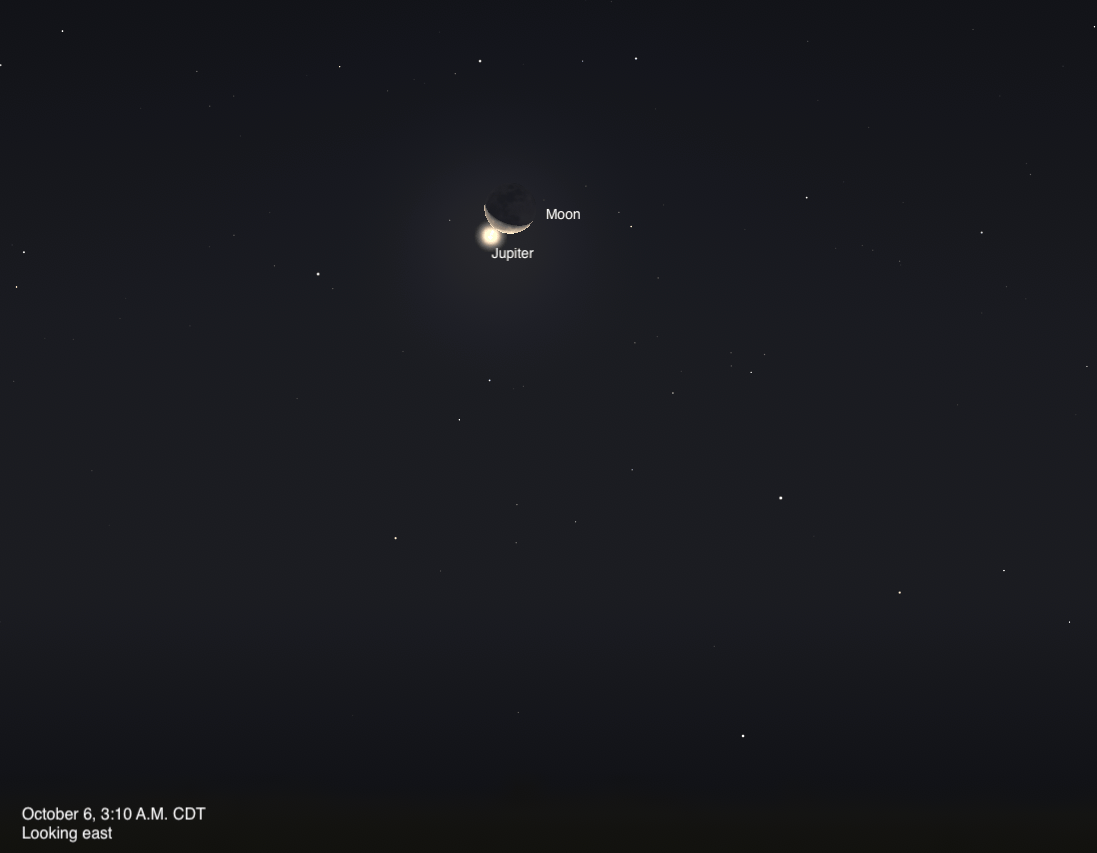
Not long after the Moon and Jupiter rise in the Midwest, our satellite closes in for an occultation of the gas giant. Credit: Stellarium/USGS/Celestia/Clementine
Looking for a sky event this week? Check out our full Sky This Week column.
October 5: The Moon, Mars, and M44
The Moon passes 0.2° north of Jupiter at 6 A.M. EDT. But before that, our satellite occults the planet for observers in parts of Canada, the U.S., Mexico, and Cuba. This is a relatively rare event, occurring on average only once every 13 years, so it’s definitely not one to be missed!
Jupiter now resides in western Leo, shining brightly at magnitude –1.9. The planet rises shortly after 2:30 A.M. local daylight time, leading the constellation’s brightest star, magnitude 1.4 Regulus, by nearly 10°. As Jupiter rises in the eastern half of the U.S., the waning Moon is very close to the planet, immediately to its west, preparing to slowly pass in front of the gas giant, covering it for roughly an hour. You can easily watch the event with the naked eye, but binoculars or a telescope will yield a more detailed view.
If you are watching through a scope, you will also catch Jupiter’s four Galilean moons, lined up with three moons on one side and one alone on the other. Some observers will get a bonus event: As Jupiter rises along the East Coast, Europa is farthest west, followed by Io and then Callisto closest to Jupiter. Ganymede is east of the planet. But keep a close eye on those western moons: Io and Callisto are approaching each other, as Io moves east and Callisto moves west. Just before 3:45 A.M. EDT (not long after Jupiter has risen in the Midwest), the two moons seem to merge as Callisto briefly occults Io in another rare event. After this, Io lies closest to Jupiter on the planet’s west, with Callisto between it and Europa, farther out. Not long after, the Moon will occult the entire jovian system.
Whether you will see the occultation — and how much of it you will catch — depends on your location. The map below depicts where the event will be visible, including regions along the northern and southern edge of the shadow where a partial occultation can be seen. The best views are in northeastern Canada and the entire eastern half of the U.S., but regions in the Southwest and portions of central Mexico are also well positioned. The timing of the event also depends on your location, beginning around 4:15–4:20 A.M. EDT (3:15–3:20 A.M. CDT) and ending roughly an hour later. Observers in the central and western U.S. won’t see Jupiter disappear, but can catch the reappearance around 3 A.M. MDT.
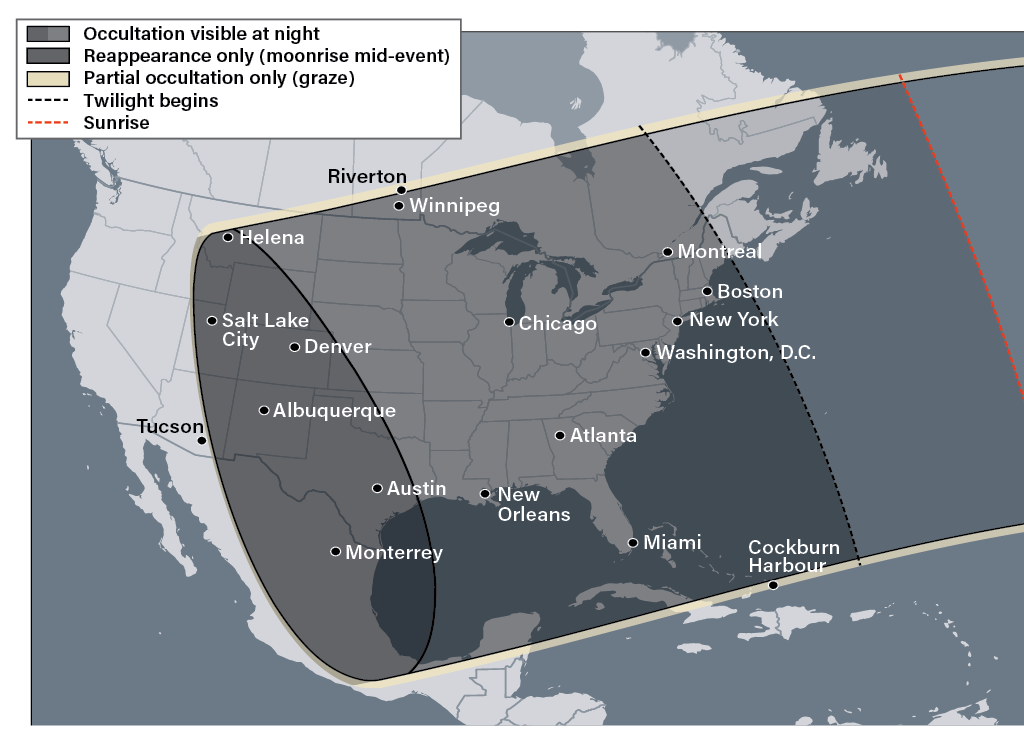
The Oct. 6 lunar occultation of Jupiter will be visible in darkness across most of the eastern and central U.S. and parts of southern Canada. For parts of the American West and eastern Mexico, the Moon and Jupiter will not yet have risen when the occultation begins; they will see only the reemergence of Jupiter from behind the Moon’s dark limb. Strips across northern Montana and southern Canada, and across southern Mexico, southern Cuba, and the Greater Antilles, will see a partial occultation of Jupiter, with the Moon grazing the planet’s disk. Credit: Astronomy: Roen Kelly, after David Dunham/International Occultation Timing Association
For more details on the occultation, including its visibility and timing, check out our article dedicated to the event: See the Moon occult Jupiter October 6 or visit the International Occultation Timing Association’s page here.
Later today, the Moon will pass 0.6° south of Regulus at midnight EDT.
Sunrise: 7:01 A.M.
Sunset: 6:34 P.M.
Moonrise: 2:31 A.M.
Moonset: 4:37 P.M.
Moon Phase: Waning crescent (14%)
*Times for sunrise, sunset, moonrise, and moonset are given in local time from 40° N 90° W. The Moon’s illumination is given at 10 P.M. local time from the same location.
Alison Klesman is senior editor of Astronomy magazine. She holds a Ph.D. in astronomy and has studied a variety of topics, from minor planets to supermassive black holes.